Role of Wash Steps in SPE Workflows
Solid-phase extraction (SPE) wash steps serve as the critical bridge between sample loading and analyte elution, functioning as the primary mechanism for removing matrix interferences while preserving target compounds. As described in SPE literature, “To remove unwanted, weakly retained materials, wash the packing with solutions that are stronger than the sample matrix, but weaker than needed to remove compounds of interest.” This delicate balance defines the wash step’s fundamental purpose.
During the retention phase, multiple compounds from complex samples may co-retain with target analytes. The wash step involves another distribution between the analyte, co-retained species, the solid surface, and the passing liquid. Each wash step can be controlled through careful selection of wash composition, volume, and application conditions, making it a tunable parameter for optimizing sample cleanup.
Proper wash optimization can significantly reduce background noise in final analyses. As noted in forensic applications, “Be sure to wash the column with the strongest solvent in which the column will be placed during the extraction. This will wash any residual compounds off the column before the sample is applied to the column. This will give you lower background noise in your final analysis.”
Selecting Wash Solvents Based on Analyte Polarity
The selection of wash solvents represents a critical decision point in SPE method development, directly impacting both cleanup efficiency and analyte recovery. For reversed-phase extractions, the composition of washing solvents should first be varied using increasing concentrations of methanol or acetonitrile in water. Typically, wash solvent methanol composition is increased in steps of 10% from 100% water through to 100% methanol.
For hydrophobic analytes retained on non-polar phases, wash solvents should be chosen based on their ability to remove interferences while maintaining analyte retention. The ideal wash removes as many interferences as possible while retaining the analyte(s). For polar analytes on normal-phase sorbents, less polar solvents serve as effective washes.
Ion-exchange mechanisms present different considerations. As documented, “Ionic bonds are strong enough to allow the analyte to remain bound while interferences are washed away with high percentages (up to 100%) of polar or nonpolar organic solvents. The pH will also affect sample cleanup. Remember to remain 2 pH units from the relevant pKa of your analyte and sorbent, both of which need to remain charged for ionic retention.”
Mixed-Mode Considerations
For copolymeric mixed-mode sorbents, wash strategy becomes more complex. For ionically bound analytes, use washes of high organic strength to remove interferences retained by hydrophobic interactions. If your analyte is also capable of hydrophobic binding, remove polar interferences ionically similar to your analyte by using aqueous or weak aqueous/organic washes while disrupting ionic binding.
Removing Matrix Interferences Without Analyte Loss
The fundamental challenge in wash optimization lies in maximizing interference removal while minimizing analyte loss. Research demonstrates that wash solvent strength should be carefully calibrated to sit between the elution strength needed for weakly retained interferences and that required for target analytes.
Experimental data shows that for a simple non-polar extraction, washing with increasing methanol concentrations produces characteristic recovery curves. As methanol percentage increases, recovery typically remains high until a threshold is reached where analyte begins to elute. The optimal wash composition exists just below this threshold, providing maximum interference removal with minimal analyte loss.
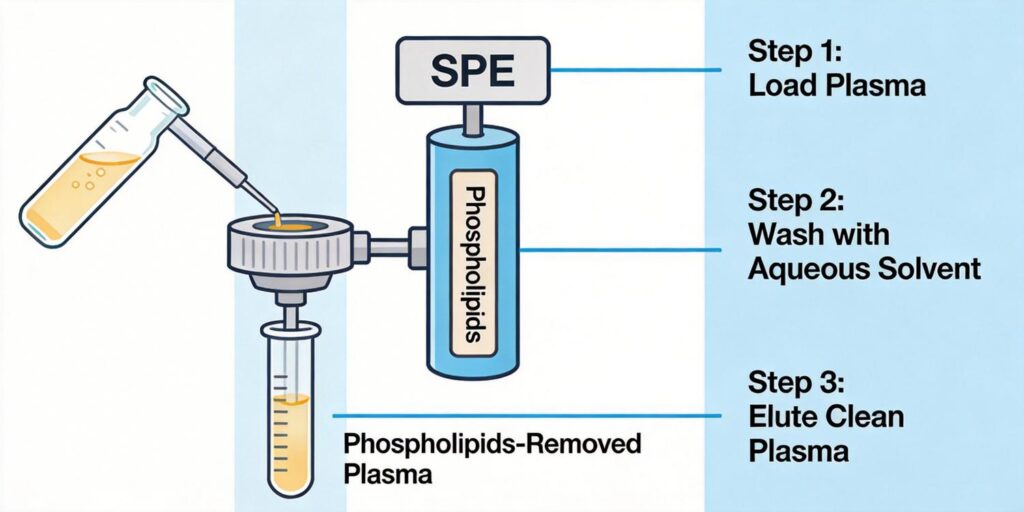
For complex matrices like biological fluids, sequential washing strategies often prove necessary. An initial aqueous wash removes proteins and highly polar interferences, followed by a weak organic wash to remove moderately polar compounds. As noted in forensic applications, “The first wash must be aqueous to remove the plasma proteins; in the case above, an aqueous cleaning step should be followed by a cleaning step using a reagent that will solubilize the analyte of interest.”
Sequential Washing Strategies
Advanced SPE applications frequently employ sequential washing to address complex matrices containing multiple interference classes. A typical sequential approach might include:
- Initial aqueous wash: Removes salts, sugars, and highly polar compounds
- Weak organic wash: 5-20% methanol or acetonitrile in water to remove moderately polar interferences
- Intermediate organic wash: 20-50% organic for removing less polar compounds
- Drying step: When changing between aqueous and organic solvents
As documented in SPE protocols, “Make certain your column is dry when changing between aqueous solutions and organic solvents. The easiest way to make sure your column is dry is to pull maximum vacuum on the column for 5 min. Touch the column; if it is at room temperature, it is dry. If it is cold, sorbent is still evaporating off the column.”
For ion-exchange applications, sequential washing might involve pH-adjusted buffers followed by organic washes. One protocol notes: “Rinse: Remove reservoir • 3 mL water • 3 mL 0.1 M sodium acetate (pH 4.5) • 3 mL methanol” demonstrating the sequential approach to removing different interference classes.
Troubleshooting Poor Cleanup Results
When SPE methods yield inadequate cleanup, systematic troubleshooting should address several potential issues:
Insufficient Wash Strength
If interferences persist in eluates, the wash solvent may lack sufficient strength to remove them. Incrementally increase organic percentage or consider alternative solvent systems. For normal-phase applications, increasing solvent polarity may be necessary.
Excessive Wash Strength
Low analyte recovery often indicates wash solvents are too strong. Reduce organic content or switch to weaker solvents. For ion-exchange, ensure pH remains within 2 units of analyte pKa to maintain ionic interactions.
Incomplete Drying
Residual water can dilute elution solvents, reducing efficiency and potentially causing phase separation. Ensure proper drying between aqueous washes and organic elution steps.
Matrix Effects
Complex matrices may require additional pretreatment. As noted, “With particularly complex samples, even the use of a copolymeric extraction column alone may be insufficient to yield an extract clean enough to give determinant results. In these situations simple wash and back-extractions can be used to render the sample clean enough for analysts.”
Experimental Design for Wash Optimization
Systematic wash optimization follows a structured experimental approach:
Initial Screening
Begin with a broad solvent strength gradient. For reversed-phase applications, test methanol-water mixtures from 0% to 100% methanol in 10-20% increments. Monitor both analyte recovery and interference removal at each point.
Refinement Phase
Based on initial results, narrow the range around the optimal strength. Test smaller increments (2-5%) to precisely define the wash composition that maximizes cleanup while maintaining acceptable recovery (typically >70%).
Volume Optimization
Once optimal composition is identified, optimize wash volume. Test volumes from 0.5 to 5 mL (depending on cartridge size) to determine the minimum volume providing adequate cleanup.
Sequential Strategy Development
For complex matrices, develop sequential washes. Test combinations of aqueous and organic washes in different orders and volumes. Document notes that “the possibility of cutting down on the number of washing steps and on the volume of the washing solution should be considered. Thus, the initial water wash can often be omitted without effect on the purity, and the volume of the washing solution may be reduced.”
Impact on Analytical Reproducibility
Well-optimized wash steps significantly enhance analytical reproducibility through several mechanisms:
Consistent Matrix Removal
Proper washing ensures consistent removal of matrix components that could cause variable ionization suppression in MS or detector response in chromatography. This consistency directly improves quantitative accuracy and precision.
Reduced Carryover
Effective washing minimizes carryover between samples, particularly important in automated systems. As noted in automation contexts, “If carryover is detected in the automated portion of the sample preparation, try to find a wash reagent to clean the fluid path that dissolves the analyte of interest well and that will also remove anything that may be remaining from the sample matrix.”
Improved Method Robustness
Optimized wash conditions accommodate normal method variations without compromising results. This robustness becomes particularly valuable when analyzing samples with variable matrix compositions.
Enhanced Detection Limits
By reducing background interference, proper washing lowers baseline noise and improves signal-to-noise ratios, effectively lowering method detection limits.
Long-term Column Performance
Consistent washing prevents accumulation of strongly retained compounds that could degrade sorbent performance over time, extending cartridge lifetime and maintaining recovery consistency.
In conclusion, wash step optimization represents a critical component of SPE method development that directly impacts analytical performance. Through systematic experimentation and understanding of analyte-sorbent interactions, laboratories can develop wash protocols that maximize cleanup efficiency while maintaining high analyte recovery and reproducibility. The investment in wash optimization pays dividends in improved data quality, reduced method troubleshooting, and enhanced confidence in analytical results.
For laboratories seeking optimized SPE solutions, Poseidon Scientific offers a comprehensive range of HLB SPE cartridges, MAX SPE cartridges, MCX SPE cartridges, WAX SPE cartridges, WCX SPE cartridges, and 96-well SPE plates designed to support efficient wash optimization and reproducible sample preparation.