
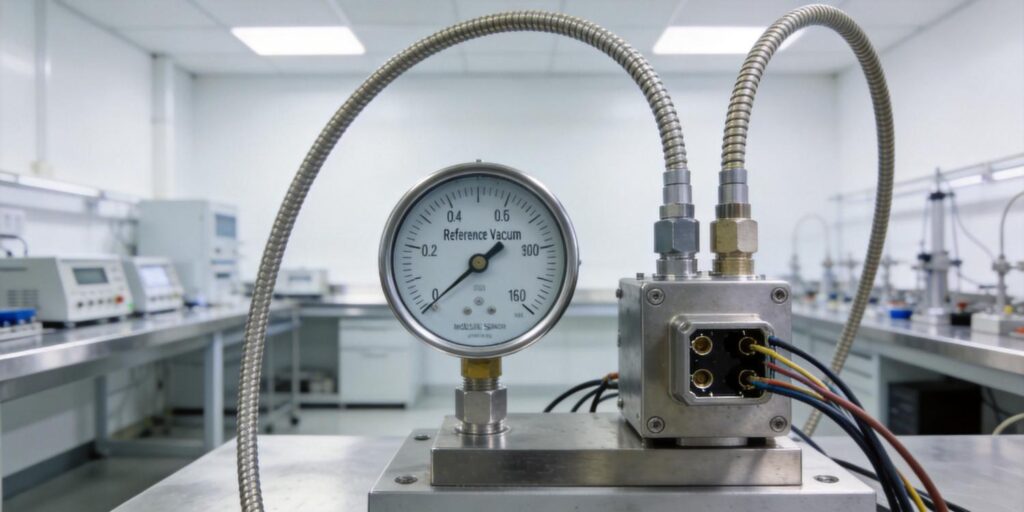
In high-volume vacuum production environments—semiconductor fabs, PVD coating lines, and vacuum heat-treatment facilities—gauge calibration is not a periodic checkbox but a cornerstone of process capability. A drifting vacuum gauge can introduce pressure offsets that cascade into film-thickness variation, etch-depth errors, or inconsistent hardness profiles, directly eroding yield and increasing scrap costs. Poseidon Scientific designed the VG-SP205 Pirani Vacuum Transmitter for the rough-vacuum regime (atmosphere to 10⁻³ Torr) and the VG-SM225 Cold Cathode Vacuum Gauge for high-vacuum operation (10⁻³ to 10⁻⁷ Torr) with factory-calibrated stability, temperature compensation, and field-serviceable features that extend calibration intervals while maintaining traceability and compliance. Both instruments ship with 0–10 V analog output (effective 2–8 V range) and optional customizable RS232 digital protocol, simplifying integration into production metrology systems.
This article presents eight best-practice pillars for vacuum gauge calibration in production facilities. Each recommendation draws on established vacuum metrology principles and the operational realities of 24/7 manufacturing, helping engineers and procurement teams implement robust programs that minimize downtime and maximize measurement confidence.
Calibration Frequency Standards
Calibration frequency should be risk-based rather than calendar-driven. In clean, non-reactive environments (e.g., optical coating or mass spectrometry), industry guidelines recommend verifying the VG-SP205 Pirani every 6–12 months and the VG-SM225 Cold Cathode every 12–18 months. In reactive-gas service—fluorine plasmas, oxygen-rich PVD, or hydrocarbon back-streaming—shorten intervals to 3–6 months for the Pirani and 6–12 months for the cold cathode, or base them on operating hours (typically 2000–4000 h).
Key triggers for immediate recalibration or verification include:
- Extended cold-cathode startup time (>5 min at 10⁻⁶ Torr)
- Pressure offset >5 % versus a reference instrument
- More than 50 000 rapid vent/pump-down cycles on a load-lock
The VG-SP205 requires only quarterly atmospheric zero-checks at 760 Torr; its platinum filament and temperature-compensated electronics limit long-term drift to <0.5 % per year in typical service. The VG-SM225’s removable electrode design allows on-site cleaning to restore the original curve without full recalibration in most cases, extending effective calibration intervals by 50–100 % compared with non-serviceable gauges.
Reference Gauges and Traceability
All production calibrations must be traceable to national standards. Use a certified spinning-rotor gauge or capacitance diaphragm manometer (accuracy ±0.5 % of reading) as the primary reference. Poseidon performs factory calibration of every VG-SP205 and VG-SM225 against NIST-traceable standards in dedicated vacuum chambers, generating a unique voltage-to-pressure map stored in the transmitter firmware.
For in-house verification:
- Maintain at least one working-standard gauge per vacuum regime, recalibrated annually by an accredited lab.
- Cross-check both Poseidon gauges at two points in their linear regions (e.g., 10⁻⁴ Torr and 10⁻⁶ Torr for the cold cathode).
- Record serial numbers, reference gauge certificates, and environmental conditions for full traceability.
This chain ensures compliance with ISO 17025 laboratory requirements and SEMI metrology guidelines while providing defensible data for customer audits.
In-situ vs Bench Calibration
In-situ calibration (gauge remains installed) minimizes downtime but introduces uncertainties from chamber outgassing, residual gas composition, and conductance effects. Bench calibration (gauge removed to a dedicated station) offers the highest accuracy because the reference manifold can be baked, pumped to <10⁻⁸ Torr, and isolated from process contaminants.
Recommended practice for Poseidon instruments:
- VG-SP205 Pirani: perform in-situ zero-check at atmosphere during scheduled PMs; reserve full bench calibration for annual verification or after suspected contamination.
- VG-SM225 Cold Cathode: clean electrodes in-situ (500-mesh sanding, 10 % deviation).
The VG-SM225’s cartridge-style sensor allows removal without breaking the main chamber vacuum when an isolation valve is used, combining the speed of in-situ service with the accuracy of bench work.
Environmental Control During Calibration
Temperature, humidity, and vibration directly affect calibration results. Maintain the calibration station at 23 ± 2 °C and <60 % RH—exactly the conditions used in Poseidon’s factory. Both gauges incorporate active temperature compensation, but excursions beyond 15–50 °C still introduce transient errors up to 1 %.
Additional controls:
- Use vibration-isolated tables to avoid microphonic noise in the cold-cathode electrometer.
- Purge the reference manifold with dry nitrogen between runs to eliminate water-vapor memory effects.
- Allow 30–60 min thermal stabilization after gauge installation before recording data.
These steps ensure the 0–10 V output matches the factory curve within ±2 % across the full operating range.
Documenting Results
Complete, auditable records are mandatory for ISO and customer compliance. For each calibration event capture:
| Parameter | Recommended Content |
|---|---|
| Gauge model & serial | VG-SP205-XXXX or VG-SM225-XXXX |
| Date & technician | ISO 8601 format |
| Reference standard | Certificate number & expiry |
| Test points | At least three pressures per decade in linear region |
| As-found vs as-left data | Raw voltage and calculated pressure |
| Environmental conditions | Temperature, humidity, barometric pressure |
| Corrective actions | Electrode cleaning, firmware update, or replacement |
Store records in both digital (CSV/JSON export via RS232) and paper/electronic quality-management systems. Poseidon gauges output calibration constants via digital protocol, enabling automated upload to MES or SPC software.
Drift Trend Monitoring
Proactive drift monitoring turns calibration from a reactive task into a predictive tool. Use the RS232 digital output of either gauge to log pressure, status flags, and internal diagnostics at 1 Hz during production runs. Trend the following:
- Offset at a fixed check pressure (e.g., 10⁻⁵ Torr for the VG-SM225)
- Cold-cathode startup time (increases with contamination)
- Pirani output at atmosphere (detects filament aging)
Set SPC control limits at ±3 % of reading. When drift approaches the limit, schedule electrode cleaning on the VG-SM225 or zero-check on the VG-SP205—often restoring performance without full recalibration. This approach has extended average calibration intervals by 40 % in continuous-operation fabs.
Minimizing Downtime
Production facilities cannot afford multi-day gauge removal. Poseidon’s design philosophy prioritizes speed:
- VG-SP205: tool-free atmospheric zero-check during any chamber opening; full exchange (hot-swap) in <5 min if ever required.
- VG-SM225: removable sensor cartridge allows electrode cleaning or swap while the chamber remains under vacuum via isolation valve.
Keep one calibrated spare of each model on the shelf. Digital RS232 self-diagnostics flag impending issues days in advance, enabling planned maintenance during scheduled tool PM windows. Facilities using this strategy report <30 min total gauge-related downtime per quarter versus days with non-serviceable instruments.
Compliance with ISO Standards
ISO 17025 (testing and calibration laboratories) and ISO 9001 (quality management) both require documented traceability, uncertainty budgets, and personnel competence. Poseidon instruments support compliance by:
- Shipping with individual calibration certificates traceable to NIST/PTB.
- Providing digital output of raw sensor data for independent uncertainty calculation.
- Allowing third-party auditors to verify in-situ performance against certified references.
Custom RS232 protocols can embed ISO-required metadata (calibration due date, uncertainty statement) directly in every data frame, simplifying automated audit trails. Facilities that integrate Poseidon gauges into their ISO-compliant metrology program routinely pass customer and third-party audits on the first review.
Best-practice vacuum gauge calibration in production facilities balances scientific rigor with operational practicality. By selecting instruments that are factory-calibrated to traceable standards, field-serviceable, and equipped with low-drift electronics and digital diagnostics, teams achieve longer calibration intervals, lower uncertainty, and near-zero unplanned downtime. The VG-SP205 Pirani Vacuum Transmitter and VG-SM225 Cold Cathode Vacuum Gauge embody this balance—delivering the measurement integrity that modern vacuum processes demand at a fraction of the cost and maintenance burden of legacy alternatives.
Engineers and procurement specialists seeking to strengthen their calibration program are invited to review the full specifications and user manuals:
- VG-SP205 Pirani Vacuum Transmitter – maintenance-friendly rough-vacuum solution with simple zero-check procedures
- VG-SM225 Cold Cathode Vacuum Gauge – field-cleanable high-vacuum gauge that restores calibration curve without factory return
Accurate, traceable vacuum measurement is not an overhead expense—it is a competitive advantage. Implementing the eight practices above converts calibration from a recurring interruption into a streamlined, data-driven process that protects yield and supports continuous improvement.


