Environmental Contaminants Monitored at Trace Levels
Environmental monitoring programs routinely target contaminants at part-per-billion (ppb) and part-per-trillion (ppt) concentrations. These trace-level pollutants include pesticides (triazines, organophosphates, carbamates), pharmaceuticals, industrial chemicals (PCBs, PAHs, phenols), endocrine disruptors, and heavy metals. The challenge for analytical chemists is that these compounds exist at concentrations far below the detection limits of most analytical instruments, necessitating effective pre-concentration strategies.
Importance of Pre-concentration for Detection Sensitivity
Solid-phase extraction (SPE) serves as a critical pre-concentration technique that bridges the gap between environmental concentrations and instrument detection capabilities. Unlike pharmacological levels in bodily fluids (ppm to ppb), environmental pollutants often require concentration factors of 100-1000× to reach detectable levels. SPE achieves this through selective adsorption of analytes onto sorbent materials while allowing interfering matrix components to pass through. This dual function of concentration and cleanup is essential for reliable trace analysis.
Large-Volume Water Sample Processing Using SPE
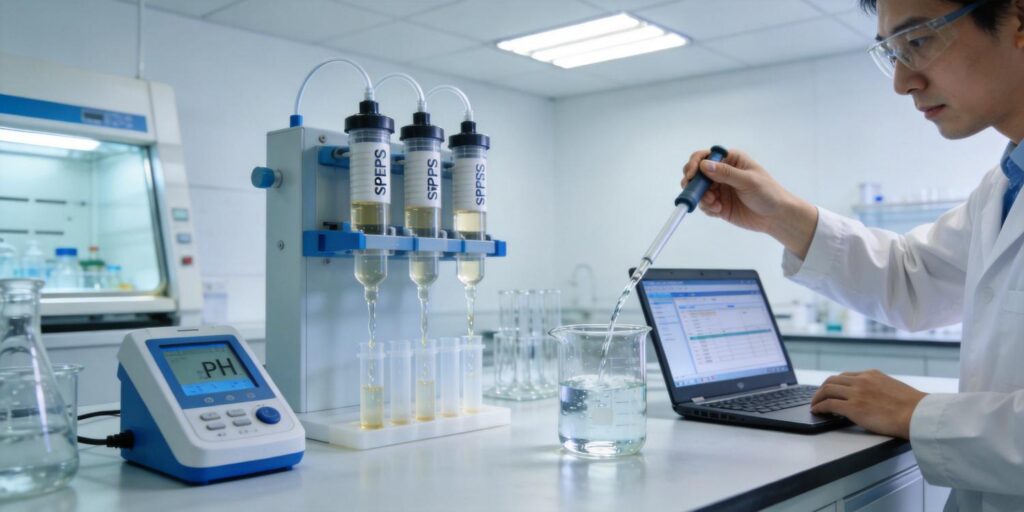
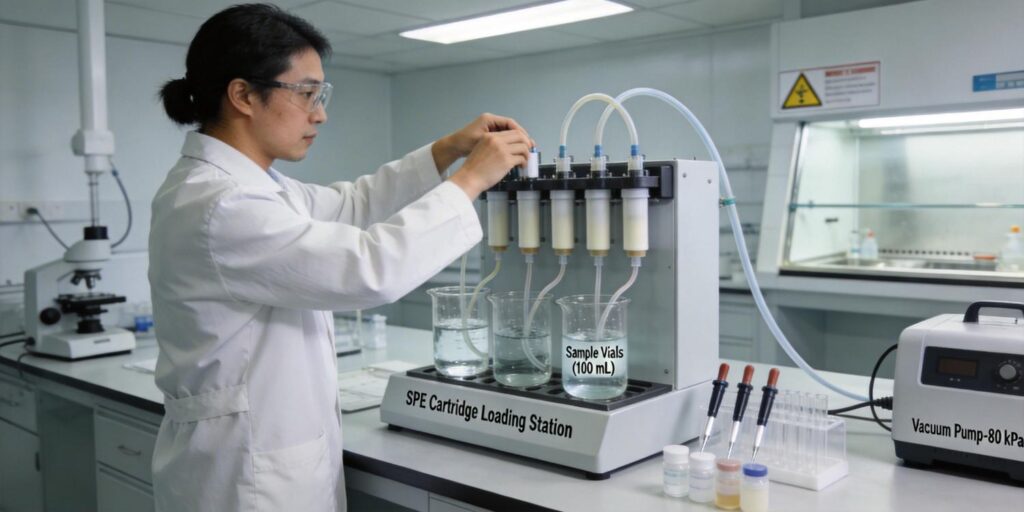
Environmental chemists routinely process liter-scale water samples—drinking water, surface water, groundwater, wastewater, and seawater—to achieve necessary concentration factors. The fundamental principle involves passing large volumes through SPE cartridges where analytes are retained while the aqueous matrix passes through. This approach offers significant advantages over traditional liquid-liquid extraction (LLE), including reduced solvent consumption, elimination of emulsion formation, and improved reproducibility.
For particulate-laden samples like river water or wastewater, pre-filtration through glass-fiber filters (0.45-0.7 μm) or depth filters containing diatomaceous earth is often necessary to prevent cartridge clogging. Soil and sediment samples can be converted to “water” samples through aqueous extraction or leaching procedures before SPE processing.
Cartridge Capacity Considerations
Selecting appropriate SPE cartridge capacity is crucial for successful trace enrichment. The breakthrough volume—the sample volume at which analytes begin to elute from the sorbent bed—determines maximum loading capacity. For trace analysis, sorbent mass should be sufficient to handle both the target analytes and potential matrix interferences like dissolved organic matter (DOM).
Common configurations include:
- Standard cartridges (100-500 mg sorbent): Suitable for 100 mL to 1 L samples
- High-capacity cartridges (1-10 g sorbent): Designed for multi-liter environmental samples
- SPE disks: Offer large surface area with minimal bed mass for rapid processing
Mixed-mode sorbents combining hydrophobic and ion-exchange mechanisms provide enhanced capacity for diverse contaminant classes.
Optimizing Flow Rates During Loading
Flow rate optimization represents a critical parameter in SPE method development for trace analysis. Recovery is inversely proportional to flow rate (recovery ∝ 1/flow), making controlled loading essential for quantitative analyte retention. Recommended flow rates typically range from 1-3 drops/second (approximately 1-5 mL/min) for optimal mass transfer kinetics.
Several factors influence optimal flow rates:
- Sorbent particle size: Smaller particles (≤40 μm) require slower flow rates
- Analyte hydrophobicity: More hydrophobic compounds tolerate higher flow rates
- Sample matrix complexity: Complex matrices with high DOM content benefit from reduced flow rates
- Cartridge dimensions: Longer bed lengths permit higher flow rates
Automated SPE systems provide precise flow control, ensuring reproducible extraction efficiency across multiple samples.
Elution Solvent Strategies for Trace Analytes
Effective elution of trace analytes requires careful solvent selection to achieve quantitative recovery in minimal volume. The elution solvent must be sufficiently strong to displace analytes from the sorbent while maintaining compatibility with subsequent analytical techniques.
Common elution strategies include:
- Organic solvent mixtures: Methanol, acetonitrile, or acetone, often with acid or base modifiers
- pH-controlled elution: For ionizable compounds using acid/base to disrupt ionic interactions
- Minimal elution volumes: Typically 1-5 mL to maintain high concentration factors
- Sequential elution: Using solvents of increasing strength for fractionation of compound classes
For reversed-phase SPE, elution solvents with high organic content (≥80% methanol or acetonitrile) generally provide quantitative recovery of hydrophobic contaminants. The eluate can often be injected directly into reversed-phase HPLC systems, eliminating solvent exchange steps required with LLE.
Analytical Validation with LC-MS or GC-MS
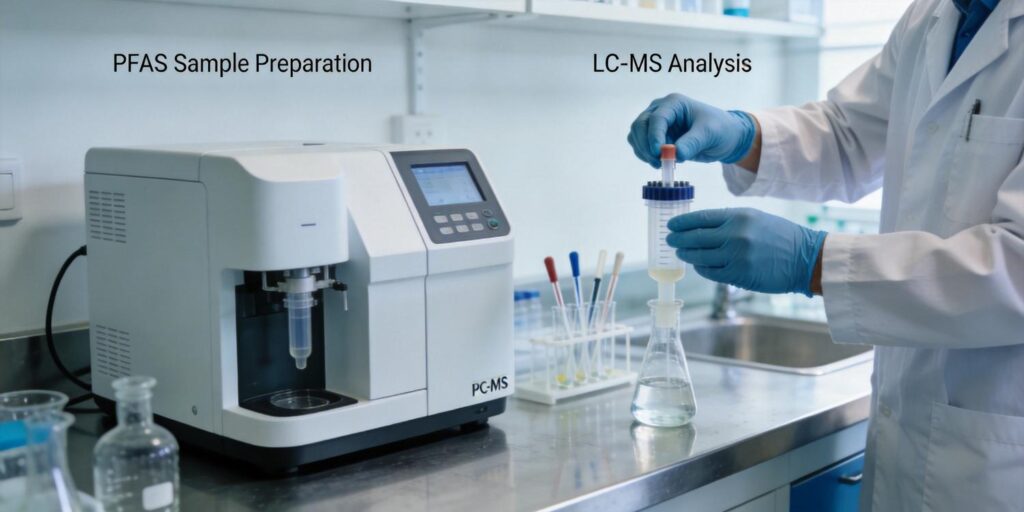
Validation of SPE methods for trace environmental analysis requires rigorous assessment using sensitive detection techniques. Liquid chromatography-mass spectrometry (LC-MS) and gas chromatography-mass spectrometry (GC-MS) provide the necessary selectivity and sensitivity for ppt-level quantification.
Key validation parameters include:
- Recovery studies: Spiked samples at multiple concentration levels (typically 0.1-100 μg/L)
- Matrix effects: Evaluation of signal suppression/enhancement in different water matrices
- Method detection limits (MDLs): Determined as 3× signal-to-noise ratio
- Precision and accuracy: Intra-day and inter-day variability assessments
- Linearity: Calibration curves spanning expected concentration ranges
On-line SPE-LC-MS systems offer automated trace enrichment with reduced sample handling, while off-line approaches provide flexibility for method development and large sample batches. Quality control measures including procedural blanks, matrix spikes, and duplicate analyses ensure data reliability for regulatory compliance monitoring.
The integration of SPE with advanced analytical instrumentation has revolutionized environmental monitoring, enabling detection of contaminants at environmentally relevant concentrations while maintaining the throughput required for comprehensive water quality assessment programs.