Why Lipid-Rich Fish Tissue Presents Unique Analytical Challenges
Fish tissue samples, especially those from fatty species like salmon, mackerel, or herring, present significant challenges for trace analysis due to their high lipid content. Lipids—primarily triglycerides, phospholipids, and free fatty acids—can co-extract with target analytes during solvent extraction, leading to severe matrix effects in LC-MS and GC-MS analysis. These effects manifest as ion suppression or enhancement, reduced chromatographic resolution, and rapid contamination of the analytical column and ion source. Moreover, lipid residues can clog SPE cartridges and decrease throughput. For laboratories monitoring environmental contaminants (e.g., PCBs, PBDEs, pesticides) or veterinary drug residues, efficient lipid removal prior to instrumental analysis is not optional—it is mandatory for reliable quantification at trace levels.
Homogenization and Solvent Extraction: The First Step in Cleanup
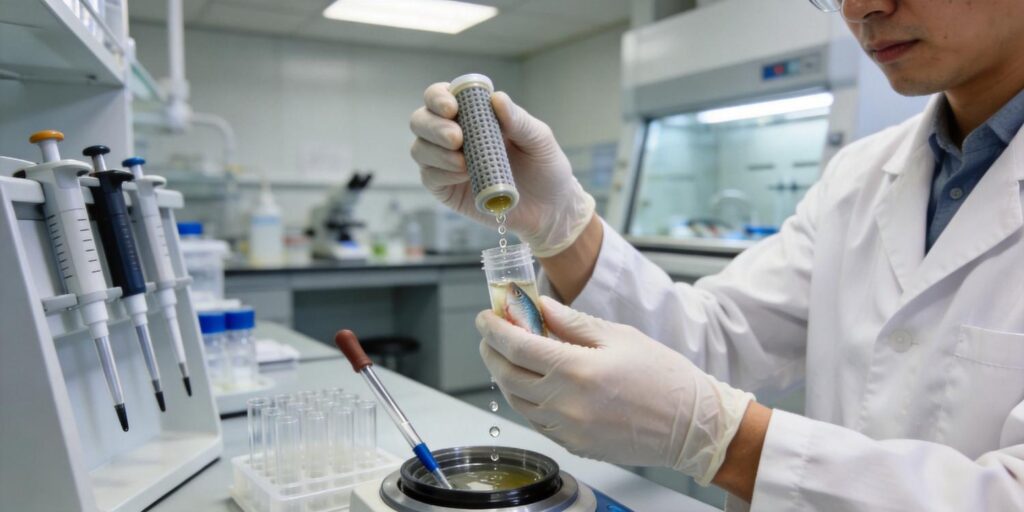
The workflow begins with homogenization of the fish tissue. Typically, 1–5 g of tissue is blended with a suitable extraction solvent. Common choices include acetonitrile (for polar analytes) or a mixture of hexane and acetone (for non-polar contaminants). The addition of anhydrous sodium sulfate helps remove water from the tissue, improving extraction efficiency. After homogenization, the sample is centrifuged or filtered to separate the organic extract from solids. The resulting crude extract contains not only the target analytes but also a substantial amount of co-extracted lipids, which must be removed by solid-phase extraction.
SPE Sorbent Selection: Targeting Lipid Removal
For lipid-rich matrices, the choice of SPE sorbent is critical. Among the available options, HLB SPE cartridges are widely favored due to their hydrophilic-lipophilic balanced polymer, which retains both polar and non-polar analytes while allowing many lipids to pass through under optimized conditions. However, for more aggressive lipid cleanup, specialized phases such as EMR-Lipid (Enhanced Matrix Removal) or zirconia-based sorbents are effective. Alternatively, a two-step cleanup using MAX SPE cartridges (mixed-mode anion exchange) followed by WAX SPE cartridges (weak anion exchange) can selectively remove fatty acids. For non-polar lipid removal, MCX SPE cartridges (mixed-mode cation exchange) are less common but can be used in tandem with other sorbents.
Conditioning and Loading: Protecting the Sorbent Bed
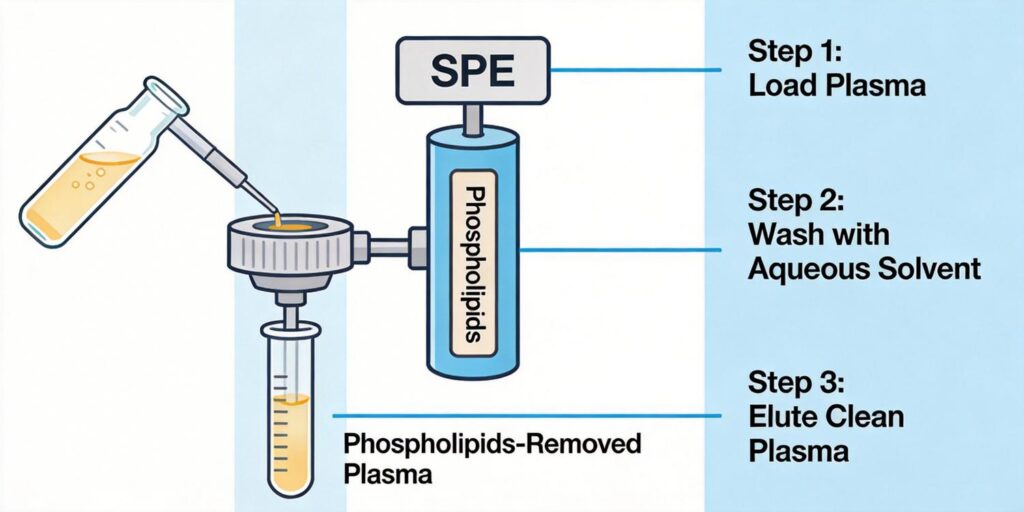
Proper conditioning is essential to activate the sorbent and ensure reproducible retention. For HLB cartridges, condition with methanol followed by water or the loading solvent (e.g., 5% methanol in water). The crude extract, often reduced in volume by evaporation and reconstituted in a compatible solvent, is then loaded at a slow flow rate (1–2 mL/min) to maximize analyte-sorbent interaction. Overloading the cartridge with lipids can cause breakthrough; therefore, the mass of tissue extract loaded should not exceed the sorbent’s capacity (typically 5–10 mg lipid per 100 mg sorbent).
Washing Procedures: Removing Triglycerides and Oils
After loading, a wash step selectively removes neutral lipids while keeping analytes bound. A common wash for HLB cartridges is 5% methanol in water or a mixture of hexane and ethyl acetate (e.g., 90:10, v/v) for non-polar analytes. For MAX/WAX cartridges, an acidic wash (e.g., 2% formic acid in water) can protonate fatty acids, facilitating their elution while retaining basic analytes. The wash volume should be sufficient (3–5 bed volumes) to elute most triglycerides and oils without displacing target compounds. Monitoring wash fractions by TLC or quick LC-MS can help optimize this step.
Elution Solvents: Recovering Target Analytes Cleanly
The final elution step must quantitatively recover the analytes of interest while leaving behind residual lipids. For HLB cartridges, elution with methanol or acetonitrile works well for moderately polar to non-polar compounds. For mixed-mode sorbents like WCX SPE cartridges, elution with 5% ammonium hydroxide in methanol releases basic analytes. The eluate is then evaporated and reconstituted in a solvent compatible with LC-MS or GC-MS analysis. In many protocols, a subsequent cleanup using 96-well SPE plates is employed for high-throughput applications, allowing parallel processing of multiple samples.
LC-MS and GC-MS Detection: Ensuring Sensitivity and Selectivity
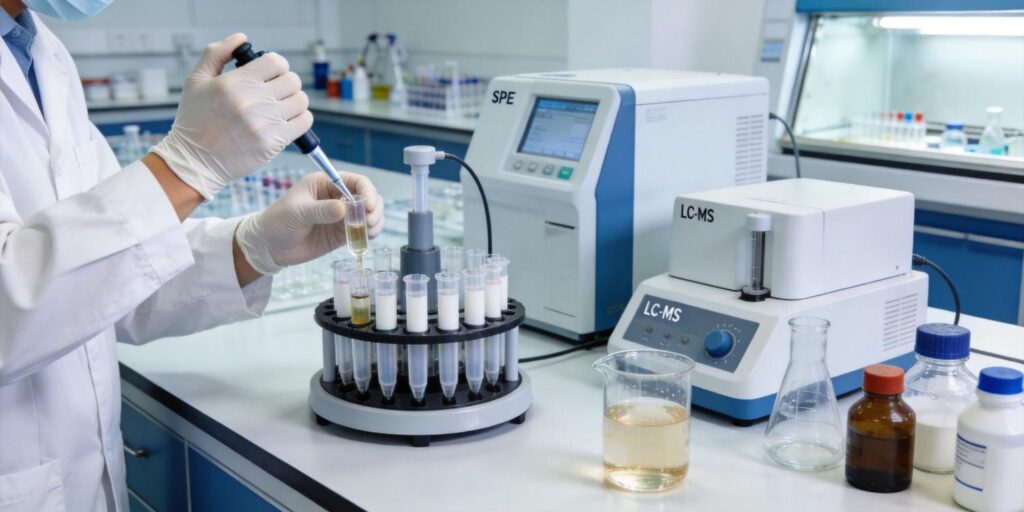
After SPE cleanup, the extract is analyzed by LC-MS/MS or GC-MS/MS. For LC-MS, reversed-phase C18 columns are standard, with mobile phases containing 0.1% formic acid or ammonium formate. For GC-MS, the extract is often derivatized (e.g., silylation for hydroxylated compounds) to improve volatility and thermal stability. The absence of lipid interferences results in cleaner chromatograms, lower background noise, and improved signal-to-noise ratios for target analytes. Laboratories should verify that matrix effects are below 20% by post-extraction spiking experiments.
Method Validation in Seafood Testing Labs
Rigorous method validation is required before implementation in a regulated environment. Key parameters include linearity (R² > 0.99 over the expected concentration range), accuracy (recovery 70–120%), precision (RSD < 20%), and the limit of quantification (LOQ) at or below regulatory limits. For fish tissue, matrix-matched calibration is strongly recommended to compensate for any residual matrix effects. Additionally, cross-validation with alternative cleanup methods (e.g., QuEChERS, GPC) can confirm the robustness of the SPE approach. Regular participation in proficiency testing schemes, such as those offered by FAPAS or NIST, ensures ongoing method performance.
In summary, the combination of proper homogenization, optimized SPE sorbent selection, and careful wash/elution protocols enables reliable analysis of lipid-rich fish tissue extracts. By integrating proven sorbents like HLB, MAX, WAX, MCX, and WCX from Poseidon Scientific into your workflow, your laboratory can achieve consistent, high-quality results for seafood safety and environmental monitoring.