SPE Sample Preparation for Trace Heavy Metal Chelates in Water
Heavy metal contamination in environmental waters remains a critical global concern. While regulatory frameworks often target total metal concentrations, the speciation and chelation state of metals profoundly impact their toxicity, bioavailability, and environmental fate. Chelating agents—both naturally occurring (humic substances, amino acids) and anthropogenic (EDTA, NTA, DTPA)—form stable complexes with heavy metals, altering their solubility and mobility. Analyzing these chelated species at trace levels demands robust sample preparation methods that preserve the intact metal–chelate complex while removing matrix interferences. Solid-phase extraction (SPE) has emerged as the technique of choice, offering selectivity, high enrichment factors, and compatibility with downstream chromatographic or spectroscopic detection.
Heavy Metal Chelates in Environmental Waters
In natural and wastewater systems, metals such as Cu, Ni, Zn, Cd, Pb, and Hg are frequently encountered as chelates. For instance, Cu-EDTA complexes are prevalent in industrial effluents, while humic-bound metals dominate in river water. The stability constants of these chelates dictate their persistence and transport. Analyzing intact chelates rather than total metals provides insights into metal cycling, toxicity mechanisms, and the efficacy of remediation strategies. However, trace-level analysis (ng/L to µg/L) requires pre-concentration and clean-up, which SPE can deliver when optimized for the specific chelate chemistry.
Sample Preservation and Filtration
Preserving the integrity of metal chelates during sample collection and storage is paramount. Key steps include:
- pH control: Maintain near-natural pH (typically 6–8) to avoid dissociation of weak complexes. Acidification, common for total metals, can release metals from their chelating ligands.
- Filtration: Use 0.45 µm filters (e.g., PES, PVDF) to remove particulate matter without adsorbing dissolved chelates. Pre-rinse filters with ultrapure water to avoid contamination.
- Storage: Store samples in pre-cleaned HDPE or PTFE bottles at 4°C in the dark. Analyze within 48 hours for labile complexes; for stable chelates (e.g., EDTA metal complexes), extended storage is possible.
- Preservation: Avoid adding preservatives unless validated for the specific chelate. For organometallic species, such as metal-EDTA, no chemical preservation is recommended.
SPE Sorbent Selection for Chelated Complexes
Choosing the right SPE sorbent is critical for retaining metal chelates while excluding interferences. Options include:
- Reversed-phase (C18, C8): Suitable for hydrophobic chelates like metal-dithiocarbamates or metal-8-hydroxyquinoline. The nonpolar interaction retains the organic portion of the complex.
- Ion-exchange (SAX, WCX): For charged chelates. Anion exchangers (SAX) capture negatively charged complexes (e.g., Cu-EDTA²⁻), while weak cation exchangers (WCX) retain positively charged ones (e.g., some metal-amino complexes).
- Mixed-mode (e.g., MAX, WCX): Combining reversed-phase and ion-exchange mechanisms for complex matrices. For example, MCX (mixed-mode strong cation exchange) is effective for metal complexes with basic functional groups.
- Specialized phases: Immobilized chelating ligands (e.g., iminodiacetic acid) for selective extraction of transition metals, though these may disrupt the existing chelate structure.
For intact chelate analysis, reversed-phase or mixed-mode sorbents are generally preferred to avoid ligand displacement. Testing with model chelates is recommended prior to method development.
Conditioning and Loading Procedures
Proper conditioning ensures reproducible retention:
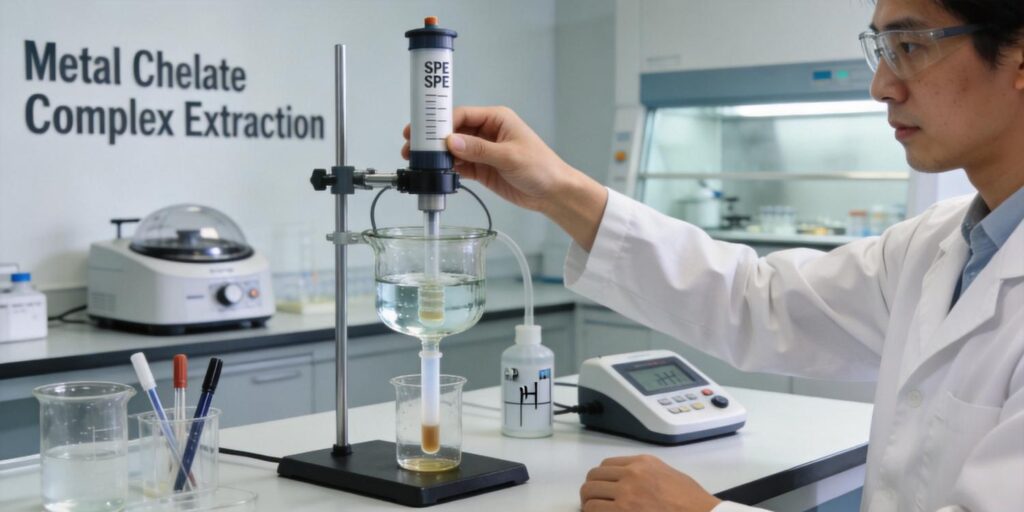
- Conditioning: Pass 2–3 column volumes of methanol followed by 2–3 volumes of ultrapure water (or buffer matching sample pH). For ion-exchange sorbents, use a buffer at the desired pH (e.g., 10 mM ammonium acetate, pH 7.0).
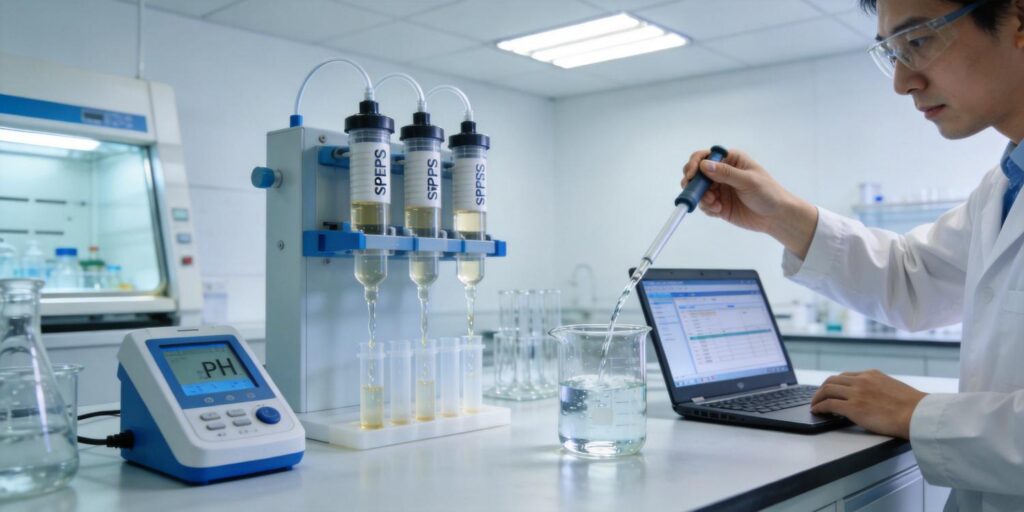
- Loading: Apply the sample at a flow rate of 1–5 mL/min. For large volumes, use a vacuum manifold or automated SPE system. The sample pH should be adjusted to maximize retention: for reversed-phase, neutral pH; for anion exchange, pH > pKa + 2 (e.g., pH 8 for EDTA complexes).
- Breakthrough volume: Determine empirically. Typical loading volumes range from 100 mL to 1 L for trace enrichment.
Washing Steps Removing Organic Interferences
After loading, a wash step removes co-extracted organic matter without eluting the target chelates:
- Weak solvent: 5–10% methanol in water or a buffer solution for reversed-phase. For ion-exchange, use a low-ionic-strength buffer (e.g., 5 mM ammonium acetate).
- Selective wash: For mixed-mode sorbents, a pH-adjusted wash can remove interferences. For example, on WAX (weak anion exchange), a wash with methanol/water (60:40) can elute neutral compounds while retaining anionic chelates.
- Volume: 2–5 mL, enough to remove matrix but not cause analyte loss. Monitor by collecting fractions.
Elution Solvents for Metal Complexes
Eluting intact chelates requires a solvent that disrupts the retention mechanism without decomplexation:
- Reversed-phase: Methanol, acetonitrile, or their mixtures with water (e.g., 0.1% formic acid in methanol). For hydrophobic chelates, 100% organic solvent may be needed.
- Ion-exchange: Buffered solutions with competing ions. For SAX, use 1 M ammonium acetate (pH 7) or 2% formic acid in methanol. For MCX, 5% ammonia in methanol is effective.
- Mixed-mode: Combine organic and ionic modifiers. For MAX, 5% formic acid in methanol often provides high recovery.
- Volume: Typically 1–3 mL; concentration under nitrogen is required for trace analysis.
Confirm elution efficiency with spiked samples and avoid using strong acids that might decompose chelates.
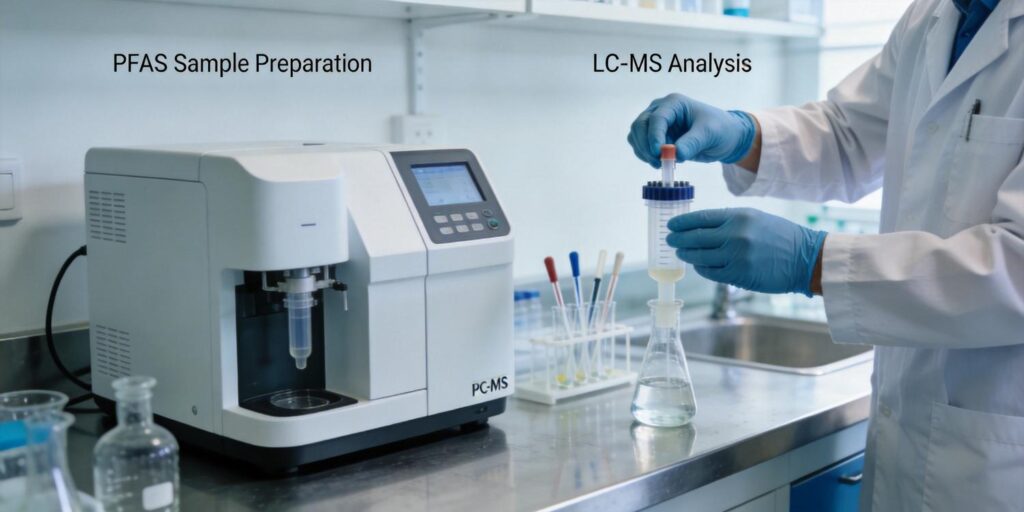
Detection Using LC-MS or ICP-MS After Extraction
Post-extraction analysis relies on sensitive detection:
- LC-MS: Reversed-phase C18 columns with ESI or APCI ionization. MRM mode offers specificity for individual chelates. Mobile phase: water/methanol with 0.1% formic acid.
- ICP-MS: Direct injection of eluate for total metal quantification. However, for speciation, coupling with LC (LC-ICP-MS) is necessary. The eluent must be compatible (low organic content preferable; use a desolvation system if needed).
- Detection limits: Sub-ng/L achievable with enrichment factors of 100–1000. Calibrate with chelate standards matched to sample matrix.
Environmental Monitoring Applications
SPE-based methods for trace heavy metal chelates have been applied in diverse contexts:
- Wastewater treatment: Monitoring EDTA-metal complexes and their removal efficiencies. See case studies on HLB SPE cartridges for polar chelates.
- Natural waters: Quantifying Cu-humic substances in river water to assess bioavailability.
- Drinking water: Analyzing Pb-citrate or Cd-NTA complexes arising from piping or additives.
- Industrial effluents: Screening for metal-cyanide or metal-DTPA complexes.
Method validation requires assessment of recovery, precision, and matrix effects. For high-throughput environmental labs, 96-well SPE plates offer parallel processing of multiple samples, significantly increasing productivity.
In summary, successful SPE of trace heavy metal chelates demands careful control of pH, sorbent chemistry, and elution conditions. The choice of sorbent—from generic C18 to specialized mixed-mode phases—must align with the chelate’s physicochemical properties. As regulations evolve toward speciation-based limits, robust SPE methods will be indispensable for environmental monitoring programs worldwide. By adhering to the outlined procedures and leveraging modern SPE products, laboratories can achieve reliable, trace-level quantitation of metal chelates in complex water matrices.