Chemical Diversity of Terpenes in Essential Oils
Essential oils are complex natural mixtures containing a wide variety of volatile organic compounds, with terpenes and terpenoids being the principal constituents. Terpenes are classified based on the number of isoprene (C5H8) units: monoterpenes (C10), sesquiterpenes (C15), diterpenes (C20), and triterpenes (C30). Monoterpenes and sesquiterpenes are the most abundant in essential oils, contributing to their characteristic aromas and biological activities. Examples include limonene (citrus), linalool (lavender), and β-caryophyllene (clove). This chemical diversity necessitates robust sample preparation techniques to isolate specific terpene fractions for analysis, quality control, or product development. Solid-phase extraction (SPE) offers a selective, reproducible, and scalable method to fractionate terpenes from the complex oily matrix, removing interfering compounds such as waxes, fatty acids, and pigments that can compromise downstream analysis.
Dilution and Preparation of Oil Samples
Essential oils are viscous and highly concentrated, which can lead to column clogging or poor mass transfer during SPE. Therefore, proper sample preparation is critical. A typical protocol involves diluting the essential oil in a non-polar or moderately polar solvent to reduce viscosity and improve flow. Common diluents include hexane, heptane, or ethyl acetate, depending on the target terpene polarity. For example, a 1:10 (v/v) dilution of essential oil in hexane is often used for non-polar terpenes. The sample should be vortexed or sonicated briefly to ensure homogeneity. If the oil contains solid residues (e.g., waxes), filtration through a 0.45 μm PTFE syringe filter is recommended before SPE. It is also essential to use anhydrous solvents to avoid hydrolysis or degradation of sensitive terpenes. Always prepare fresh dilutions and minimize exposure to light and heat to preserve sample integrity.
SPE Sorbent Selection for Terpene Isolation
The choice of SPE sorbent depends on the chemical properties of the terpenes and the interfering compounds present in the essential oil. For non-polar to moderately polar terpenes (e.g., monoterpenes and sesquiterpenes), reversed-phase sorbents such as C18 (octadecyl) or HLB (hydrophilic-lipophilic balanced) are commonly used. Poseidon Scientific’s HLB SPE cartridges provide excellent retention of a broad range of terpenes due to their balanced hydrophilic and lipophilic character. For more polar terpenoids (e.g., oxygenated monoterpenes like linalool or geraniol), mixed-mode sorbents such as MCX (mixed-mode cation exchange) or WCX (weak cation exchange) can be employed if ionization is feasible. However, for general terpene isolation, normal-phase sorbents like silica or Florisil may also be used, particularly when the goal is to remove non-polar waxes and triglycerides. MAX SPE cartridges (mixed-mode anion exchange) are suitable for acidic terpenoids. Consulting the manufacturer’s guidelines and performing small-scale scouting experiments can accelerate method development.
Conditioning and Loading Procedures
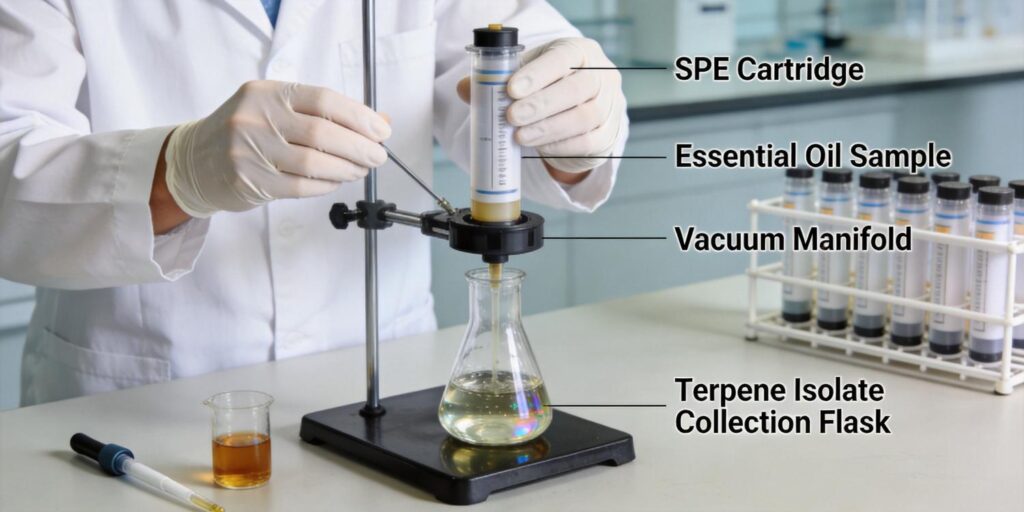
Proper conditioning of the SPE cartridge ensures consistent sorbent wetting and reproducible retention. For reversed-phase sorbents (C18, HLB), condition with 2–3 bed volumes of methanol followed by 2–3 bed volumes of the loading solvent (e.g., hexane or ethyl acetate). Avoid letting the sorbent dry out between conditioning and loading. Load the diluted essential oil sample (typically 1–2 mL) onto the cartridge at a flow rate of 1–2 mL/min using a vacuum manifold or positive pressure. For high-viscosity samples, reduce the flow rate or use a larger bed mass (e.g., 1 g or 6 mL cartridges). Collect the load fraction to monitor breakthrough. For optimal recovery, the load volume should not exceed the cartridge’s capacity; a typical loading capacity for 500 mg HLB is about 5–10 mg of total terpenes. After loading, wash the cartridge with 2–3 bed volumes of the loading solvent to remove loosely bound non-terpene components.
Washing Steps Removing Waxes and Lipids
One of the key advantages of SPE is the ability to selectively wash away unwanted matrix components before eluting the target analytes. For essential oils, waxes, long-chain hydrocarbons, and lipids can be removed by washing with a non-polar solvent such as hexane or heptane. Typically, 2–3 bed volumes of hexane are passed through the cartridge after sample loading. If using a reversed-phase sorbent, the waxes will pass through while terpenes remain retained. For normal-phase sorbents (silica), an intermediate polarity wash (e.g., 2% ethyl acetate in hexane) can elute terpenes while retaining more polar compounds. Adjust the wash solvent based on the retention profile of your target terpenes. It is advisable to collect the wash fraction and analyze it by TLC or GC-MS to verify that target terpenes are not prematurely eluted. The goal is to achieve a clean fraction enriched in terpenes, with minimal co-extracted lipids.
Elution Solvents for Terpene Compounds
Elution of terpenes from the SPE cartridge is achieved by using a solvent with sufficient strength to disrupt the analyte-sorbent interactions. For reversed-phase sorbents, methanol, acetonitrile, or ethyl acetate are common eluents. A step gradient may be employed to fractionate terpenes by polarity: for example, elute monoterpenes with 100% methanol, then sesquiterpenes with ethyl acetate. For normal-phase sorbents, increasing the percentage of ethyl acetate or acetone in hexane can selectively elute terpene classes. Typically, 2–3 bed volumes of elution solvent are sufficient. The eluate is then collected and evaporated under a gentle nitrogen stream for GC-MS analysis. If the elution solvent is not compatible with GC injection (e.g., water), it must be exchanged for a volatile solvent. The 96-well SPE plates are ideal for high-throughput method development, allowing simultaneous testing of multiple elution conditions.
GC-MS Analysis Workflow
After SPE purification, the terpene-enriched fraction is analyzed by gas chromatography-mass spectrometry (GC-MS). The dried eluate is reconstituted in a suitable solvent (e.g., hexane or ethyl acetate) and injected onto a non-polar GC column (e.g., 5% phenyl methyl siloxane, 30 m × 0.25 mm × 0.25 μm). Typical temperature program: 50°C for 2 min, ramp at 5°C/min to 250°C, hold for 5 min. Helium is used as carrier gas at 1 mL/min. Mass spectra are acquired in electron ionization (EI) mode at 70 eV, scanning m/z 40–550. Data analysis involves comparing retention indices and mass spectra with libraries (NIST, Wiley) or authentic standards. Quantification can be performed using internal standards such as n-alkanes or deuterated terpenes. The SPE cleanup reduces column contamination and improves signal-to-noise ratio, leading to more reliable identification and quantification.
Applications in Fragrance Chemistry
The isolated terpene fractions from SPE have extensive applications in fragrance chemistry. Perfumers and flavorists use purified terpenes to create consistent scent profiles, assess raw material quality, and ensure allergen compliance (EU regulation on fragrance allergens). SPE enables the isolation of target odor-active compounds (e.g., linalool, citronellol, geraniol) from complex essential oils for sensory evaluation. Additionally, it facilitates the study of chiral terpenes, which often have different olfactory properties. The MCX SPE cartridges can be used to isolate basic terpene amines if present. By integrating SPE with GC-MS, fragrance chemists can create reliable libraries of marker compounds for authenticity testing and adulteration detection. Whether for research, quality control, or product development, SPE offers a robust and scalable approach to terpene isolation from essential oils.