Hospital Wastewater as a Source of Pharmaceutical Metabolites
Hospital wastewater is a significant point source for pharmaceutical residues and their metabolites, including antibiotics, analgesics, antidepressants, and contrast media. These compounds enter wastewater streams through patient excreta, disposal of unused medications, and laboratory activities. Unlike municipal sewage, hospital effluent contains higher concentrations of active pharmaceutical ingredients (APIs) and their phase I and phase II metabolites, which can persist through conventional wastewater treatment. The presence of polar metabolites—such as glucuronides, sulfates, and hydroxylated derivatives—poses unique analytical challenges due to their high water solubility and low volatility. Solid-phase extraction (SPE) remains the gold standard for concentrating these analytes from complex aqueous matrices prior to LC-MS/MS analysis.
Sample Collection and Pretreatment
Collection of representative hospital wastewater samples requires careful planning. Grab samples are common, but 24-hour composite sampling is recommended to capture diurnal fluctuations in drug excretion. Samples are typically collected in amber glass or HDPE bottles and transported on ice. Immediate filtration through 0.45 µm or 0.7 µm glass fiber filters removes suspended solids that could clog SPE cartridges. Acidification (e.g., to pH 2–3 with HCl or formic acid) is often employed to stabilize acidic metabolites and prevent microbial degradation. For some conjugated metabolites, enzymatic hydrolysis (using β-glucuronidase or sulfatase) may be applied to convert phase II metabolites back to parent compounds, though this step is optional depending on the target list. The filtered, acidified sample should be processed within 24 hours or stored at −20 °C.
SPE Sorbent Selection for Polar Metabolites
Selecting the appropriate SPE sorbent is critical for retaining polar pharmaceutical metabolites from wastewater. Traditional reverse-phase sorbents (C18) often fail to retain highly hydrophilic compounds. Mixed-mode polymeric sorbents offer superior performance:
- HLB (Hydrophilic-Lipophilic Balance): A universal sorbent (e.g., Poseidon Scientific HLB SPE Cartridges) composed of a balanced ratio of N-vinylpyrrolidone and divinylbenzene polymers. It retains both polar and nonpolar analytes, making it ideal for a wide range of metabolites. HLB cartridges can handle large volumes and have high capacity.
- MAX (Mixed-Mode Anion eXchange): For acidic metabolites (e.g., carboxylates, sulfates), the quaternary amine groups provide strong anion-exchange retention. Use Poseidon Scientific MAX SPE Cartridges after sample pH adjustment.
- MCX (Mixed-Mode Cation eXchange): For basic metabolites (e.g., amines), sulfonic acid groups retain positively charged species. See Poseidon Scientific MCX SPE Cartridges.
- WAX / WCX: Weak anion/cation exchangers offer more selective elution for targeted compound classes. Check WAX and WCX cartridges for zwitterionic or amphoteric metabolites.
For high-throughput screening, 96-well plate formats (e.g., Poseidon Scientific 96-Well SPE Plate) enable parallel processing of multiple samples.
Conditioning and Loading Large Sample Volumes
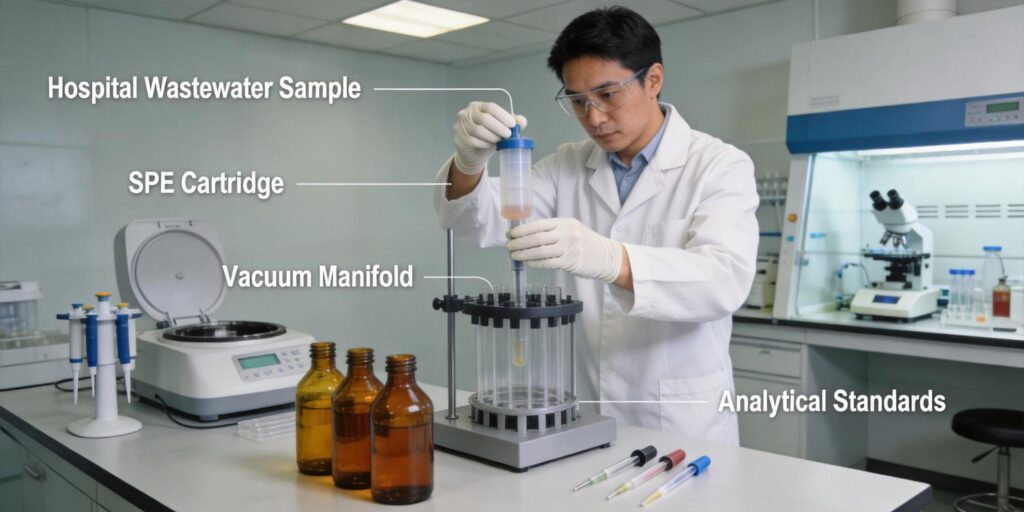
To maximize analyte recovery from large-volume wastewater samples, the SPE bed must be properly conditioned. A typical protocol for a 200 mg/6 mL HLB cartridge includes: 1) 5 mL methanol, 2) 5 mL DI water, and 3) 5 mL acidified water matching the sample pH (e.g., pH 2). Condition the sorbent at a flow rate of 1–2 mL/min using a vacuum manifold or positive pressure. Sample loading volumes of 100–500 mL are common; flow rate should be controlled at ~5–10 mL/min to allow sufficient contact time. After loading, a brief air-drying step (5–10 min under vacuum) removes residual water before washing.
Washing Steps Reducing Organic Matrix Effects
Wastewater contains high levels of dissolved organic matter (DOM), salts, and co-extractives that can suppress ionization in LC-MS/MS. A well-designed wash removes interferences while retaining target analytes:
- For reverse-phase (HLB): A wash with 5% methanol in water (v/v) helps remove highly polar interferences like humic acids.
- For mixed-mode (MCX/MAX): Use an intermediate wash with 100% methanol to remove neutral interferents, followed by a pH-adjusted wash (e.g., 2% formic acid for MCX) to preserve ionic interactions.
- For 96-well plates, a generic wash of 0.1% formic acid in 5% methanol can reduce matrix effects without significant analyte loss.
Elution Solvent Optimization
Elution solvent composition must balance recovery and selectivity. Common eluents for pharmaceutical metabolites:
- HLB: Methanol, acetonitrile, or a mixture (e.g., 80:20 methanol:water) often yields >85% recovery for most metabolites. For very polar compounds, add 0.1% formic acid to the eluent.
- MCX: Basified methanol (e.g., 5% ammonium hydroxide in methanol) neutralizes the cation-exchange groups, releasing basic metabolites.
- MAX: Acidified methanol (e.g., 2% formic acid in methanol) protonates the anion-exchange sites, eluting acidic analytes.
- WAX/WCX: Use pH-adjusted buffers (e.g., 50 mM ammonium acetate in methanol) to achieve stepwise elution.
A two-step elution strategy (e.g., first with neutral methanol, then acidic/basic methanol) can fractionate compounds by polarity and charge, simplifying subsequent LC separation. Elution volumes of 3–5 mL are typical; evaporate to dryness under nitrogen and reconstitute in 200–500 µL of mobile phase to achieve 500–1000× concentration.
LC-MS/MS Detection Methods
Reversed-phase LC-MS/MS is the workhorse for quantifying pharmaceutical metabolites. Use a C18 column (e.g., 2.1 × 100 mm, 1.7 µm) with a mobile phase of water (0.1% formic acid) and acetonitrile (0.1% formic acid). Gradient elution from 5% to 95% acetonitrile over 15–20 min provides good separation. MS/MS detection in positive/negative electrospray ionization (ESI) with multiple reaction monitoring (MRM) ensures sensitivity and specificity. For conjugated metabolites (e.g., glucuronides), negative ESI often yields stronger signals. Isotope-labeled internal standards are highly recommended to correct for matrix effects and SPE recovery losses. Calibration curves should be prepared in matrix-matched wastewater extracts to account for ion suppression.
Environmental Monitoring Considerations
When applying SPE-LC-MS/MS to hospital wastewater monitoring, consider the following:
- Method detection limits (MDLs): Typically in the low ng/L range; ensure that the SPE concentration factor (e.g., 500×) meets regulatory or research thresholds.
- Quality control: Include field blanks, laboratory blanks, and spiked matrix samples (recovery >70–120% acceptable).
- Stability: Some metabolites (e.g., acyl glucuronides) hydrolyze; process samples quickly or add preservatives.
- Alternative sorbents: If polar metabolites like metformin or acyclovir show low retention on HLB, try MCX or specialized sorbents like porous graphitic carbon.
- Regulatory context: The EU Watch List (Decision 2022/1307) and US EPA CCL5 include pharmaceuticals; robust SPE extraction is essential for compliance data.
For a reliable and reproducible workflow, choose high-quality SPE products engineered for environmental analysis. Poseidon Scientific offers a range of SPE cartridges and plates tailored to your application, ensuring minimal batch variation and consistent purification performance across hospital wastewater monitoring programs.