Pesticide Contamination Concerns in Herbal Teas
Herbal teas, prized for their natural flavors and health benefits, can harbor pesticide residues due to agricultural practices. Unregulated use of pesticides on herbs like chamomile, peppermint, and hibiscus raises food safety concerns. Regulatory bodies such as the European Union and the U.S. FDA enforce maximum residue limits (MRLs) to protect consumers. Sensitive populations, including pregnant women and children, are particularly vulnerable, making rigorous testing essential. Solid-phase extraction (SPE) is a cornerstone technique for cleaning up these complex matrices before analysis.
Extraction of Dried Herbal Tea Samples
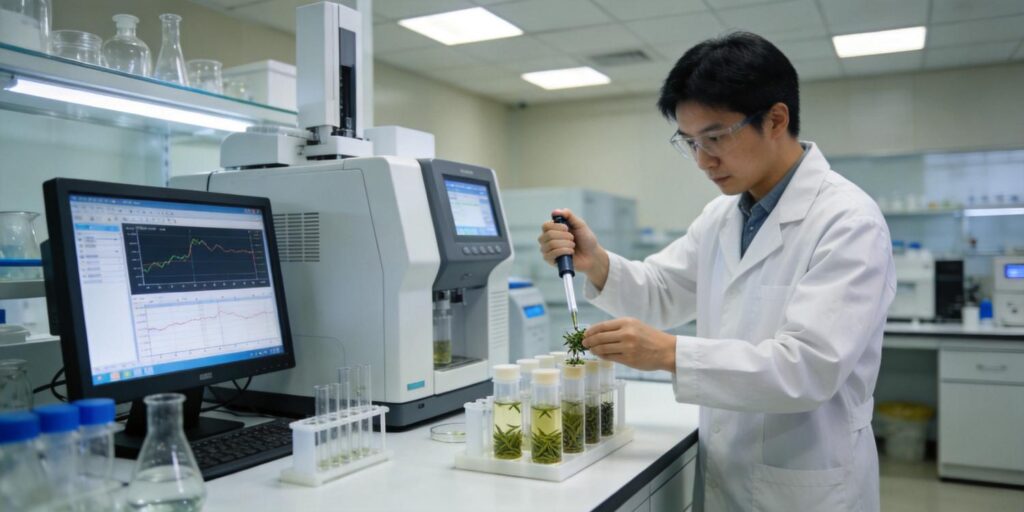
The first step involves extracting pesticides from dried herbal tea leaves. A representative sample (e.g., 2 g) is ground to a fine powder and mixed with a solvent like acetonitrile or ethyl acetate, often with a buffered salt system (e.g., QuEChERS method). The mixture is homogenized, centrifuged, and the supernatant is collected. This crude extract contains not only target pesticides but also abundant co-extractives such as chlorophylls, tannins, and polyphenols, which can interfere with downstream LC-MS analysis. SPE cleanup is therefore critical.
SPE Sorbent Selection for Cleanup
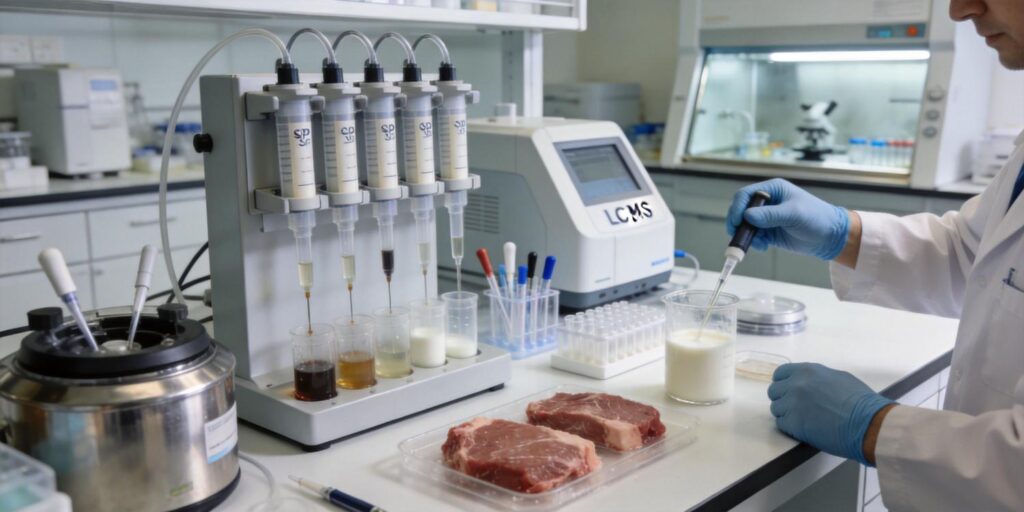
Selecting the right SPE sorbent is key to maximizing recovery while removing interferences. For pesticide analysis in herbal teas, mixed-mode or reversed-phase sorbents are commonly used. For example, our HLB cartridges (hydrophilic-lipophilic balanced) effectively retain both polar and non-polar pesticides while allowing polar pigments and sugars to pass through. Alternatively, MAX (mixed-mode anion exchange) and WAX (weak anion exchange) sorbents offer selectivity for acidic pesticides. For non-targeted screening, HLB is a versatile first choice.
Conditioning and Loading Extracts
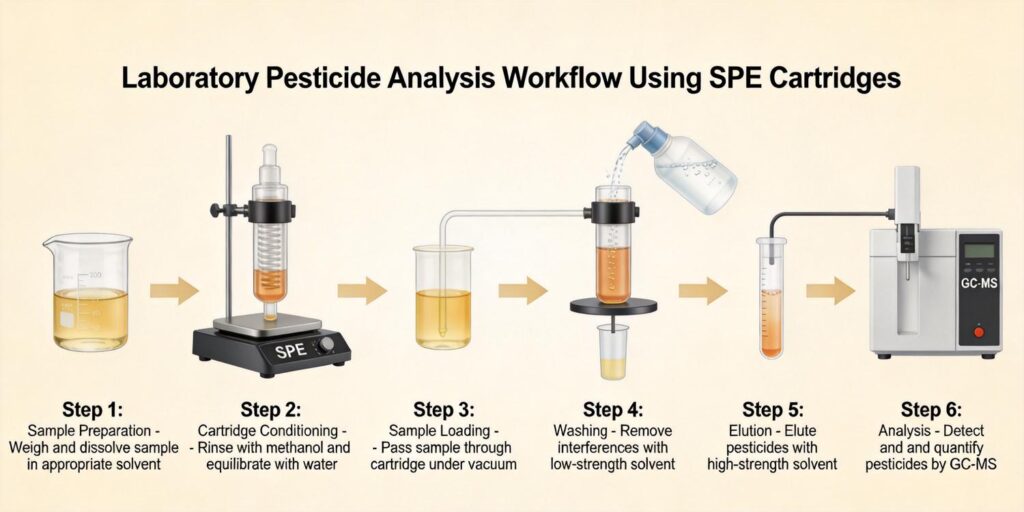
Proper conditioning of the SPE cartridge ensures reproducible results. For HLB cartridges, condition with 3 mL of methanol followed by 3 mL of water, avoiding sorbent drying. Load the herbal tea extract (e.g., 1 mL) at a slow flow rate (1-2 mL/min) to maximize binding. If the extract is highly colored, diluting with water may improve retention. After loading, the cartridge is rinsed with 5% methanol in water to remove weakly retained interferences.
Washing Steps Removing Pigments and Tannins
Herbal teas are rich in chlorophylls and tannins that can suppress ionization in LC-MS. A wash step using 60% methanol in water effectively elutes these polar pigments while retaining pesticides on the sorbent. For more stubborn interferences, a wash with 1% formic acid in water helps remove acidic tannins. Alternatively, a hexane wash can eliminate non-polar lipids. The wash volume should be optimized to avoid premature elution of target analytes.
Elution Solvents for Pesticide Residues
Pesticides are eluted with a solvent that disrupts interactions with the sorbent. For HLB, 3 mL of acetonitrile or methanol is typical. For mixed-mode sorbents like MCX (mixed-mode cation exchange), elution may require basic methanol (e.g., 5% ammonium hydroxide in methanol) to release basic pesticides. The eluate is then evaporated and reconstituted in a solvent compatible with LC-MS, such as water/methanol (1:1).
LC-MS Analysis
The cleaned extract is injected into an LC-MS system equipped with a C18 column (e.g., 50 mm x 2.1 mm, 1.7 µm). A gradient of water and methanol with 0.1% formic acid provides good separation for a wide polarity range of pesticides. Mass spectrometry in multiple reaction monitoring (MRM) mode allows quantification at trace levels (ppb). Matrix-matched calibration standards are recommended to compensate for any remaining matrix effects.
Food Safety Quality Control
To ensure reliable results, include method blanks, spiked samples, and duplicate analyses. Recovery experiments should yield 70-120% with RSD <20%. Our 96-well SPE plates are ideal for high-throughput testing in food safety labs. By following validated SPE protocols, herbal tea producers and testing laboratories can confidently monitor pesticide residues and maintain compliance with global standards.