1. Complexity of Plant Metabolite Extracts
Plant extracts represent one of the most challenging matrices for analytical chemists, containing thousands of chemical components with diverse physicochemical properties. As noted in SPE literature, plants can be considered as consisting of “an aqueous portion, a fatty portion and an insoluble or fibrous portion” (Simpson & Wynne, 2000). This complexity arises from the natural diversity of plant secondary metabolites including alkaloids, flavonoids, terpenoids, phenolic compounds, pigments, tannins, and various glycosides.
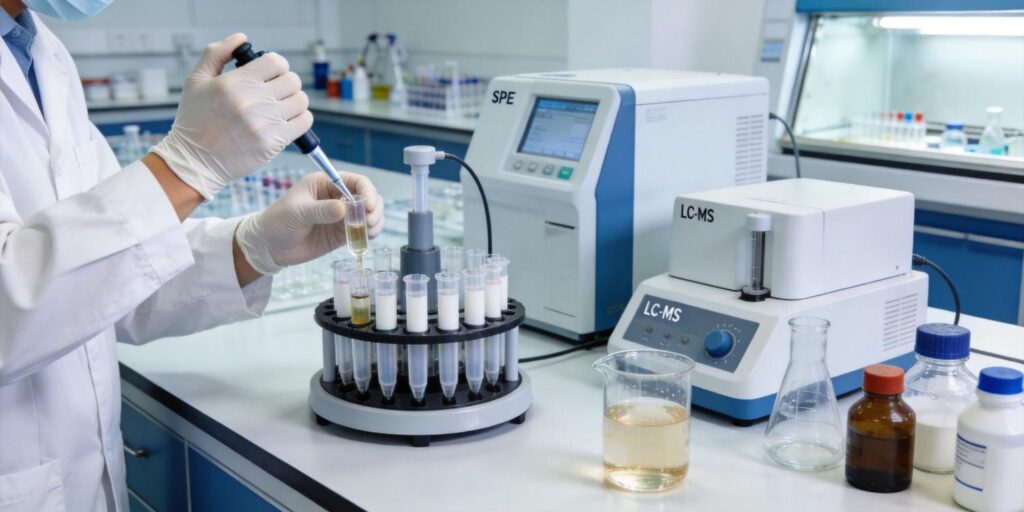
The aqueous component contains both inorganic ions and soluble organic species, while the lipid fraction includes triglycerides, fatty acids, and complex lipids. This heterogeneity creates significant challenges for LC-MS analysis, where matrix effects can suppress ionization, cause signal interference, and lead to inaccurate quantification. Traditional extraction methods often co-extract interfering compounds that can compromise chromatographic performance and mass spectrometer sensitivity.
2. Removing Pigments and Tannins Using SPE
Pigments (chlorophylls, carotenoids, anthocyanins) and tannins represent major interferences in plant extract analysis. These compounds can cause several problems in LC-MS systems:
- Column fouling: Pigments and tannins can irreversibly bind to stationary phases
- Ion suppression: These compounds can interfere with analyte ionization in the MS source
- Background interference: High concentrations can mask target analytes
Solid-phase extraction offers selective removal of these interferences. Early SPE applications for plant materials were often used “simply as a technique to remove pigments by passage of the lyophilized, soxhlet-extracted or homogenized and extracted sample through a C18 device” (Carmichael, 1982; Meier et al., 1988). The effluent (not the eluent) was collected, effectively removing pigments while allowing target analytes to pass through.
For tannin removal, mixed-mode sorbents like WAX (weak anion exchange) cartridges can be particularly effective. Tannins, being polyphenolic compounds with multiple hydroxyl groups, can be selectively retained through hydrogen bonding and π-π interactions on appropriate sorbents.
3. Selecting Polymeric vs Reversed-Phase Sorbents
Polymeric Sorbents (HLB)
HLB (Hydrophilic-Lipophilic Balance) sorbents, typically composed of poly(divinylbenzene-co-N-vinylpyrrolidone), offer several advantages for plant extract cleanup:
- Wider pH stability: Compatible with pH 0-14, allowing flexibility in sample pretreatment
- Dual retention mechanism: Both hydrophilic and lipophilic interactions
- Higher capacity: Particularly for polar compounds that might be lost on traditional C18 phases
- Better recovery: For highly oxygenated phytochemicals like flavonoids and phenolic acids
Research has shown that HLB sorbents are effective for extracting “medium-polar and non-polar organic compounds from mixtures of water and organic solvent” and are “suitable for the clean-up of feed, including fat- or water-soluble vitamins” (Journal of Chromatographic Science, 2008).
Reversed-Phase Sorbents (C18, C8)
Traditional reversed-phase sorbents remain valuable for specific applications:
- C18: Excellent for non-polar to moderately polar compounds; widely used for alkaloid extraction
- C8: Slightly less retentive than C18, useful for more polar compounds
- Specialized phases: Phenyl, cyano, or diol phases for specific selectivity requirements
The choice between polymeric and reversed-phase sorbents depends on the target analytes’ polarity, the specific interferences present, and the desired cleanup strategy.
4. Example Workflow for Botanical Extracts
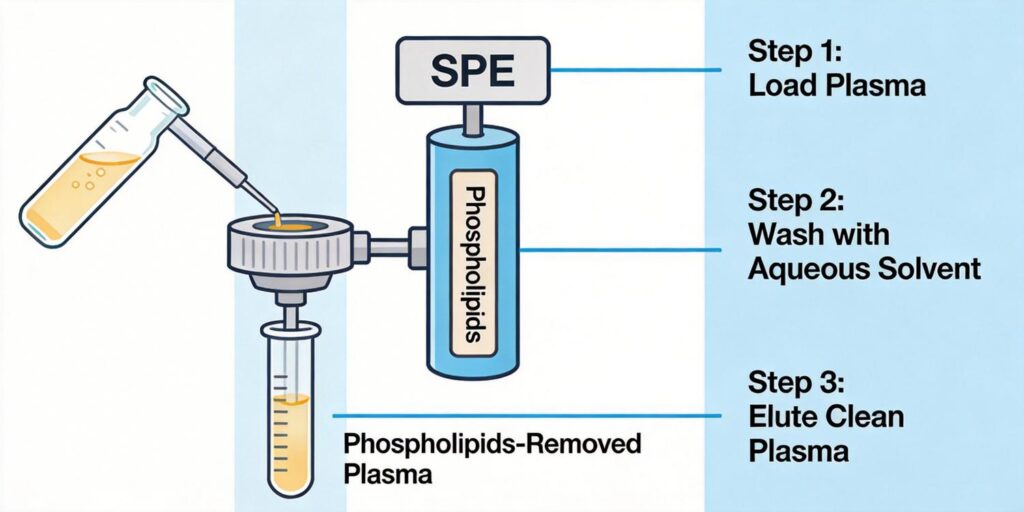
A comprehensive SPE workflow for plant extract cleanup prior to LC-MS analysis typically includes the following steps:
- Sample Preparation: Homogenize plant material, extract with appropriate solvent (methanol, ethanol, or aqueous mixtures), and filter
- SPE Cartridge Conditioning: Activate sorbent with organic solvent (methanol or acetonitrile) followed by equilibration with aqueous solvent
- Sample Loading: Apply extract at controlled flow rate (typically 1-3 drops/second)
- Wash Step: Remove interferences with appropriate solvent (often 5-10% methanol in water)
- Drying: Remove residual water if elution solvent is immiscible
- Elution: Recover analytes with optimal solvent (methanol, acetonitrile, or mixtures)
- Concentration/Reconstitution: Evaporate and reconstitute in LC-MS compatible solvent
For complex plant matrices, a tandem SPE approach using different sorbents in sequence can provide superior cleanup. For example, passing an extract through C18 followed by mixed-mode sorbents like MAX (mixed-mode anion exchange) or WCX (weak cation exchange) can remove different classes of interferences.
5. Improving LC-MS Chromatographic Performance
Effective SPE cleanup significantly enhances LC-MS performance through several mechanisms:
Reduced Matrix Effects
Matrix effects, particularly ion suppression, are major challenges in plant extract analysis. SPE removes co-extractives that compete for ionization in the MS source, leading to more consistent and accurate quantification.
Extended Column Life
Removing “column killers” like pigments, tannins, and polymeric materials prevents stationary phase degradation and maintains chromatographic performance over time. As noted in SPE literature, “SPE has been shown to significantly increase gas (GC) and liquid chromatography (LC) column life while reducing the downtime on equipment like gas chromatography and liquid chromatography mass spectrometers (GCMS and LCMS) for source cleaning” (Forensic and Clinical Applications of SPE).
Improved Peak Shape and Resolution
By removing late-eluting compounds and reducing sample complexity, SPE allows for better chromatographic separation, sharper peaks, and improved resolution of target analytes.
Enhanced Sensitivity
Concentration during SPE (typically 10-100 fold) increases analyte concentration in the final extract, improving detection limits and signal-to-noise ratios.
6. Applications in Herbal Medicine Analysis
SPE plays a crucial role in quality control and standardization of herbal medicines:
Marker Compound Analysis
For regulatory compliance and quality assurance, specific marker compounds must be quantified. SPE enables selective extraction and concentration of these markers from complex herbal matrices. Examples include:
- Flavonoids: Rutin, quercetin, and other polyphenolics from various medicinal plants
- Alkaloids: Strychnine, morphine, and other bioactive alkaloids
- Terpenoids: Ginsenosides, artemisinin, and other terpene-based compounds
- Phenolic acids: Caffeic acid, chlorogenic acid, and related compounds
Metabolite Profiling
Comprehensive metabolite profiling (metabolomics) of herbal extracts requires extensive sample cleanup to avoid MS source contamination and ensure data quality. SPE provides the necessary purification for untargeted analysis approaches.
Bioactive Compound Isolation
For bioassay-guided fractionation, SPE offers advantages over traditional solvent extraction, particularly for “highly polar compounds such as the flavonoids and other naturally occurring oxygen ring compounds” that “may be isolated from aqueous plant extracts at neutral pH” (Simpson & Wynne, 2000).
Contaminant Analysis
SPE is essential for detecting and quantifying contaminants in herbal products, including:
- Pesticide residues
- Heavy metals (after appropriate chelation)
- Mycotoxins
- Adulterants and synthetic drugs
Conclusion
Solid-phase extraction represents a critical step in the analysis of plant extracts by LC-MS, addressing the unique challenges posed by complex botanical matrices. By selectively removing pigments, tannins, and other interferences while concentrating target analytes, SPE improves chromatographic performance, extends instrument life, and enhances analytical sensitivity and accuracy.
The choice of SPE sorbent—whether polymeric HLB, traditional reversed-phase, or mixed-mode cartridges—should be guided by the specific analytes of interest and the nature of the plant matrix. For laboratories engaged in herbal medicine analysis, phytochemical research, or natural product discovery, implementing optimized SPE protocols can significantly improve data quality and analytical throughput.
At Poseidon Scientific, we offer a comprehensive range of SPE products specifically designed to address the challenges of plant extract analysis, helping researchers and quality control laboratories achieve reliable, reproducible results in their LC-MS applications.