
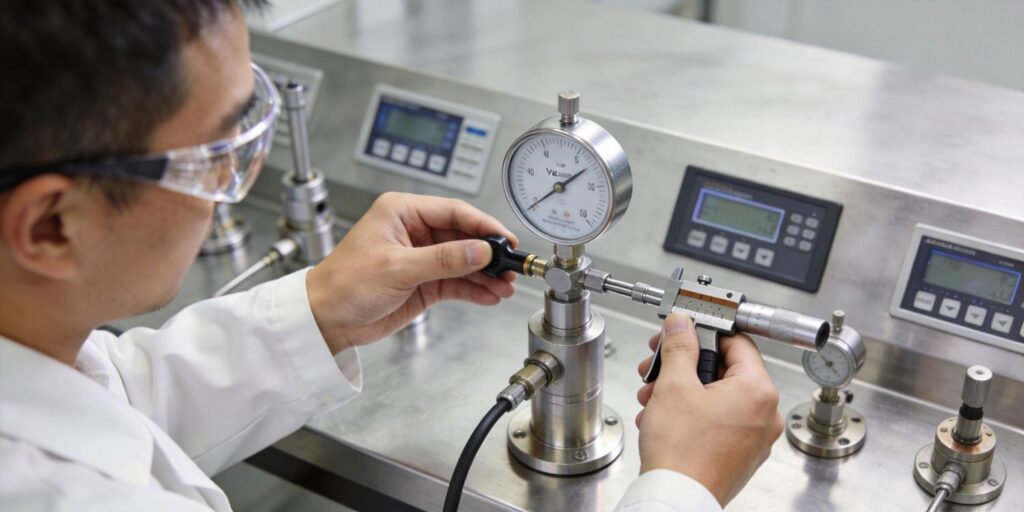
In high-vacuum applications ranging from mass spectrometers and scanning electron microscopes to vacuum heat-treatment furnaces and lithium-ion battery drying lines, accurate pressure measurement is the foundation of process repeatability and product quality. Yet even the most robust gauges experience drift over time due to contamination, temperature cycling, or electrode wear. At Poseidon Scientific, we engineered the VG-SP205 Pirani Vacuum Transmitter and VG-SM225 Cold Cathode Vacuum Gauge for long-term stability while keeping calibration practical and cost-effective. Both instruments ship with factory-established voltage-to-pressure curves, temperature compensation, and error-code diagnostics via RS-232, yet periodic verification remains essential for engineers and procurement teams who demand traceable, defensible data.
This guide answers the most common questions about vacuum gauge calibration: when to perform it, which reference standards to use, step-by-step procedures for zero and span adjustments, the practical differences between field and factory methods, required documentation, and compliance considerations. Whether you operate a single research chamber or a multi-gauge production line, these practices will help you maintain measurement integrity without unnecessary downtime or expense.
Calibration Interval Guidelines
Calibration frequency depends on operating environment, gas exposure, and process criticality. In clean, non-corrosive applications such as mass-spectrometer foreline monitoring or UHV research chambers, both the VG-SP205 and VG-SM225 maintain specified accuracy (±5 % in linear zones) for 12–18 months. In solvent-rich or mildly contaminated environments—typical of lithium-battery electrode drying or PVD coating—drift can appear within 3–6 months.
Practical triggers for calibration or verification include:
- Every 500 operating hours or after 50 thermal cycles (15–50 °C range).
- After exposure to corrosive or high-outgassing process gases (NMP, water vapor, argon).
- Whenever cross-check readings between Pirani and cold-cathode gauges diverge by more than 20 % in the 10-3 Torr overlap zone.
- Following any maintenance event, such as cold-cathode sensor cleaning or system bake-out.
These guidelines align with industry experience for “quantity monitoring” gauges where absolute laboratory-grade precision is secondary to repeatability. For semiconductor or pharmaceutical applications requiring stricter traceability, shorten intervals to quarterly.
Reference Standards
Traceable reference standards form the backbone of any calibration. For the pressure range covered by Poseidon gauges (atmosphere to 10-7 Torr), the following instruments are recommended:
| Pressure Range | Preferred Reference Standard | Typical Uncertainty | Traceability |
|---|---|---|---|
| Atmosphere to 10 Torr | Capacitance diaphragm gauge (CDG) | ±0.2 % reading | NIST / PTB |
| 10 to 10-3 Torr | Spinning rotor gauge (SRG) or high-accuracy Pirani | ±0.5–1 % | NIST / PTB |
| 10-3 to 10-7 Torr | Calibrated cold-cathode or Bayard-Alpert gauge with known sensitivity | ±10–20 % | Transfer standard |
Always use a reference gauge whose full-scale accuracy exceeds the target gauge by at least a factor of three. Poseidon’s factory calibration employs certified transfer standards in a dedicated vacuum bench with dry nitrogen or air, ensuring each VG-SP205 and VG-SM225 ships with a documented sensitivity curve.
Zero Adjustment Procedure
Zero adjustment corrects baseline offset caused by temperature drift, minor contamination, or electronic aging. For the VG-SP205 Pirani, true zero is established at atmospheric pressure (760 Torr), where filament power is minimal.
VG-SP205 Pirani Zero Adjustment (Field)
- Vent the chamber to atmosphere and stabilize temperature (20–25 °C ideal).
- Connect the gauge to a calibrated multimeter or controller displaying the 0–10 V output.
- Access the RS-232 diagnostic menu (command “ZERO?”) and issue the zero-calibration command while the chamber is at local atmospheric pressure.
- The firmware automatically stores the new baseline power value; confirm output reads approximately 0.5–1.0 V (atmospheric reference point).
- Repeat after 30 minutes to verify stability.
For the VG-SM225 Cold Cathode, zero adjustment is performed at the lowest achievable system pressure (typically <10-7 Torr after bake-out) because the gauge has no output at atmosphere.
VG-SM225 Cold Cathode Zero Adjustment (Field)
- Achieve the lowest stable chamber pressure using a turbo or cryo pump.
- Ensure the discharge has ignited (green LED steady) and wait 15–30 minutes for stabilization.
- Via RS-232 (“ZERO?” command), capture the residual current offset and store it as the new zero point.
- Verify that output voltage drops to the expected low-pressure floor (approximately 0.2–0.5 V).
Both procedures take less than 10 minutes and require no hardware disassembly.
Span Calibration Method
Span calibration adjusts the slope of the pressure-versus-output curve across the operating range. Poseidon gauges use multi-point mapping rather than single-point span to preserve linearity.
Multi-Point Span Procedure (Recommended for Both Gauges)
- Install the gauge and a certified reference gauge on the same KF25 port or adjacent ports with negligible conductance difference.
- Evacuate to five evenly spaced points across the gauge’s linear zone:
- Pirani: 100 Torr, 10 Torr, 1 Torr, 0.1 Torr, 0.01 Torr
- Cold Cathode: 5 × 10⁻⁴ Torr, 1 × 10⁻⁴ Torr, 1 × 10⁻⁵ Torr, 1 × 10⁻⁶ Torr
- At each stable point, record reference pressure and gauge output voltage.
- Use the RS-232 interface (“SPAN n” commands) to upload correction coefficients; the firmware applies a piecewise linear fit.
- Repeat the sequence twice and average results for best reproducibility.
In the 10-3 Torr overlap zone, cross-verify both gauges simultaneously to confirm span agreement within ±15 %. This method restores full accuracy without returning the gauge to the factory in most cases.
In-Field vs Factory Calibration
Field calibration is verification plus limited adjustment—ideal for routine maintenance. It uses the procedures above, requires only a reference gauge and RS-232 connection, and can be completed in under one hour without breaking vacuum for sensor removal. The removable cold-cathode head allows electrode cleaning before span adjustment, further extending usability.
Factory calibration at Poseidon is a full curve re-mapping under controlled conditions (temperature-stabilized chamber, certified gas, multi-point transfer standards). It is recommended every 18–24 months or after severe contamination. Turnaround is typically 5–7 business days, with a new calibration certificate issued for each gauge. Because the VG-SM225 sensor is fully detachable, only the head needs return shipping—reducing cost and logistics compared with monolithic imported gauges.
Choose field calibration for production lines requiring minimal downtime; reserve factory service for annual compliance audits or when cross-check discrepancies exceed 25 % after cleaning.
Documentation Requirements
Traceable records protect both process quality and regulatory compliance. Maintain a digital log for every gauge containing:
- Gauge serial number and installation date
- Calibration date, operator name, and reference standard ID
- Before-and-after voltage-versus-pressure data tables (minimum five points)
- Correction coefficients applied via RS-232
- Environmental conditions (temperature, gas type)
- Post-calibration cross-check results with secondary gauge
- Any maintenance performed (e.g., electrode cleaning)
Poseidon’s RS-232 protocol automatically exports these data in CSV format, simplifying integration with SCADA or ISO-compliant quality-management systems. Retain records for the gauge’s service life plus one year, or as required by customer contracts.
Compliance Considerations
Vacuum gauge calibration falls under broader quality and metrology standards. In semiconductor and pharmaceutical applications, ISO/IEC 17025 accreditation for calibration laboratories is often mandatory. For medical-device or battery production, traceability to national standards (NIST, PTB, NIM) and documented uncertainty budgets are expected during audits.
Poseidon Scientific maintains in-house calibration benches traceable to national standards and issues certificates compliant with these requirements. The VG-SP205 and VG-SM225 designs support 21 CFR Part 11 electronic records when paired with appropriate controllers. For EU customers, CE-marked gauges and RoHS-compliant materials further simplify regulatory filings.
Engineers responsible for FDA-regulated or IATF 16949 automotive processes should incorporate gauge calibration into the equipment qualification (IQ/OQ/PQ) protocol, using the overlap-zone cross-check as an independent verification method.
Conclusion
Proper vacuum gauge calibration is not a one-time event but a disciplined program that combines scheduled verification, reference standards, straightforward zero and span procedures, and meticulous documentation. By leveraging the complementary strengths of the VG-SP205 Pirani and VG-SM225 Cold Cathode—fast thermal response, cleanable electrodes, 10-3 Torr overlap, and RS-232 customization—facilities achieve continuous, validated pressure data from atmosphere to 10-7 Torr while controlling total cost of ownership.
Procurement teams benefit from domestic sourcing, rapid turnaround, and calibration services priced far below imported equivalents. Engineers gain peace of mind knowing their gauges remain within specification without frequent system shutdowns.
Ready to simplify your calibration program? Download Poseidon’s free Vacuum Gauge Calibration Checklist and RS-232 Command Reference (PDF) from the product pages linked above. It includes step-by-step field procedures, sample log templates, and troubleshooting flowcharts tailored to both single- and dual-gauge installations.
For personalized support—whether a full factory recalibration, on-site training for your team, or a no-obligation loaner gauge during your next verification cycle—contact our applications engineering team directly. We specialize in helping engineers and procurement specialists implement calibration protocols that meet both technical and compliance requirements while minimizing downtime. Let Poseidon Scientific keep your vacuum measurements accurate, traceable, and cost-effective.


