
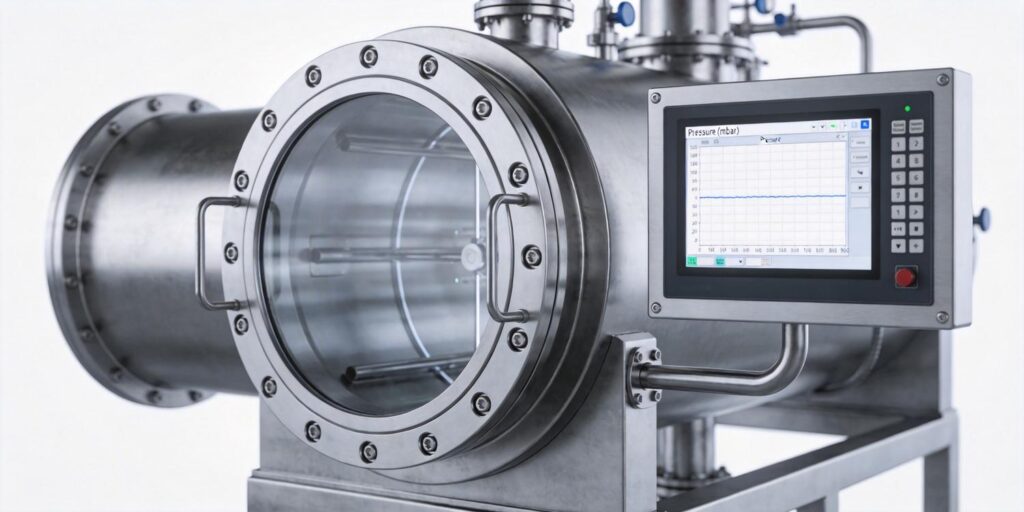
Understanding Pressure Fluctuations in Vacuum Systems
Vacuum systems in analytical instruments, semiconductor processing, and industrial heat treatment demand exceptional pressure stability to deliver consistent results. Even minor fluctuations—often on the order of 10% or more—can degrade process outcomes, extend cycle times, or trigger false alarms in safety interlocks. Identifying the root causes of these instabilities is the first step toward meaningful improvement.
Common sources include outgassing from chamber walls and internal components, particularly in systems that cycle between atmosphere and high vacuum. Temperature variations alter gas desorption rates and affect the thermal conductivity readings in thermal gauges. Leaks, whether virtual or real, introduce uncontrolled gas loads, while pump performance drift—due to oil contamination in rotary vane pumps or foreline pressure spikes—directly impacts chamber pressure. Gas composition changes, such as the introduction of helium or process gases with different molecular weights, further complicate readings because most vacuum gauges are calibrated for nitrogen or air.
According to foundational vacuum science, these effects are compounded by the non-linear response of many gauges outside their optimal operating windows. For instance, in the transition region around 10⁻³ Torr, both thermal and ionization-based gauges exhibit reduced sensitivity, amplifying apparent fluctuations.
The Critical Role of Gauge Response Time in Real-Time Monitoring
Response time—the interval between a pressure change and a stable, accurate gauge output—determines how quickly a control system can react. In dynamic vacuum environments, such as mass spectrometer forelines or vacuum furnace load locks, delays of even a few seconds can allow pressure excursions that compromise product quality or instrument uptime.
Pirani gauges, which rely on thermal conductivity, typically offer sub-second response in the rough vacuum range (atmosphere to 10⁻³ Torr). Their heated filament adjusts power rapidly to maintain constant temperature, providing near-instantaneous feedback suitable for fast-acting pressure control loops. However, their performance degrades in high vacuum where gas density drops and heat loss becomes minimal.
Cold cathode gauges, operating on the Penning discharge principle, excel in the high-vacuum regime (10⁻³ to 10⁻⁷ Torr) but introduce unique timing considerations. Startup delays—typically 5 minutes at 10⁻⁶ Torr and up to 30 minutes at 10⁻⁷ Torr—stem from the need to establish a self-sustaining discharge in sparse molecular environments. Once operating, their ion current responds quickly to pressure changes, but discontinuities in the current-pressure curve can appear if contamination builds up on electrodes.
Selecting the right gauge for the pressure regime—Pirani for roughing stages and cold cathode for high vacuum—ensures the system captures transients without lag. Poseidon Scientific’s VG-SP205 Pirani Vacuum Transmitter and VG-SM225 Cold Cathode Vacuum Gauge were engineered precisely for this complementary pairing, delivering combined coverage from atmosphere to 10⁻⁷ Torr with minimal overlap uncertainty.
Advanced Signal Filtering Techniques for Cleaner Pressure Data
Raw gauge signals often contain electrical noise, thermal drift, and minor plasma instabilities (in ionization gauges). Without proper filtering, these artifacts propagate into control systems, causing erratic valve positioning or pump speed adjustments.
Digital low-pass filters, such as moving-average or exponential smoothing algorithms implemented in the gauge’s embedded firmware, effectively attenuate high-frequency noise while preserving step-response dynamics. For example, a 0.5–2 second time-constant filter on the VG-SP205’s analog 0–10 V output reduces temperature-induced ripple without introducing unacceptable latency.
In software-driven systems, Kalman filtering or adaptive digital signal processing can further refine data by incorporating known gauge characteristics—such as the non-linear Pirani curve or cold cathode hysteresis between pump-down and vent-up. These techniques are particularly valuable in environments with electromagnetic interference from nearby RF plasma sources or high-voltage accelerators.
Proper filtering also mitigates the impact of gas-species dependence. Since both Pirani and cold cathode readings vary with gas type, applying calibrated correction factors within the filter chain maintains accuracy across process gases without manual intervention.
Optimizing PID Control Loops with Precise Vacuum Gauge Feedback
Proportional-integral-derivative (PID) controllers are the workhorse of vacuum pressure regulation, modulating roughing valves, throttle valves, or variable-speed pumps. Their effectiveness hinges on accurate, low-noise feedback from the pressure sensor.
With legacy gauges exhibiting ±50% error at range extremes or slow response, operators often detune PID gains to avoid oscillations—sacrificing both speed and stability. Modern transmitters like the VG-SP205 and VG-SM225 provide linear 0–10 V analog outputs (effective 2–8 V range) plus customizable RS232 digital protocols, enabling direct integration into PLC or embedded control platforms.
Precise feedback allows aggressive tuning: higher proportional gain for rapid correction of disturbances, integral action to eliminate steady-state offset from outgassing, and derivative terms to dampen overshoot during pump-down. In practice, this combination reduces settling time by 30–50% and limits pressure overshoot to under 5% of setpoint.
The VG-SM225’s built-in high-voltage management and automatic shutdown above 10⁻³ Torr further protect the system from damage during transitions, ensuring uninterrupted feedback to the PID loop.
Case Study: Stability Improvements After Upgrading to Advanced Gauges
A leading mass spectrometer manufacturer experienced frequent foreline pressure excursions (±15% around 10⁻² Torr) that triggered ion source instability and extended qualification cycles. Legacy Pirani gauges suffered from thermal drift and slow response to sudden gas loads during sample introduction.
After replacing the original sensors with Poseidon Scientific’s VG-SP205 Pirani for the roughing stage and VG-SM225 Cold Cathode for the high-vacuum monitoring, pressure stability improved dramatically. Real-time data logging showed fluctuation reduced to ±3% within 2 seconds of disturbance. Startup time for the cold cathode section dropped to under 3 minutes at 10⁻⁶ Torr thanks to optimized Penning cell geometry and voltage ramping.
Maintenance intervals extended from quarterly cleaning to annual electrode polishing on the cold cathode unit, while the Pirani required zero intervention. Overall system uptime increased by 18%, directly translating to higher sample throughput.
ROI Analysis: Quantifying the Value of Upgraded Pressure Monitoring
Investing in high-performance vacuum gauges yields measurable returns across multiple dimensions. At a typical replacement cost of $3,000–$3,500 per unit (versus $5,000–$10,000 for equivalent imported models), the initial outlay is recovered quickly through reduced downtime and lower spare-parts inventory.
In the case study above, the upgrade paid for itself within four months via increased instrument utilization. Broader benefits include lower scrap rates in vacuum heat treatment (fewer failed batches due to pressure instability) and extended mean time between failures for turbomolecular pumps, which operate more reliably under tight pressure control.
Additional savings stem from simplified calibration—factory-mapped curves and digital outputs reduce field adjustment time—and the ability to customize communication protocols for seamless integration, eliminating costly driver development. Over a five-year lifecycle, total cost of ownership typically drops 40–60% compared with legacy systems.
Conclusion: Take the Next Step Toward Vacuum System Optimization
Stable vacuum pressure is no longer a luxury—it is a competitive necessity. By addressing fluctuation sources with fast-response gauges, applying intelligent signal filtering, and leveraging accurate feedback for PID tuning, engineers can achieve the tight control margins that modern processes demand.
Poseidon Scientific’s VG-SP205 Pirani Vacuum Transmitter and VG-SM225 Cold Cathode Vacuum Gauge deliver the performance, compactness, and customization required for today’s demanding applications. Their combination provides full-range coverage with the durability and maintainability that engineers value most.
Learn more about the VG-SP205 Pirani Vacuum Transmitter or explore the VG-SM225 Cold Cathode Vacuum Gauge.
Ready to quantify the stability gains possible in your system? Contact our applications team for a no-obligation vacuum system evaluation and pressure-monitoring audit. We’ll help you select the optimal configuration and demonstrate the difference precise monitoring can make.


