Regulatory Monitoring of Hormone Residues
Global food safety authorities have established stringent regulations for hormone residue monitoring in meat products to protect consumer health and ensure fair trade practices. The European Union’s Directive 96/22/EC and subsequent amendments, along with the United States Food and Drug Administration’s (FDA) guidelines, set maximum residue limits (MRLs) for various synthetic and natural hormones used in animal production. These regulations specifically target anabolic steroids, corticosteroids, and other growth-promoting agents that may accumulate in edible tissues.
Regulatory frameworks typically require monitoring programs that include both screening and confirmatory methods. Screening methods often utilize immunoassays for high-throughput analysis, while confirmatory methods rely on chromatographic techniques coupled with mass spectrometry. The Codex Alimentarius Commission provides international standards for hormone residue analysis, ensuring harmonization across different jurisdictions. Laboratories performing these analyses must adhere to Good Laboratory Practice (GLP) guidelines and maintain accreditation under ISO/IEC 17025 standards to ensure data reliability and legal defensibility.
Matrix Challenges in Meat Tissue Extracts
Meat tissue presents unique analytical challenges due to its complex composition of proteins, lipids, carbohydrates, and various endogenous compounds. The high lipid content in adipose tissue and muscle samples can interfere with extraction efficiency and cause matrix effects during analysis. As noted in veterinary drug analysis literature, “adipose or muscle tissue is usually analyzed with the intent to determine the health effects of consumption of that tissue and, as such, focuses on identification of pesticides or drug residues.”
Traditional sample preparation for solid tissues typically requires homogenization and deproteinization steps. Research demonstrates that “homogenizing the meconium in methanol, centrifuging the homogenate, drying down the supernate to a volume of less than 1 mL and then diluting this in the same phosphate buffer that would have been used for diluting a urine sample” can successfully adapt urine-based SPE protocols to tissue matrices. The high protein and lipid content often makes these samples prone to emulsification during liquid-liquid extraction, making SPE a valuable alternative technique.
Matrix Solid Phase Dispersion (MSPD) has emerged as a particularly effective approach for solid samples. This technique, developed to address the need for “faster, simpler and more efficient sample preparation,” involves blending the sample directly with SPE sorbent material, achieving disruption and extraction in a single step. For hormone residue analysis, this approach minimizes sample manipulation while effectively removing interfering matrix components.
SPE Sorbent Selection for Steroid Hormones
Selecting appropriate SPE sorbents for steroid hormone extraction requires careful consideration of analyte polarity, functional groups, and matrix composition. Steroid hormones exhibit diverse chemical properties ranging from relatively non-polar compounds like testosterone to more highly functionalized, water-soluble compounds such as stanozolol and its metabolites.
Reversed-Phase Sorbents
C18 phases have found widespread application for steroid hormone extraction due to their ability to retain these moderately hydrophobic compounds. As documented in veterinary drug analysis, “most methods for the separation of anabolic steroids therefore employ a C18 phase SPE cartridge for desalting and crude extraction.” These sorbents effectively remove salts and polar interferences while retaining target analytes that can be eluted with organic solvents like dichloromethane, methanol, or ethyl acetate.
Mixed-Mode Sorbents
For more comprehensive extraction of steroid hormones with varying polarities, mixed-mode sorbents combining hydrophobic and ion-exchange interactions offer superior performance. These materials provide “high recoveries of analytes from plasma, urine, whole blood, and tissues, and the resulting SPE eluates are easily amenable to subsequent GC- and HPLC-analysis.” The strategy of pH-dependent sample application and extraction allows selective retention of analytes based on their ionization state.
Specialized Sorbents
Silica-based sorbents offer alternative selectivity for corticosteroid extraction, where varying ratios of dichloromethane and ethyl acetate can provide selective elution. Immuno-affinity columns represent another specialized approach, particularly useful for class-specific extraction of corticosteroids based on their common C-17 pendant groups.
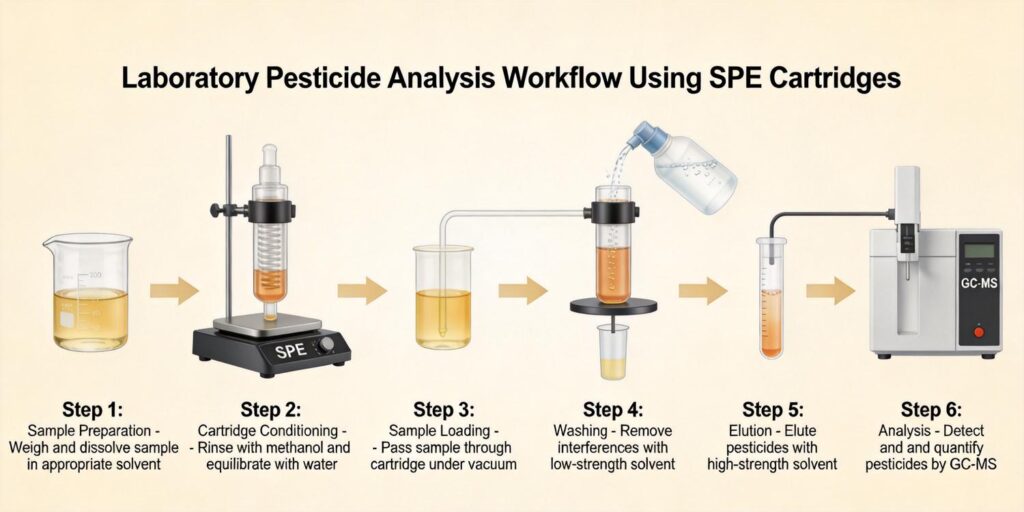
Example Extraction and SPE Cleanup Workflow
A robust SPE workflow for hormone residue analysis in meat samples typically follows these optimized steps:
- Sample Preparation: Homogenize 5g of meat tissue with 20mL of methanol:water (80:20) containing 0.1% formic acid. Centrifuge at 4000×g for 10 minutes and collect the supernatant.
- SPE Cartridge Conditioning: Condition a 200mg mixed-mode C8/SCX cartridge (such as Poseidon Scientific’s MAX series) with 3mL methanol followed by 3mL deionized water.
- Sample Loading: Dilute the supernatant 1:1 with phosphate buffer (pH 6.0) and load onto the conditioned cartridge at a flow rate of 1-2 mL/min.
- Washing: Wash with 3mL of deionized water followed by 3mL of methanol:water (20:80) to remove polar interferences.
- Drying: Apply vacuum for 5 minutes to remove residual water from the sorbent bed.
- Elution: Elute steroid hormones with 3mL of methanol containing 2% ammonium hydroxide. Collect eluate in a clean tube.
- Concentration: Evaporate eluate to dryness under gentle nitrogen stream at 40°C and reconstitute in 200μL of mobile phase for LC-MS/MS analysis.
This workflow effectively removes lipids, proteins, and other matrix interferences while maintaining high recovery rates for target hormones. The mixed-mode sorbent provides both hydrophobic retention for neutral steroids and cation-exchange interaction for basic compounds, ensuring comprehensive extraction.
LC-MS/MS Quantification of Hormones
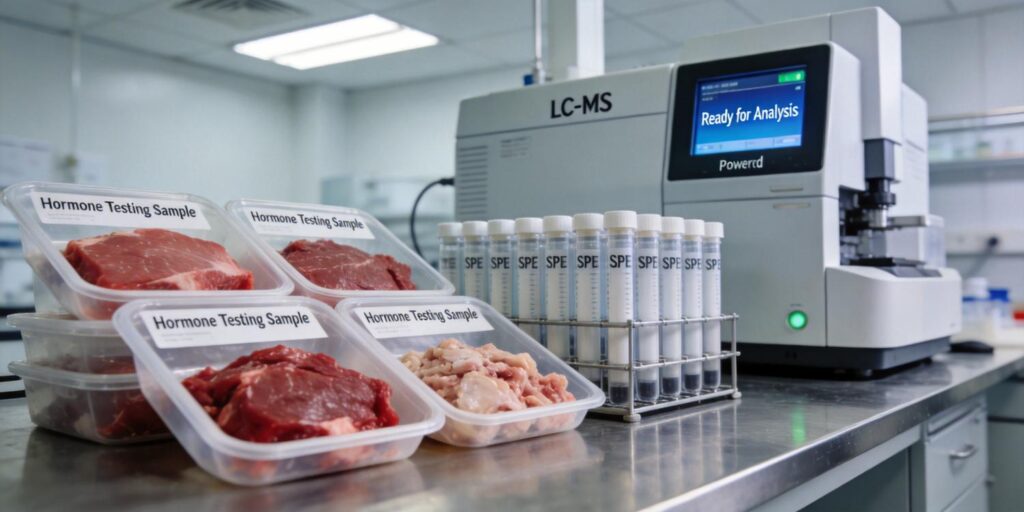
Liquid chromatography coupled with tandem mass spectrometry (LC-MS/MS) has become the gold standard for hormone residue quantification due to its exceptional sensitivity, specificity, and ability to analyze multiple compounds simultaneously. Modern triple quadrupole instruments operating in multiple reaction monitoring (MRM) mode can achieve detection limits in the low ng/g range, well below regulatory requirements.
The transition to LC-MS/MS from traditional GC-MS methods has been driven by several factors. As noted in analytical literature, “the LC interface allows the introduction of aqueous samples into the mass spectrometer and may reduce the need for derivatization of some compounds.” This is particularly advantageous for polar hormone metabolites that require extensive derivatization for GC analysis.
Typical LC conditions for hormone analysis include:
- Column: C18 or phenyl-hexyl stationary phase (100 × 2.1 mm, 1.7-2.6 μm particle size)
- Mobile Phase: Gradient elution with water and methanol/acetonitrile containing 0.1% formic acid
- Flow Rate: 0.3-0.4 mL/min
- Injection Volume: 5-10 μL
- Mass Spectrometer: Electrospray ionization in positive or negative mode with optimized collision energies for each analyte
Method validation should include assessment of linearity (typically 1-200 ng/g), precision (RSD < 15%), accuracy (85-115% recovery), and matrix effects. The use of stable isotope-labeled internal standards for each analyte class compensates for potential matrix suppression or enhancement effects.
Recovery Validation Strategies
Comprehensive recovery validation is essential for demonstrating method reliability and regulatory compliance. The following strategies ensure accurate quantification of hormone residues in meat samples:
Spike-and-Recovery Experiments
Prepare matrix-matched calibration standards by spiking hormone-free meat tissue with known concentrations of target analytes. Process these samples through the entire analytical workflow alongside unspiked controls. Calculate recovery percentages by comparing measured concentrations to expected values. Acceptable recovery ranges typically fall between 70-120% with relative standard deviations below 15%.
Internal Standard Correction
Incorporate stable isotope-labeled analogs of target hormones as internal standards added at the beginning of sample preparation. These compounds experience similar extraction efficiencies and matrix effects as native analytes, allowing for correction of recovery variations. As demonstrated in veterinary applications, this approach provides “high recoveries of analytes from plasma, urine, whole blood, and tissues” with minimal matrix interference.
Method Comparison Studies
Validate new SPE methods against established reference methods or participate in proficiency testing programs. Comparative studies should include analysis of certified reference materials and incurred samples containing naturally incurred residues. Document any observed differences in recovery patterns between spiked and incurred samples, as these may indicate issues with analyte accessibility in the tissue matrix.
Robustness Testing
Evaluate method performance under varying conditions including different sample batches, analyst experience levels, and minor modifications to extraction parameters. This testing should demonstrate that “SPE recoveries should exceed 90% absolute recovery” as noted in forensic applications, and that the method remains reliable across expected operational variations.
Long-Term Performance Monitoring
Implement quality control samples at multiple concentration levels in each analytical batch. Track recovery trends over time to identify potential degradation of SPE sorbent performance or changes in matrix composition. Regular maintenance of LC-MS/MS instrumentation and periodic re-validation ensure continued method reliability.
By implementing these validation strategies, laboratories can confidently report hormone residue data that meets regulatory requirements and withstands scientific scrutiny. The combination of optimized SPE cleanup with sensitive LC-MS/MS detection provides a robust framework for ensuring meat product safety in global markets.