Role of SPE in Pharmacokinetics
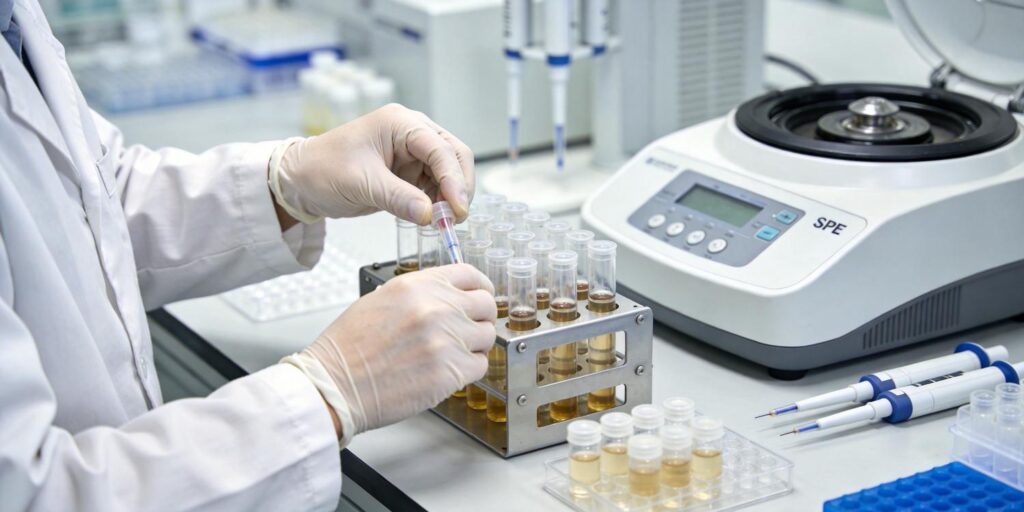
Solid Phase Extraction (SPE) has become an indispensable tool in modern pharmacokinetic studies, particularly in drug metabolism research. As noted in the literature, “Solid-phase extraction is widely used for the preparation of biological samples for further analysis in areas as diverse as clinical chemistry, forensic science, and biomedical and pharmaceutical research” (Ingwersen, 2000). The technique’s popularity stems from its ability to achieve high selectivities and recoveries while minimizing hazardous solvent consumption.
Critical Functions in Pharmacokinetic Analysis
SPE serves multiple critical functions in pharmacokinetic studies:
1. Sample Concentration and Clean-up
Modern drug candidates are often very potent substances administered at relatively low doses in preclinical and clinical studies. As Ingwersen (2000) emphasizes, “Assay sensitivity is a major goal of pharmacokinetic studies; sensitivity must be high enough to allow estimation of the terminal plasma half-life in vivo.” SPE enables the concentration of analytes from large sample volumes while simultaneously removing interfering matrix components.
2. Prevention of Analytical Column Clogging
Biological matrices contain proteins, lipids, and other macromolecules that can damage or clog analytical columns. SPE effectively removes these components, extending column life and maintaining analytical performance.
3. Elimination of Protein Binding
Many drugs and metabolites exhibit significant protein binding in biological samples. SPE disrupts these interactions, ensuring accurate quantification of free drug concentrations—a critical parameter in pharmacokinetic modeling.
4. Matrix Simplification
Complex biological matrices like plasma, urine, and tissue homogenates contain numerous endogenous compounds that can interfere with analytical measurements. SPE selectively isolates target analytes, providing cleaner extracts for subsequent analysis by HPLC, GC-MS, or LC-MS/MS.
Advantages Over Traditional Methods
Compared to traditional liquid-liquid extraction, SPE offers several advantages for pharmacokinetic studies:
- Improved throughput: Parallel processing capabilities versus serial processing in liquid-liquid extraction
- Decreased organic solvent usage: Reduced waste generation and environmental impact
- Higher and more reproducible recoveries: Typically 80-95% recovery rates with excellent precision
- Cleaner extracts: Reduced contamination from solvent impurities
- No emulsion formation: Eliminates a common problem in liquid-liquid extraction
- Tunable selectivity: Multiple SPE phase choices and solvent combinations
- Ready automation: Compatible with modern laboratory automation systems
Sample Preparation for Metabolites
The analysis of drug metabolites presents unique challenges in sample preparation, particularly due to their often polar nature and structural diversity. As Wilson and Nicholson (1987) demonstrated, “Solid phase extraction chromatography and nuclear magnetic resonance spectrometry for the identification and isolation of drug metabolites” represents a powerful combination for metabolite studies.
Metabolite Characteristics and SPE Considerations
Drug metabolites typically exhibit:
- Increased polarity: Phase I metabolites (hydroxylated, dealkylated) are more polar than parent drugs
- Ionic character: Phase II conjugates (glucuronides, sulfates) are ionic at physiological pH
- Structural diversity: Multiple metabolic pathways can produce numerous metabolites
- Lower concentrations: Metabolites often circulate at lower concentrations than parent drugs
SPE Sorbent Selection for Metabolites
Mixed-Mode Sorbents
Copolymeric sorbents combining reversed-phase and ion-exchange functionalities are particularly effective for metabolite extraction. As described in forensic applications, “The versatility of SPE can be best exhibited by its usage in the separation of a wide variety of drugs using a combination of separation strategies” (Telepchak et al., 2000). These sorbents, such as CLEAN SCREEN DAU or Bond Elut Certify, combine C8 reversed-phase functionality with benzene sulfonic acid cation exchange, enabling simultaneous extraction of parent drugs and their metabolites.
Specialized Sorbents for Specific Metabolites
| Metabolite Type | Recommended SPE Sorbent | Key Features |
|---|---|---|
| Glucuronide Conjugates | WAX (Weak Anion Exchange) | Selective retention of acidic metabolites at appropriate pH |
| Sulfate Conjugates | MAX (Mixed Anion Exchange) | Strong anion exchange for sulfate retention |
| Basic Metabolites | MCX (Mixed Cation Exchange) | Cation exchange for amine-containing metabolites |
| Hydrophobic Metabolites | HLB (Hydrophilic-Lipophilic Balance) | Retains both polar and non-polar metabolites |
| Zwitterionic Metabolites | WCX (Weak Cation Exchange) | Selective for compounds with both acidic and basic groups |
pH Optimization for Metabolite Extraction
Proper pH control is critical for successful metabolite extraction. The pKa values of both parent drugs and metabolites must be considered:
- Acidic metabolites: Extract at pH 2-3 below their pKa to ensure protonation and retention on anion exchange sorbents
- Basic metabolites: Extract at pH 2-3 above their pKa to ensure deprotonation and retention on cation exchange sorbents
- Neutral metabolites: Use reversed-phase sorbents with appropriate organic modifiers
Case Study: Gabapentin Metabolite Analysis
Wolf et al. (1996) demonstrated the successful application of SPE for gabapentin analysis in serum. Their method utilized solid-phase extraction followed by gas-liquid chromatography, highlighting how SPE can be optimized for specific metabolite profiles. The derivatization of gabapentin with MTBSTFA and 1% BDMCS improved peak shape and increased molecular weights, enhancing chromatographic separation.
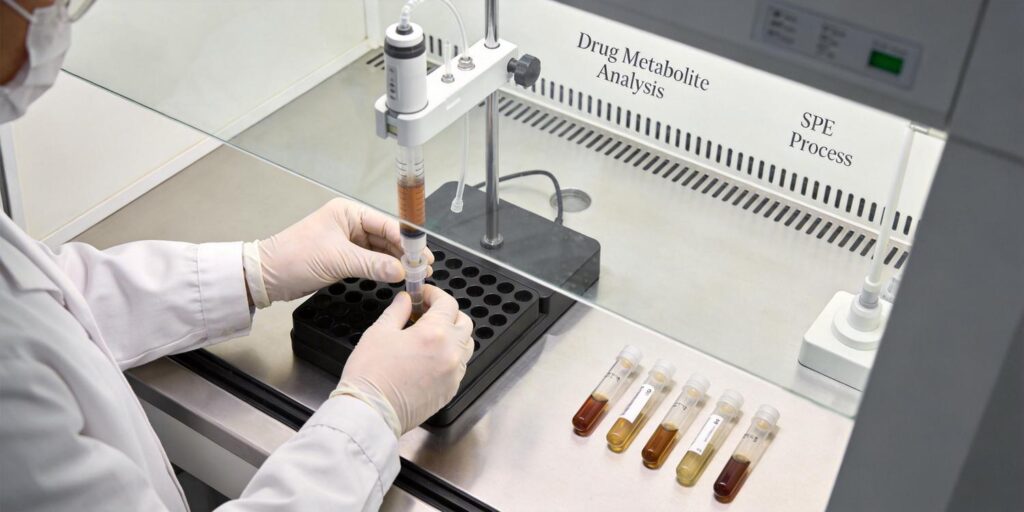
SPE Workflow for Drug Metabolism Studies
Standard SPE Procedure for Biological Samples
The fundamental SPE workflow consists of five key steps, as outlined in numerous applications:
1. Cartridge Conditioning
Proper conditioning prepares the sorbent for optimal analyte retention. Typical conditioning involves:
- 3-5 mL methanol (or appropriate organic solvent)
- 3-5 mL water or buffer (pH-adjusted to match sample conditions)
- Maintenance of sorbent wetness until sample application
2. Sample Application
Sample preparation before SPE is critical:
- Plasma/Serum: Often requires protein precipitation or dilution with buffer
- Urine: May require pH adjustment and filtration
- Tissue homogenates: Require homogenization and centrifugation
- Flow rate control: 1-3 mL/min for optimal recovery
3. Washing Steps
Washing removes weakly retained matrix components while retaining analytes:
- Water or dilute buffer: Removes salts and polar interferences
- Water-methanol mixtures: Removes moderately polar compounds
- pH-adjusted washes: Selective removal of specific interference classes
4. Drying
Cartridge drying (5-10 minutes under vacuum) removes residual water that could interfere with elution solvent miscibility.
5. Elution
Selective elution recovers analytes in minimal solvent volume:
- Organic solvents: Methanol, acetonitrile, ethyl acetate
- pH-adjusted eluents: For ion-exchange mechanisms
- Solvent mixtures: Often provide better elution efficiency
- Volume optimization: Typically 1-3 mL for complete elution
Automated SPE Systems
Modern pharmacokinetic laboratories increasingly utilize automated SPE systems for high-throughput analysis. As noted in the literature, “The method lends itself to automation, which can increase the throughput and substantially reduce the amount of manual labor” (de Zeeuw and Franke, 2000). Automated systems offer:
- Improved reproducibility: Reduced operator variability
- Higher throughput: Parallel processing of multiple samples
- Reduced labor costs: Automation of repetitive tasks
- Integration with analytical systems: Direct injection capabilities
96-Well Plate Format
The 96-well SPE plate format has revolutionized high-throughput pharmacokinetic studies. This format enables:
- Simultaneous processing of up to 96 samples
- Compatibility with automated liquid handlers
- Reduced solvent consumption per sample
- Direct compatibility with 96-well autosamplers
Method Development Strategy
Effective SPE method development for drug metabolism studies follows a systematic approach:
- Analyte characterization: Determine pKa, polarity, functional groups, and solubility
- Matrix characterization: Identify potential interferences and matrix effects
- Sorbent screening: Test multiple sorbent chemistries (reversed-phase, ion-exchange, mixed-mode)
- pH optimization: Systematically vary sample and wash pH
- Solvent optimization: Test different wash and elution solvents
- Validation: Establish recovery, precision, and selectivity
Quality Control Considerations
For regulatory-compliant pharmacokinetic studies, SPE methods must include:
- Internal standards: Stable isotope-labeled analogs of target analytes
- Process controls: Spiked samples at multiple concentration levels
- Blank samples: To monitor for contamination
- Carryover assessment: Between high and low concentration samples
- Stability evaluation: Of processed samples under storage conditions
Future Directions in SPE for Drug Metabolism Studies
The future of SPE in drug metabolism research looks promising, with several emerging trends:
Miniaturization
As Simpson (2000) noted, “Further attempts to speed up and/or miniaturize the extraction process have recently led to the introduction of SPE discs or micro-columns with extraction path lengths in the order of 0.5-2 mm.” Miniaturized SPE formats offer reduced sample requirements—critical for pediatric or small animal studies.
New Sorbent Technologies
Advanced sorbent materials continue to emerge, including:
- Molecularly imprinted polymers: Highly selective for specific analyte classes
- Restricted access materials: Exclude macromolecules while retaining small molecules
- Monolithic sorbents: Improved flow characteristics and capacity
- Nanomaterial-based sorbents: Enhanced surface area and selectivity
Integration with Analytical Systems
On-line SPE systems directly coupled to analytical instruments offer:
- Reduced sample handling: Minimizes analyte loss and degradation
- Improved sensitivity: Quantitative transfer of extracted analytes
- Automated operation: From sample preparation to data acquisition
High-Throughput Screening
SPE continues to evolve to meet the demands of high-throughput pharmacokinetic screening in drug discovery, with emphasis on:
- Rapid method development: For new chemical entities
- Metabolite profiling: Simultaneous analysis of multiple metabolites
- Metabolite identification: Coupled with high-resolution mass spectrometry
Conclusion
Solid Phase Extraction remains a cornerstone technology in drug metabolism and pharmacokinetic studies. Its versatility, selectivity, and compatibility with modern analytical platforms make it indispensable for the isolation and concentration of drugs and their metabolites from complex biological matrices. As drug development continues to focus on more potent compounds with complex metabolic profiles, SPE will undoubtedly continue to evolve, offering improved selectivity, sensitivity, and throughput for pharmacokinetic research.
The successful application of SPE in drug metabolism studies requires careful consideration of analyte properties, matrix characteristics, and analytical requirements. By selecting appropriate sorbent chemistries, optimizing extraction conditions, and implementing quality control measures, researchers can obtain reliable, reproducible data critical for understanding drug disposition, metabolism, and elimination—fundamental aspects of modern pharmacokinetic science.