1. Matrix Effect Overview in LC-MS Analysis
Matrix effects represent one of the most significant challenges in liquid chromatography-mass spectrometry (LC-MS) analysis, particularly when dealing with complex biological and environmental samples. These effects occur when co-eluting compounds from the sample matrix interfere with the ionization process of target analytes, leading to either suppression or enhancement of signal intensity. As noted in forensic applications, “Biological samples are notoriously dirty; injecting them with minimum cleanup onto very sensitive and expensive instruments makes very little sense.”
The matrix effect phenomenon is particularly problematic in atmospheric pressure ionization (API) techniques like electrospray ionization (ESI), where co-extracted endogenous interferences from biofluids can cause significant ionization suppression. This can result in false negatives, inaccurate quantification, and poor method reproducibility. The presence of matrix components can also lead to instrument fouling, with electrospray, thermospray, or particle beam instruments all being susceptible to overloading or clogging of the MS chamber outlet.
Common matrix components that contribute to these effects include:
- Proteins and phospholipids in biological samples
- Humic substances in environmental water samples
- Inorganic salts and buffers
- Endogenous metabolites and lipids
- Sample preparation reagents and solvents
As research demonstrates, “SPE has been shown to significantly increase gas (GC) and liquid chromatography (LC) column life while reducing the downtime on equipment like gas chromatography and liquid chromatography mass spectrometers (GCMS and LCMS) for source cleaning.” This underscores the critical role of proper sample preparation in mitigating matrix effects.
2. Ion Suppression Mechanisms and Their Impact
2.1 Physical and Chemical Mechanisms
Ion suppression occurs through several distinct mechanisms during the ionization process in LC-MS systems. The primary mechanisms include:
Competition for Charge
Matrix components compete with target analytes for available charges during the electrospray ionization process. When high concentrations of easily ionizable compounds are present, they can monopolize the available charge, reducing the ionization efficiency of target analytes. This is particularly problematic in biological matrices where numerous endogenous compounds are present at high concentrations.
Surface Activity Effects
Compounds with high surface activity can preferentially occupy the droplet surface during electrospray, preventing target analytes from reaching optimal positions for ionization. Phospholipids and surfactants are notorious for this effect, as they can form micelles or accumulate at droplet interfaces, effectively shielding target analytes from the ionization process.
Gas-Phase Reactions
Even after ionization, matrix components can participate in gas-phase reactions that neutralize target analyte ions. Proton transfer reactions between matrix components and analyte ions can lead to signal suppression, particularly when matrix compounds have higher proton affinities than the target analytes.
2.2 Consequences of Ion Suppression
The impact of ion suppression extends beyond simple signal reduction. Key consequences include:
- Reduced Sensitivity: Lower signal intensity decreases method sensitivity and increases limits of detection
- Poor Quantification Accuracy: Variable suppression leads to inaccurate concentration measurements
- Method Reproducibility Issues: Matrix variability between samples causes inconsistent suppression
- Increased Method Development Time: Extensive optimization required to overcome suppression effects
- Instrument Maintenance Issues: Matrix buildup requires more frequent source cleaning and maintenance
As documented in SPE literature, “The new goals are to strip out inorganic compounds that may affect the ion sources that induce ionization/fragmentation and eliminate large molecules that may foul up the interfaces between the sample introduction port and the mass spectrometer.”
3. SPE Cleanup Strategies for Matrix Effect Prevention
3.1 Selective SPE Phase Selection
The foundation of effective matrix effect prevention lies in selecting the appropriate SPE phase for your specific application. Different SPE chemistries offer varying degrees of selectivity and cleanup efficiency:
Reversed-Phase SPE (HLB, C18, C8)
Hydrophilic-lipophilic balanced (HLB) phases and traditional reversed-phase sorbents are excellent for removing non-polar interferences. HLB phases, in particular, offer “high capacity for extremely polar compounds” and are “compatible with solvents pH 0-14,” making them versatile for diverse applications. These phases work by retaining analytes through hydrophobic interactions while allowing polar matrix components to pass through during the wash steps.
Mixed-Mode SPE (MCX, MAX, WCX, WAX)
Mixed-mode sorbents combine reversed-phase and ion-exchange mechanisms, providing superior selectivity for charged analytes. As noted in Waters documentation, mixed-mode SPE offers the “cleanest extracts” and “best reduction of matrix effects” through dual retention mechanisms. The Oasis 2×4 strategy demonstrates how only two protocols and four sorbents can analyze all types of compounds: acids, bases, and neutrals.
Ion-Exchange SPE
For specifically charged analytes, ion-exchange SPE provides exceptional selectivity. As described in forensic applications, “Ionic bonds are strong enough to allow the analyte to remain bound while interferences are washed away with high percentages (up to 100%) of polar or nonpolar organic solvents.”
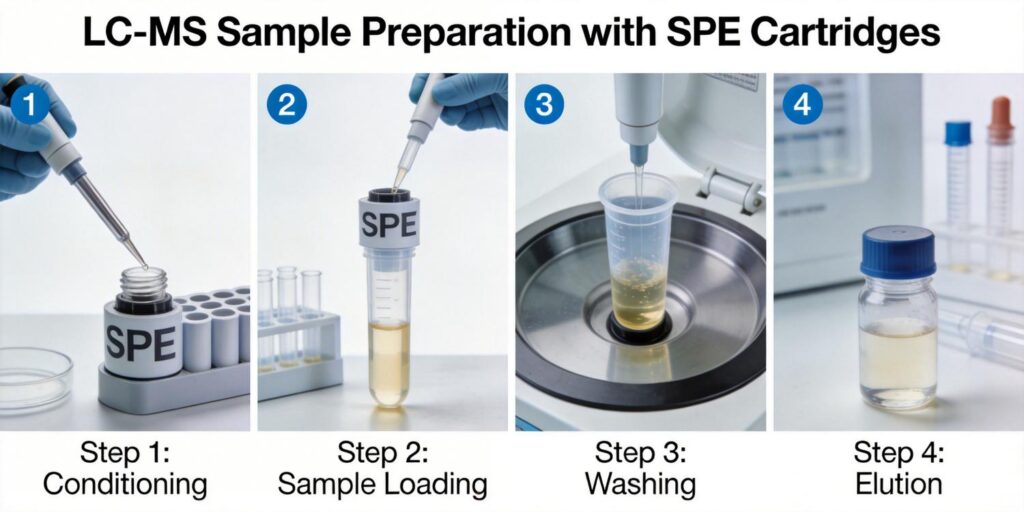
3.2 Optimized SPE Protocol Development
Effective SPE cleanup requires careful optimization of each step in the extraction process:
Conditioning and Equilibration
Proper conditioning prepares the sorbent for optimal analyte retention. As troubleshooting guides note, “Column pH conditions are usually driven by the desired ionization state of target analytes. Un-ionized compounds favor retention in reversed phase systems. In most cases, the pH of the sample and that of the sorbent should be equivalent for optimal binding.”
Sample Loading Optimization
Flow rate control during sample loading is critical. Research indicates that “breakthrough is the ineffective retention of target analytes on the solid phase sorbent, resulting in low analyte recovery. During sample application the most common cause of breakthrough is flow rates that exceed the sorbent affinity for binding of target compounds.”
Selective Wash Steps
Strategic wash steps remove matrix interferences while retaining target analytes. For mixed-mode extractions, “use washes of high organic strength to remove interferences retained by hydrophobic interactions. If your analyte is also capable of hydrophobic binding, remove polar interferences ionically similar to your analyte by using aqueous or weak aqueous/organic washes.”
Efficient Elution
Elution conditions must balance complete analyte recovery with minimal co-elution of interferences. For ion-exchange SPE, “elute with aqueous buffers containing a stronger counter-ion than your analyte or by changing pH to disrupt the ionic attraction. Make sure the elution solvent has enough organic character to overcome any adsorption due to the packing material.”
3.3 Advanced SPE Strategies for Complex Matrices
Sequential SPE Cleanup
For particularly challenging matrices, sequential SPE using different chemistries can provide enhanced cleanup. This approach allows removal of different classes of interferences in separate steps, significantly reducing matrix effects.
96-Well Plate Formats for High Throughput
As demonstrated in pharmaceutical applications, “High throughput liquid chromatography/mass spectrometry bioanalysis using the 96-well disk solid phase extraction plate for sample preparation” enables efficient processing of large sample batches while maintaining consistent cleanup quality.
Automated SPE Systems
Automation improves reproducibility and throughput while reducing human error. Automated systems ensure consistent flow rates, timing, and solvent volumes, all critical factors in achieving reproducible matrix effect reduction.
3.4 Method Validation and Quality Control
To ensure effective matrix effect mitigation, incorporate these validation practices:
- Matrix Effect Assessment: Use post-column infusion or post-extraction addition to quantify matrix effects
- Recovery Studies: Validate that SPE recoveries exceed 90% for reliable quantification
- Process Efficiency Evaluation: Assess combined effects of recovery and matrix suppression
- Internal Standard Selection: Use stable isotope-labeled internal standards that co-elute with analytes
- Cross-Validation: Compare SPE cleanup efficiency across different sample batches and matrices
3.5 Practical Considerations for Implementation
When implementing SPE cleanup for matrix effect prevention, consider these practical aspects:
Sorbent Capacity Matching
Ensure sorbent capacity matches expected analyte and matrix loads. Overloading can lead to breakthrough and reduced cleanup efficiency. As method development guides suggest, “For a given sample matrix there is an optimum sorbent that will give excellent retention and excellent elution for one specific analyte.”
Solvent Compatibility
Consider final elution solvent compatibility with LC-MS systems. SPE offers the advantage that “solvents that are miscible with the sample matrix may be used to elute the analytes,” facilitating direct injection of extracts into reversed-phase HPLC systems.
Cost-Benefit Analysis
Balance cleanup efficiency with practical considerations like throughput, cost, and ease of implementation. As noted in comparative studies, “SPE can be automated quite easily with a variety of currently available equipment,” offering advantages over traditional liquid-liquid extraction.
Conclusion
Effective prevention of matrix effects in LC-MS analysis requires a comprehensive understanding of both the mechanisms causing ion suppression and the strategies available for mitigation through SPE cleanup. By selecting appropriate SPE phases, optimizing extraction protocols, and implementing rigorous validation practices, laboratories can significantly reduce matrix effects, improve data quality, and extend instrument lifetime.
The evolution of SPE technology, particularly the development of mixed-mode sorbents and high-throughput formats, has provided analytical chemists with powerful tools for matrix effect management. As research continues to demonstrate, “SPE-LC/MS has been successfully demonstrated in many papers” for achieving clean extracts and reliable quantification in complex matrices.
For laboratories seeking to optimize their LC-MS methods, investing in proper SPE cleanup strategies represents one of the most effective approaches to overcoming matrix effect challenges and ensuring accurate, reproducible results across diverse sample types.