
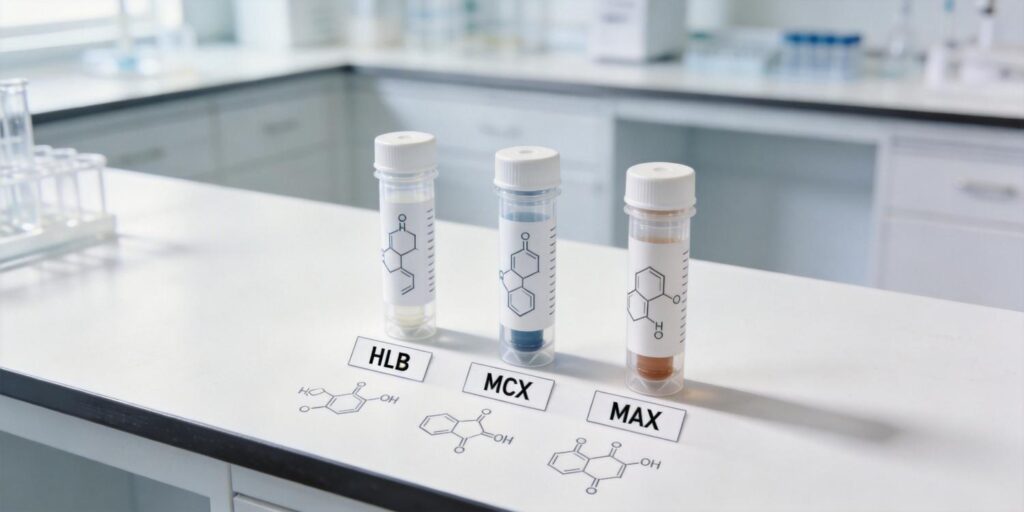
Overview of Mixed-Mode and Reversed-Phase SPE Sorbents
Solid-phase extraction (SPE) has revolutionized sample preparation by enabling scientists to reduce chromatographic complexity, increase signal-to-noise ratios, improve detection limits, minimize matrix effects, concentrate analytes of interest, and enhance analytical robustness. The introduction of Oasis HLB in 1996 fundamentally changed how scientists perform SPE, establishing new possibilities for method development.
SPE sorbents can be broadly categorized into two main types: reversed-phase and mixed-mode. Reversed-phase sorbents like Oasis HLB rely primarily on hydrophobic interactions between the analyte and the sorbent surface. These are versatile, water-wettable polymeric sorbents that provide high capacity for a wide range of compounds including acids, bases, and neutrals.
Mixed-mode sorbents, represented by Oasis MCX and MAX, incorporate both reversed-phase and ion-exchange functionality. This dual retention mechanism provides orthogonal selectivity and improved sample cleanup. Mixed-mode sorbents are particularly valuable when higher analyte specificity, sensitivity, and cleanliness are required.
The Oasis family employs a unique water-wettable copolymer technology that eliminates the conditioning and equilibration steps traditionally required by silica-based and other polymeric sorbents. This innovation allows direct loading of aqueous samples without sacrificing recovery, reducing solvent consumption by up to 70% and saving 40% in sample preparation time.
Chemistry Differences Between HLB, MCX, and MAX
Oasis HLB: Hydrophilic-Lipophilic Balanced Sorbent
Oasis HLB serves as the backbone of all Oasis sorbents. It’s a multi-purpose reversed-phase sorbent constructed with a water-wettable copolymer stable from pH 0-14. The “hydrophilic-lipophilic balanced” designation refers to its unique ability to retain both polar and non-polar compounds through a balanced combination of hydrophilic and lipophilic retention mechanisms.
Key characteristics of HLB include:
- No silanol interactions to complicate retention modes
- High capacity for extremely polar compounds
- Compatibility with solvents across the entire pH range
- Direct aqueous sample loading without conditioning
Oasis MCX: Mixed-Mode Cation Exchange Sorbent
Oasis MCX is specifically designed for basic compounds with pKa values between 2-10. This sorbent features a tightly controlled ion-exchange capacity of 1 meq/g, combining strong cation exchange functionality with reversed-phase retention.
The retention mechanism involves:
- Cation exchange through sulfonic acid groups (SO₃⁻)
- Hydrophobic interactions with the polymeric backbone
- No interfering silanol groups
For basic drugs like propranolol, MCX provides selective retention through ionic interactions with the protonated amine groups, while also offering hydrophobic retention for the non-polar portions of the molecule.
Oasis MAX: Mixed-Mode Anion Exchange Sorbent
Oasis MAX targets acidic compounds with pKa values between 2-8. With a controlled ion-exchange capacity of 0.25 meq/g, this sorbent combines anion exchange functionality with reversed-phase retention.
The retention mechanism includes:
- Anion exchange through quaternary ammonium groups
- Hydrophobic interactions with the polymer matrix
- Absence of complicating silanol interactions
For acidic compounds like suprofen, MAX provides selective retention through ionic interactions with the deprotonated carboxyl groups, complemented by hydrophobic retention of the aromatic ring system.
Role of Ionization and pKa in Sorbent Selection
The ionization state of analytes plays a critical role in SPE sorbent selection and method optimization. Understanding pKa values—the pH at which a compound is 50% ionized—is essential for predicting retention behavior and designing effective extraction protocols.
Fundamental Principles
For reversed-phase separations, analytes should be in their non-ionized (molecular) form to maximize hydrophobic retention. For ion-exchange separations, analytes must be in their ionized form to interact with the charged functional groups on the sorbent surface.
The general rules for ionization control are:
- Acidic compounds: Negatively charged above their pKa
- Basic compounds: Positively charged below their pKa
- For approximately 100% ionization, maintain pH at least 2 units above pKa for acids or 2 units below pKa for bases
Application to Specific Sorbents
Oasis HLB: Works best when analytes are non-ionized. For mixed analytes, pH adjustment may be necessary to ensure optimal retention of all compounds.
Oasis MCX: Requires basic compounds to be protonated (positively charged). Sample pH should be at least 2 units below the pKa of the basic analytes to ensure complete protonation and effective cation exchange.
Oasis MAX: Requires acidic compounds to be deprotonated (negatively charged). Sample pH should be at least 2 units above the pKa of the acidic analytes to ensure complete deprotonation and effective anion exchange.
Sample Matrix Considerations
The complexity of the sample matrix significantly influences sorbent selection and method development. Different matrices present unique challenges that must be addressed through appropriate SPE strategy.
Biological Matrices (Plasma, Serum, Urine)
Biological samples contain proteins, phospholipids, salts, and endogenous compounds that can interfere with analysis. For these matrices:
- Oasis PRiME HLB: Excellent for routine bioanalytical cleanup, removing >95% of common matrix interferences including phospholipids, fats, salts, and proteins
- Oasis MCX: Ideal for basic drug analysis in plasma and urine, providing superior cleanup of phospholipids that cause matrix effects and ion suppression
- Oasis MAX: Effective for acidic drug metabolites in biological fluids, offering selective retention and cleanup
Environmental Matrices (Water, Soil Extracts)
Environmental samples often contain humic acids, inorganic salts, and other complex interferences:
- Oasis HLB: Broad-spectrum retention for environmental contaminants of varying polarity
- Mixed-mode sorbents: Provide additional selectivity when analyzing ionizable environmental contaminants
Food and Agricultural Matrices
Food samples contain fats, pigments, carbohydrates, and other complex matrices:
- Oasis PRiME HLB</strong: Effective for multi-residue veterinary drug screening in meats
- Mixed-mode sorbents: Provide selective cleanup for specific analyte classes in complex food matrices
Example Workflows for Drug Analysis
Workflow 1: Basic Drug Analysis Using Oasis MCX
For basic drugs with pKa ≥ 4.5 (e.g., antidepressants, antipsychotics, beta-blockers):
- Sample Pretreatment: Dilute plasma/serum with 4% H₃PO₄ in water (1:1 v/v) or with 200 mM ammonium formate containing 4% H₃PO₄
- Load: Apply pretreated sample to Oasis MCX cartridge
- Wash 1: 100% methanol
- Wash 2: 2% formic acid in 100 mM ammonium formate aqueous solution
- Elute: 5% ammoniated methanol
This protocol removes >99% of phospholipids and provides excellent cleanup for LC-MS analysis.
Workflow 2: Acidic Drug Analysis Using Oasis MAX
For acidic drugs with pKa 2-8 (e.g., NSAIDs, acidic metabolites):
- Sample Pretreatment: Adjust urine/plasma to basic pH (≥2 units above analyte pKa)
- Load: Apply sample to Oasis MAX cartridge
- Wash: 5% ammonium hydroxide
- Elute 1: 100% methanol
- Elute 2: 2% formic acid in methanol
Workflow 3: Broad-Spectrum Analysis Using Oasis HLB
For screening applications or analysis of compounds with diverse properties:
- Load: Apply aqueous sample directly to Oasis HLB cartridge
- Wash: 5% methanol in water
- Elute: 90/10 acetonitrile/methanol or 100% methanol
Selection Decision Chart
Step 1: Analyze Your Requirements
Ask yourself:
- Do you need maximum specificity and cleanliness?
- Are you analyzing ionizable compounds?
- What is your sample matrix complexity?
- Is this for routine analysis or method development?
Step 2: Follow the Decision Tree
For Routine Analysis with General Cleanup:
→ Choose Oasis PRiME HLB for simplified protocols removing >95% of common matrix interferences
For Analysis of Specific Compound Classes:
If analyzing BASIC compounds (pKa 2-10):
→ Choose Oasis MCX for mixed-mode cation exchange/reversed-phase retention
If analyzing ACIDIC compounds (pKa 2-8):
→ Choose Oasis MAX for mixed-mode anion exchange/reversed-phase retention
If analyzing STRONG BASES (pKa >10):
→ Choose Oasis WCX for weak cation exchange applications
If analyzing STRONG ACIDS (pKa <1):
→ Choose Oasis WAX for weak anion exchange applications
For Broad-Spectrum or Unknown Analysis:
→ Start with Oasis HLB for its universal retention capabilities
→ Consider Oasis Sorbent Selection Kits for method development with all four mixed-mode sorbents
Step 3: Consider Matrix-Specific Factors
| Matrix | Primary Challenge | Recommended Sorbent | Key Benefit |
|---|---|---|---|
| Plasma/Serum | Phospholipids, proteins | Oasis PRiME HLB or Oasis MCX | Phospholipid removal >95% |
| Urine | Salts, metabolites | Oasis HLB or mixed-mode | Salt removal, metabolite enrichment |
| Tissue Homogenates | Lipids, proteins | Oasis PRiME HLB | Fat and protein removal |
| Environmental Water | Humic acids, inorganics | Oasis HLB | Broad contaminant retention |
Practical Implementation Tips
Method Development Strategy
The Oasis 2×4 strategy simplifies method development by using only 2 protocols and 4 sorbents to analyze all types of compounds (acids, bases, and neutrals). This systematic approach reduces development time while ensuring optimal results.
Format Selection
Consider your throughput requirements when selecting formats:
- Cartridges: 1 cc to 35 cc sizes for manual processing
- 96-well plates: For high-throughput automation
- μElution plates: For limited sample volumes (10-375 μL) with minimal elution volume (25 μL)
- On-line columns: For automated SPE-LC/MS systems
Quality Considerations
When evaluating SPE products, consider:
- Lot-to-lot reproducibility
- Absence of extractable contaminants
- Consistent flow characteristics
- Manufacturer’s quality control data
Conclusion
Choosing between HLB, MCX, and MAX SPE sorbents requires careful consideration of analyte properties, matrix complexity, and analytical requirements. Oasis HLB serves as an excellent starting point for broad-spectrum applications, while Oasis MCX and MAX provide enhanced selectivity for basic and acidic compounds respectively through their mixed-mode retention mechanisms.
The key to successful SPE method development lies in understanding the ionization behavior of your analytes (through their pKa values), the complexity of your sample matrix, and the specific cleanup requirements of your analytical method. By following the systematic approach outlined in this guide and leveraging the Oasis 2×4 strategy, analytical scientists can develop robust, efficient SPE methods that deliver the sensitivity, specificity, and reliability required for modern analytical challenges.
For method development with unknown analytes or complex mixtures, consider using Oasis Sorbent Selection Kits that include all four mixed-mode sorbents (MCX, MAX, WCX, WAX) to quickly identify the optimal sorbent for your specific application.


