Overview of SPE Method Development
Solid Phase Extraction (SPE) method development represents a systematic approach to isolating target analytes from complex matrices while removing interfering compounds. As a sample preparation technique with principles similar to HPLC, SPE has evolved significantly since its introduction, offering substantial advantages over traditional liquid-liquid extraction methods including improved throughput, decreased organic solvent usage, higher recoveries, and cleaner extracts.
The fundamental SPE process involves five key steps: conditioning, sample application, washing, drying, and elution. Each step requires careful optimization specific to the compounds and matrix being analyzed. According to established literature, there are three basic approaches to SPE method development: the intellectual approach (thinking through the problem logically), the shotgun approach (screening numerous phases and solvent combinations), and the educated approach—the recommended method that requires organizing your attempt at method development while reviewing objectives and preliminary information.
Successful SPE method development begins with clearly defining your objectives: Is it a single or multiple drug extraction? Are you doing low or high-level detection? Is it qualitative or quantitative analysis? Once objectives are established, you need to research previous SPE and analysis conditions for your analyte and matrix, characterize the analyte’s structure, pKa, polarity, functional groups, and solvent solubility/stability, and characterize the sample matrix including possible interferences, pH, ionic strength, and qualitative/quantitative variability.
Choosing Sorbent Chemistry
Selecting the appropriate sorbent chemistry represents one of the most critical decisions in SPE method development. The choice depends on the physicochemical properties of your analyte and the nature of the sample matrix. Modern SPE offers a variety of popular chemistries including reversed-phase, normal phase, and ion-exchange mechanisms.
Reversed-Phase Sorbents
Reversed-phase sorbents (C2, C8, C18, Phenyl, ENV PS-DVB) operate through hydrophobic bonding mechanisms, also called van der Waals forces or dispersion forces. These phases are ideal for non-polar to moderately polar compounds and typically work best when analytes are dissolved in polar solvents like water or aqueous buffers. The bond strength in reversed-phase SPE is relatively weak at 1–5 kcal/mol, with increasing strength as the number of hydrocarbon atoms increases.
Normal Phase Sorbents
Normal phase sorbents (Silica, -CN, Diol, Amino, Alumina, Florisil) retain polar compounds through polar-polar interactions. These are particularly useful for compounds that are too polar for reversed-phase extraction or when the sample matrix is non-polar. Normal phase extractions typically work best when analytes are dissolved in non-polar organic solvents.
Ion-Exchange Sorbents
Ion-exchange sorbents (Strong Cation Exchange/SCX, Strong Anion Exchange/SAX) operate through ionic interactions and are ideal for charged analytes. These sorbents require careful pH control to ensure both the analyte and sorbent remain charged. For SCX sorbents, the pH should be at least 2 units below the analyte’s pKa, while for SAX sorbents, the pH should be at least 2 units above the analyte’s pKa.
Copolymeric and Mixed-Mode Sorbents
Copolymeric phases, introduced in 1986, represent a significant advancement in SPE technology. These mixed-mode sorbents combine multiple retention mechanisms (typically reversed-phase and ion-exchange) in a single phase, offering enhanced selectivity for complex samples. They allow for more aggressive washing steps while maintaining analyte retention, resulting in cleaner extracts.
When selecting sorbent chemistry, consider the capacity of the packing material. Capacity is dependent on the alkyl chain configuration and total carbon loading on the silica substrate. For hydrophobic phases, analytes retain better out of polar solvents, whereas normal phase sorbents extract better out of nonpolar solvents.
Solvent Optimization
Solvent optimization in SPE involves careful selection of solvents for each step of the extraction process: conditioning, sample loading, washing, and elution. Each solvent choice significantly impacts recovery, selectivity, and extract cleanliness.
Conditioning Solvents
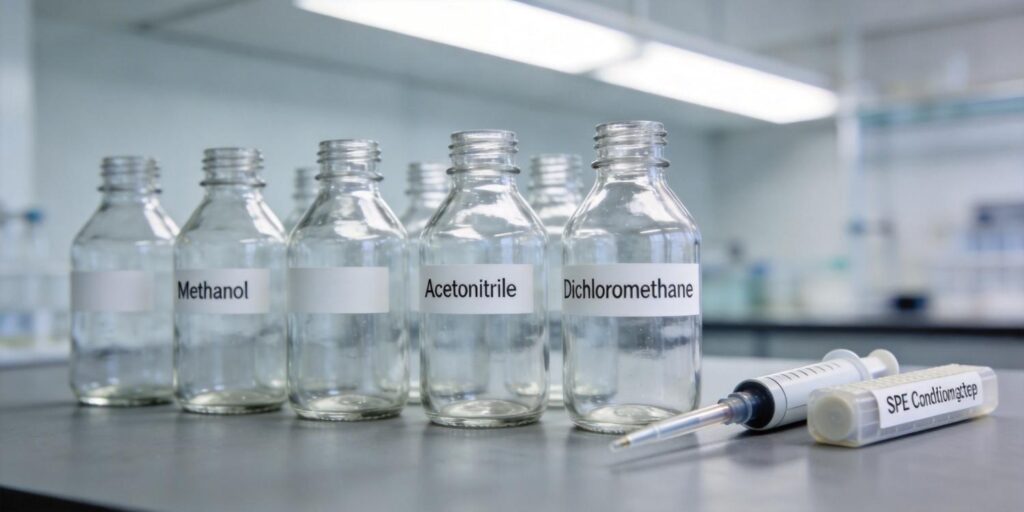
Conditioning prepares the sorbent for sample introduction by solvating the SPE column and normalizing the column environment to the sample. For reversed-phase SPE, typical conditioning involves methanol followed by water or aqueous buffer. For normal phase SPE, non-polar solvents like hexane or dichloromethane are used. Proper conditioning ensures consistent analyte retention and prevents channeling through the sorbent bed.
Sample Loading Solvents
The sample loading solvent should be compatible with both the sample matrix and the sorbent chemistry. For reversed-phase SPE, aqueous or predominantly aqueous solvents are preferred. The organic content should typically be less than 10% to ensure adequate analyte retention. For ion-exchange SPE, the pH and ionic strength must be controlled to maintain analyte and sorbent charge states.
Wash Solvents
Wash solvents remove interfering compounds while maintaining analyte retention. The ideal wash solvent is the strongest solvent that will not elute the target analytes. For reversed-phase SPE, water or aqueous buffers with low organic content (5-20%) effectively remove polar interferences. For ion-exchange SPE, organic solvents (up to 100%) can remove hydrophobic interferences while maintaining ionic retention.
Elution Solvents
Elution solvents must disrupt the binding mechanisms to release analytes in the smallest possible volume. For reversed-phase SPE, solvents with high eluotropic strength (methanol, acetonitrile, or mixtures with water) are effective. For ion-exchange SPE, changing pH or using buffers with competing ions disrupts ionic interactions. Mixed-mode sorbents often require solvents that simultaneously disrupt both hydrophobic and ionic interactions.
Solvent properties critical to SPE optimization include eluotropic value, viscosity, UV cut-off, and toxicity. The ratio of breakthrough volume to elution volume determines the concentration factor achieved during extraction.
Testing Retention and Recovery
Testing retention and recovery represents the experimental phase of SPE method development. This involves systematically evaluating different sorbents and solvent combinations to identify optimal conditions.
Initial Screening
Begin by testing neat standards on a variety of sorbents to determine which phases provide maximum analyte retention. This rapid screening approach provides insight into which retention mechanisms work best for your analytes. Evaluate recovery by comparing the amount of analyte eluted to the amount loaded.
Breakthrough Volume Determination
Breakthrough volume testing determines the maximum sample volume that can be loaded without analyte loss. This is particularly important for trace enrichment applications. The breakthrough volume depends on the analyte’s affinity for the sorbent and the sorbent’s capacity.
Wash Optimization
Systematically test different wash solvents to identify the strongest wash that does not elute the target analytes. Evaluate eluate cleanliness under conditions of maximum analyte retention. For complex samples, you may need multiple wash steps with solvents of increasing strength.
Elution Optimization
Test different elution solvents and volumes to achieve maximum recovery in the smallest possible volume. Consider solvent mixtures that provide optimal elution strength while maintaining compatibility with your analytical instrumentation.
Matrix Effects Evaluation
Test both blank and fortified matrix samples to assess eluate cleanliness and recovery using optimized wash and eluent solvents. The sample matrix can compete with analytes for sorbent binding sites, potentially reducing capacity due to competitive interactions. Solutions to matrix interference problems include increasing bed size, changing sorbent type, switching to different retention mechanisms, or using coupled columns.
Remember that recovery is a balance between sensitivity and selectivity. In an optimized method, recovery should be evaluated based on the optimal recovery needed to sustain the required signal-to-noise ratio, not on absolute percent recovery. If acceptable limits of detection are achieved with no interfering compounds at only 30% recovery, higher recovery may not be necessary and could actually increase interferences and noise.
Validation Considerations
SPE method validation ensures the developed procedure produces reliable, reproducible results suitable for its intended purpose. Comprehensive validation addresses multiple variables that can impact method performance.
Method Robustness
Validate the SPE procedure across different sorbent lots, cartridges from different manufacturers, and varying sorbent weights. Assess performance variances within a single sorbent type and between different manufacturers. Test different preconditioning protocols, loading solvents (varying % organic, pH, ionic strength, volume), wash solvents, and eluent volumes.
Flow Rate Optimization
Evaluate the impact of flow rates during loading, washing, and elution steps. Flow rates that are too slow add unnecessary time to the analysis and may facilitate entrapment of unwanted matrix components. Flows that are too fast can adversely affect recovery, especially when ion-exchange mechanisms are employed. Unlike HPLC, SPE flow characteristics are rather crude, with greater variation in particle size and packing density.
Linearity and Range
Test method performance across different analyte concentrations and matrix loadings. Establish the linear range of the extraction procedure and determine limits of detection and quantification. Consider how matrix effects change with different sample loadings.
Analyte and Matrix Stability
Evaluate analyte stability in loading solvents and eluents. Assess matrix stability in loading solvents, particularly for biological samples that may contain enzymes or other components that could degrade analytes. Consider the impact of buffer salts in final extracts, especially when evaporating extracts to dryness prior to reconstitution.
Extractables and Contamination
Test for extractables from SPE cartridges, including packing materials, frits, and tubes. Low extractable levels are particularly important for high-sensitivity work. Evaluate potential contamination problems, including carry-over from previous extractions due to adsorption of analytes or impurities onto manifold surfaces.
Automation Compatibility
If planning to automate the SPE procedure, validate performance on automated systems. Consider different elution methods (vacuum, gravity flow, positive pressure, centrifugation) and their impact on reproducibility. For vacuum-mediated elution, ensure continuous vacuum regulation to maintain constant flow through cartridges.
Quality Assurance
Implement quality assurance measures to ensure consistent results from batch-to-batch and year-to-year. This includes random testing of cartridges for surface characteristics and packing parameters, performance certificates in each box, and pre-washed packings, frits, and tubes for low extractables.
Successful SPE method development requires a systematic, educated approach that considers analyte properties, matrix characteristics, sorbent chemistry, solvent optimization, and comprehensive validation. By following these strategies, analysts can develop robust SPE methods that provide clean extracts, high recoveries, and reproducible results for a wide range of applications.