Purpose of Conditioning
Solid phase extraction (SPE) cartridge conditioning is the critical first step in any SPE protocol, serving multiple essential functions that directly impact extraction efficiency and reproducibility. When silica particles are bonded with hydrophobic phases like C18 or C8, they become “waterproof” and must be conditioned to interact effectively with aqueous samples. The primary purpose of conditioning is to prepare the sorbent surface for optimal analyte retention by wetting the hydrophobic bonded phases and activating functional groups.
Conditioning accomplishes several key objectives: it expands functional binding sites away from the solid surface, exposes them to diffusive flow of samples and reagents, and facilitates extension of functional carbon chains to create a receptive stationary phase on the silica or resin backbone. According to established SPE literature, methanol wets the surface of the sorbent and penetrates bonded alkyl phases, allowing water to wet the silica surface efficiently. This penetration into the bonded layer permits water molecules and analytes to diffuse into the bonded phase, creating the proper environment for hydrophobic interactions during sample loading.
Typical Solvents Used
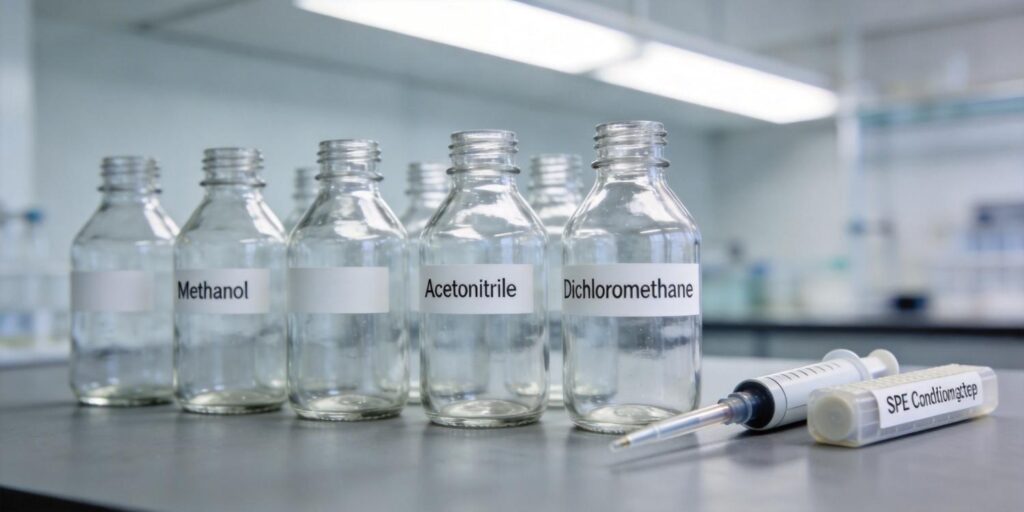
The selection of conditioning solvents depends on the SPE mechanism and the nature of the analytes and sample matrix. For reversed-phase applications, methanol is the most commonly used primary conditioning solvent due to its ideal properties: complete miscibility with aqueous matrices, low surface tension (0.6 cP at 20°C), efficient diffusion into sorbent pores, and high mass transfer with hydrocarbon bonds that expand alkyl chains.
Primary Conditioning Solvents
- Methanol: The universal choice for reversed-phase SPE, with viscosity of 0.6 cP at 20°C and surface tension of 22.6 mN/m
- Acetonitrile: Alternative for reversed-phase applications, with viscosity of 0.37 cP and eluotropic strength of 0.65
- Isopropanol: Effective for hydrocarbon-like C18 silica sorbents with surface tension (20.93 mN/m) closest to hexane (19.65 mN/m)
- Dichloromethane: Used for normal-phase applications with eluotropic strength of 0.42
Secondary Conditioning Solvents
Following the organic solvent, a water-miscible solvent or buffer is typically applied:
- Deionized water: Most common for removing excess organic solvent
- Buffer solutions: pH-adjusted buffers matching sample conditions (e.g., phosphate buffers at pH 6.0)
- Salt solutions: 0.1M solutions of sodium acetate, potassium phosphate, or ammonium acetate to block secondary interactions
Research demonstrates that solutions of salt ions applied in methanol are far more effective conditioning agents for eliminating or moderating secondary interactions than aqueous or aqueous/methanol solutions. The inclusion of cationic species during conditioning minimizes secondary interactions and allows the sorbent to function as a true reversed phase.
Conditioning Sequence Examples
Standard Reversed-Phase Conditioning
For typical C18 cartridges used in drug analysis:
- 3 mL methanol: Apply at 1-2 mL/min flow rate under light vacuum (2-3″ Hg)
- 3 mL deionized water: Apply immediately after methanol without letting the bed dry
- 2 mL buffer solution: Typically 0.1M phosphate buffer at pH 6.0
Mixed-Mode SPE Conditioning
For mixed-mode cartridges combining hydrophobic and ion-exchange mechanisms:
- 2 mL methanol: To wet the hydrophobic phase
- 2 mL phosphate buffer (0.1 mol/L, pH 6.0): Preferably potassium phosphate
- 1 mL additional buffer or water: Leave approximately 1-2 mm of solvent above sorbent bed
Normal-Phase Conditioning
For silica, diol, or alumina sorbents:
- 6 mL dichloromethane: For diol sorbents
- 1 mL n-hexane: To establish proper phase environment
Ion-Exchange Conditioning
For strong cation exchange (SCX) or strong anion exchange (SAX) cartridges:
- 6 mL methanol: Initial wetting
- 3 mL buffer solution: pH-adjusted buffer matching sample conditions (pH 4.5 for SCX, pH 8 for SAX)
Common Mistakes
1. Allowing the Sorbent to Dry
The most critical error in SPE conditioning is allowing the cartridge to dry between conditioning and sample application. When the sorbent bed dries, the carefully prepared hydrophobic environment collapses, and channels may form in the packing. The cartridge must not become dry before sample application, as this significantly reduces recovery and reproducibility.
2. Excessive Flow Rates
Applying conditioning solvents too quickly (typically above 5 mL/min for 6 mL cartridges) prevents adequate solvent-sorbent contact time. Flow rates between 0.5 and 3.0 mL/min are generally acceptable to allow sufficient contact for solvation without causing channeling. Excessive vacuum or pressure creates channels where liquids take the path of least resistance, reducing available surface area for sample contact.
3. Insufficient Solvent Volumes
Using inadequate volumes of conditioning solvents fails to properly wet the entire sorbent bed. For standard 500 mg cartridges, 2-3 mL of methanol followed by 2-3 mL of water or buffer is typically required. The exact volume should be 2-3 times the void volume of the cartridge.
4. Incorrect pH Adjustment
Failing to match buffer pH to sample conditions, particularly for ionizable compounds. For basic analytes, conditioning with buffers containing cationic species (potassium or sodium ions) is crucial for blocking secondary silanol interactions. Research shows marked differences in the effect of sodium versus potassium ions, making exact buffer composition reporting essential.
5. Contamination from Cartridge Components
Not accounting for extractables from cartridge tubes, frits, and packing materials. High-quality SPE products with pre-washed components minimize this issue, but conditioning helps remove residual contaminants.
Optimization Tips
1. Flow Rate Control
Maintain consistent, moderate flow rates during conditioning. For manual processing, use drop-wise solvent flow when time and throughput are not major concerns. Automated systems should be programmed with appropriate vacuum or pressure settings to achieve 1-3 mL/min flow rates.
2. Solvent Selection Based on Application
Choose conditioning solvents based on specific application requirements:
- For basic compounds: Include salt solutions (0.1M potassium acetate in methanol) to block secondary interactions
- For sensitive MS detection: Use high-purity solvents and consider additional pre-wash steps
- For viscous samples: Account for solvent viscosity effects on flow rates
3. Volume Optimization
Determine optimal conditioning volumes through method development:
- Start with manufacturer recommendations (typically 2-3 bed volumes)
- Test recovery with reduced volumes to minimize solvent consumption
- Ensure complete wetting by observing uniform solvent front through sorbent bed
4. Buffer Composition Precision
Pay meticulous attention to buffer composition and pH:
- Use precise pH measurement and adjustment
- Document exact buffer make-up including counter ions
- Consider the hydration sphere properties of different cations
- Prepare fresh buffers regularly to maintain consistency
5. Quality Control Measures
Implement quality checks for conditioning effectiveness:
- Monitor recovery during method validation
- Test different cartridge lots for consistency
- Use mass balance to track analyte distribution
- Include system suitability tests in routine procedures
6. Troubleshooting Common Issues
Address conditioning problems proactively:
- Low recovery: Increase conditioning solvent volume or contact time
- Poor reproducibility: Standardize flow rates and solvent preparation
- Channeling: Reduce flow rates and avoid bed drying
- Carryover contamination: Include additional wash steps or change solvents
Proper SPE cartridge conditioning establishes the foundation for successful sample preparation. By understanding the principles behind conditioning, selecting appropriate solvents, following optimized sequences, avoiding common mistakes, and implementing optimization strategies, laboratories can achieve consistent, high-recovery extractions across diverse applications. The conditioning step, though often considered routine, requires careful attention to detail to ensure the reliability and reproducibility of SPE-based analytical methods.