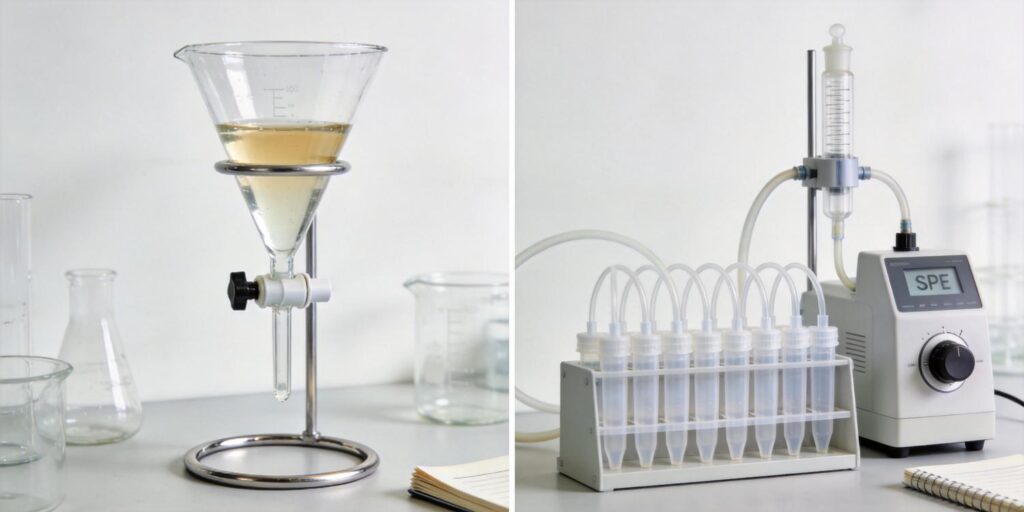
1. Overview of Liquid-Liquid Extraction (LLE)
Liquid-Liquid Extraction (LLE), also known as solvent extraction, is a traditional sample preparation technique that has been widely used for decades in analytical chemistry. The fundamental principle involves partitioning compounds between two immiscible liquid phases based on their relative solubilities. Typically, an aqueous sample is mixed with an organic solvent that is not miscible with water, and the target analytes distribute themselves between these two phases according to their partition coefficients.
The extraction efficiency in LLE is governed by the distribution constant (K), which represents the equilibrium concentration ratio of the analyte between the organic and aqueous phases. As described in the literature, the extraction efficiency (E) can be calculated using the equation: E = KOV / (1 + KOV), where KO is the distribution constant and V is the organic/aqueous phase ratio. This equilibrium-driven process requires multiple extractions to achieve high recovery rates, as each extraction only moves a fraction of the analyte from one phase to another.
LLE procedures typically involve several steps: sample preparation, extraction with organic solvent, phase separation (often using separatory funnels), and sometimes back-extractions to improve purity. The technique has been particularly valuable in pharmaceutical, environmental, and forensic applications where sample cleanup and analyte concentration are essential before analysis by techniques like GC, LC, or mass spectrometry.
2. Limitations of Liquid-Liquid Extraction
2.1 Equilibrium Limitations and Incomplete Recovery
One of the fundamental limitations of LLE is its dependence on equilibrium processes. As noted in the literature, “the problem with using an equilibrium process is that you may never know when equilibrium has been reached, and the equilibrium distribution may necessitate multiple extractions.” This creates a situation where, like a frog jumping 50% of the distance out of a well each time, repeated LLEs will yield recovery closer and closer to 100% without ever achieving complete extraction.
The equilibrium nature of LLE means that different analytes may exhibit vastly different distribution coefficients between extracting solvents and various matrices because of other contaminants. This variability makes it challenging to achieve consistent, high recoveries across different sample types and analyte concentrations.
2.2 Formation of Emulsions
Perhaps one of the most frustrating practical limitations of LLE is the formation of emulsions, particularly when dealing with “real-world” samples containing surfactants, proteins, or other emulsifying agents. As one source notes, “For anyone who has ever experienced the frustration of attempting to ‘break’ an emulsion formed while extracting ‘real-world’ samples by LLE, this advantage alone might make SPE attractive.” Emulsions can significantly delay analysis, reduce recovery, and introduce variability into results.
2.3 High Solvent Consumption and Waste Generation
LLE typically requires large volumes of organic solvents, which presents several challenges:
- Cost considerations: Organic solvents are expensive to purchase, and disposal costs often exceed purchase costs, especially for chlorinated hydrocarbons.
- Environmental impact: Large volumes of solvent waste require proper disposal, creating environmental concerns.
- Safety hazards: Exposure to large volumes of organic solvents poses health risks to laboratory personnel.
2.4 Time-Consuming and Labor-Intensive Process
Traditional LLE procedures are notoriously time-consuming and labor-intensive. The process typically involves:
- Manual shaking of separatory funnels
- Multiple extraction steps
- Phase separation and collection
- Evaporation and reconstitution steps
- Cleaning of glassware between extractions
This manual dedication to “tediously shaken separatory funnels, which are expensive to purchase, tedious to clean, and subject to breakage” significantly limits throughput and increases labor costs.
2.5 Limited Selectivity and Cleanup Efficiency
LLE is a general technique that extracts many compounds simultaneously, offering limited selectivity. As demonstrated in forensic applications, LLE extracts of opiates from urine show “high levels of impurities and low recoveries of the opiates.” The technique often requires back-extractions to improve purity, which can result in analyte loss during each extraction step.
2.6 Sample Loss and Contamination Risks
Each transfer step in LLE introduces the potential for sample loss and contamination. The multiple handling steps, combined with the use of large glassware, increase the risk of:
- Sample loss during transfers
- Contamination from glassware or solvents
- Cross-contamination between samples
- Introduction of solvent impurities
2.7 Difficulty with Automation
LLE is challenging to automate effectively due to its reliance on phase separation and the physical handling of separatory funnels. This limitation becomes particularly significant in high-throughput laboratories where automation is essential for efficiency and consistency.
3. Advantages of Solid Phase Extraction (SPE)
3.1 Fundamental Theoretical Advantage: Non-Equilibrium Process
The primary theoretical advantage that SPE has over LLE and other separation procedures is that “SPE is a non-equilibrium procedure. In contrast, liquid-liquid extraction, batch adsorption, etc., are equilibrium processes.” This fundamental difference allows SPE to achieve complete extraction in a single pass when properly optimized, rather than approaching completeness asymptotically through multiple extractions.
3.2 Superior Recovery and Reproducibility
SPE consistently delivers higher and more reproducible recoveries compared to LLE. As noted in forensic applications, “SPE recoveries should exceed 90% absolute recovery. If you don’t get that kind of recovery you are not adjusting other parameters (such as solubility, pH, and solvent strength) correctly.” In contrast, “liquid–liquid extraction not only has trouble achieving high recovery on a reliable, reproducible level but also, the more extractions you need to do, the more of your sample you lose.”
SPE actually concentrates samples on the column and allows for reproducible results at very low analyte levels, making it particularly valuable for trace analysis applications.
3.3 Dramatic Reduction in Solvent Usage
SPE offers significant advantages in solvent reduction:
- 75-76% reduction in total liquid volumes compared to traditional packed columns
- Lower cost per extraction
- Reduced disposal costs and environmental impact
- Decreased exposure to organic solvents for laboratory personnel
As one source emphasizes, “Using smaller volumes of solvent is very important today. Lab personnel need to be mindful of solvent usage as it costs more to dispose of solvents today than it does to buy them.”
3.4 Elimination of Emulsion Problems
One of the most practical advantages of SPE is the elimination of emulsion formation. The solid-liquid interface in SPE avoids the liquid-liquid interface where emulsions typically form in LLE. This advantage alone can save significant time and frustration in laboratories dealing with complex sample matrices.
3.5 Enhanced Selectivity and Cleaner Extracts
SPE provides the analyst with the ability to extract a broad range of compounds with increased selectivity. Unlike LLE, which is a general technique that extracts many compounds, SPE offers:
- Tunable selectivity through different SPE phase choices and solvent mixtures
- Cleaner extracts with reduced contamination and solvent impurities
- The ability to use miscible solvents that would be impossible in LLE
As demonstrated in forensic applications, copolymeric SPE columns show “both improved recovery and elimination of a significant amount of background interference” compared to LLE and even traditional bonded-phase SPE columns.
3.6 Faster Processing Times and Higher Throughput
SPE allows for significantly shorter sample extraction times, especially when back-extractions are required. “In SPE the analyst can switch from organic solvents to aqueous solvents and back to organic solvents in a matter of 15 minutes. This is not the case in liquid–liquid extraction.”
Additionally, SPE enables:
- Improved throughput through parallel processing capabilities
- Multiple simultaneous extractions
- Reduced operator dedication time
- Faster dry-down times due to smaller eluate volumes
3.7 Ease of Automation
SPE can be automated quite easily with a variety of currently available equipment, including:
- Liquid handling and SPE workstations
- 96-well plate autosamplers
- Manifold systems for parallel processing
- Integration with analytical instruments
This automation capability is particularly valuable for high-throughput laboratories and ensures consistent, reproducible results.
3.8 Reduced Instrument Downtime and Maintenance
SPE has been shown to significantly increase gas chromatography (GC) and liquid chromatography (LC) column life while reducing downtime on expensive instruments like GC-MS and LC-MS for source cleaning. As noted in the literature, “Biological samples are notoriously dirty; injecting them with minimum cleanup onto very sensitive and expensive instruments makes very little sense.”
3.9 Flexibility in Solvent Selection
A unique advantage of SPE is the ability to use elution solvents that are miscible with the sample matrix. “An elution solvent may be used which is miscible with the sample in a solid-phase extraction, because the elution solvent and the sample never come into direct contact. Thus, our sample may be aqueous but our SPE elution solvent may be methanol, which is miscible in all proportions with water. Such a scheme, impossible in a LLE, is not only possible with SPE – it accounts for the majority of all solid-phase extractions!”
3.10 Multiple Extraction Mechanisms and Formats
SPE offers multiple extraction mechanisms including:
- Reverse-phase extraction for non-polar compounds
- Normal-phase extraction for polar compounds
- Ion-exchange extraction for ionic compounds
- Mixed-mode extraction combining multiple mechanisms
Additionally, SPE is available in various formats including cartridges, 96-well plates, disks, and automated systems, providing flexibility for different laboratory needs and sample volumes.
3.11 Improved Safety and Reduced Breakage Risk
SPE eliminates the need for separatory funnels, which are “expensive to purchase, tedious to clean, and subject to breakage.” The use of disposable SPE cartridges or plates reduces glassware handling, minimizes breakage risks, and improves laboratory safety.
3.12 Better Compatibility with Modern Analytical Techniques
SPE is particularly well-suited for modern analytical techniques that require:
- Small sample volumes (as low as 100 μL or less)
- High sensitivity and low detection limits
- Compatibility with LC-MS, GC-MS, and other sensitive instruments
- Integration with automated sample preparation systems
Conclusion
The transition from Liquid-Liquid Extraction to Solid Phase Extraction represents a significant advancement in sample preparation technology. While LLE served analytical chemistry well for decades, its limitations in terms of solvent consumption, emulsion formation, time requirements, and reproducibility have become increasingly problematic in modern laboratories.
SPE addresses these limitations through its non-equilibrium extraction mechanism, reduced solvent usage, elimination of emulsions, enhanced selectivity, and compatibility with automation. The technique’s ability to deliver cleaner extracts, higher recoveries, and better reproducibility makes it the preferred choice for a wide range of applications in pharmaceutical, environmental, forensic, and clinical laboratories.
As sample volumes decrease and analytical sensitivity requirements increase, SPE’s advantages become even more pronounced. The development of specialized sorbents, reduced-volume columns, and automated systems continues to expand SPE’s capabilities, making it an essential tool for modern analytical chemistry.
For laboratories considering the transition from LLE to SPE, the benefits in terms of improved data quality, reduced costs, increased throughput, and enhanced safety make SPE a compelling choice for most applications. As one expert notes, “A good rule of thumb is that the dirtier the matrix and more polar the compounds, the more likely SPE will be the best choice for sample preparation.”