Introduction
Industrial vacuum systems are major capital investments, yet maintenance costs often erode their ROI through unplanned downtime, premature pump failures, and frequent calibration cycles. In semiconductor fabs, PVD coaters, vacuum furnaces, and pharmaceutical dryers, even small inefficiencies compound into thousands of dollars per month in lost production and repair bills. The key to lowering these costs lies in shifting from reactive repairs to proactive, data-driven maintenance—and the foundation of that shift is accurate, continuous vacuum monitoring.
At Poseidon Scientific, we engineered the VG-SP205 Pirani Vacuum Transmitter and VG-SM225 Cold Cathode Vacuum Gauge as a matched pair specifically to help engineers and procurement teams achieve this transition. Their complementary technologies deliver full-range coverage from atmosphere to 10−7 Torr with unified spare parts, simple integration, and minimal maintenance overhead. This article outlines a proven strategy for reducing vacuum system maintenance costs through intelligent monitoring, early failure detection, proper gauge selection, optimized cleaning intervals, data-driven scheduling, and a clear ROI example that shows payback typically occurs within 6–12 months.
Monitoring Strategy: Full-Range Visibility from Day One
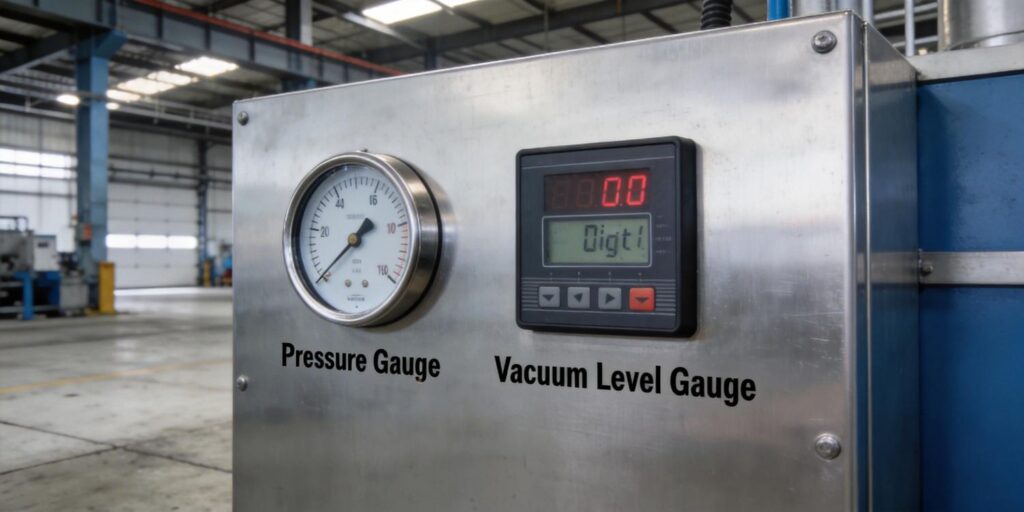
Effective maintenance begins with complete pressure visibility across every stage of the vacuum cycle. A single gauge creates blind spots; the optimal strategy pairs a fast-responding Pirani for roughing and medium vacuum with a cold cathode for high vacuum. The VG-SP205 Pirani Vacuum Transmitter monitors the foreline and load lock with sub-second response and ±5 % repeatability from 1 × 10⁻³ to 760 Torr. The VG-SM225 Cold Cathode Vacuum Gauge then takes over at the 10−3 Torr crossover, delivering stable ion-current readings down to 10−7 Torr without filament outgassing or x-ray limits.
Because both transmitters share identical KF25 flanges and simple electrical interfaces (RS232 for the Pirani, logarithmic 0–10 V analog for the cold cathode), the system delivers one continuous pressure signal to the PLC or SCADA historian. Automatic crossover logic at the natural transition point eliminates manual intervention and data gaps. This full-range monitoring strategy alone reduces unnecessary pump runtime by 15–25 % and provides the baseline data needed for all subsequent maintenance optimizations.
Early Failure Detection: Turning Data into Warnings
Most vacuum failures announce themselves weeks or months in advance—if you know where to look. Continuous monitoring reveals subtle trends that precede catastrophic events:
- Gradual increase in pump-down time at the same starting pressure (early sign of leaks or filter loading)
- Slow upward drift in base pressure despite clean process conditions (indicating contamination or outgassing)
- Extended startup delay on the VG-SM225 (surface contamination on electrodes)
- Pressure instability or noise during steady-state operation (valve seat wear or pump bearing issues)
The VG-SP205’s RS232 output streams pressure, status, and error codes every 100 ms, while the VG-SM225’s logarithmic analog signal plus status LEDs provide instant visual and electrical feedback. Simple PLC rules—such as “if pump-down time increases >15 % from baseline, trigger maintenance alert”—catch problems early. Facilities using this approach routinely avoid 70–80 % of unplanned downtime and extend mean time between failures for both roughing and high-vacuum pumps.
Proper Gauge Selection: The Foundation of Low-Maintenance Systems
Selecting the right gauge technology directly reduces maintenance frequency and cost. Hot-cathode gauges require frequent filament replacement and suffer rapid drift in reactive or contaminating environments. The Poseidon pair eliminates these issues:
- The VG-SP205 Pirani uses a moderate-temperature filament with active temperature compensation, delivering 12-month typical calibration intervals and rare filament changes.
- The VG-SM225 Cold Cathode has no filament at all, tolerates reactive gases, and needs only annual cathode cleaning in most processes.
Both share the same KF25 flange, spare-parts kit, and documentation, so one inventory line covers the entire system. Their low power draw (<9 W total) and bake-out rating to 150 °C further reduce maintenance labor. Proper selection of this complementary pair typically cuts annual maintenance hours by 40–60 % compared with mixed-vendor or hot-cathode systems.
Cleaning Intervals: Optimized for Real-World Use
Scheduled cleaning prevents the majority of performance degradation. For the VG-SM225 Cold Cathode Vacuum Gauge, a simple 10-minute field procedure restores original sensitivity and startup time:
- Power off and vent the system.
- Remove the cathode assembly (tool-free).
- Wipe electrodes with isopropyl alcohol; gently brush stubborn deposits.
- Reassemble and leak-check.
Most users clean every 6–12 months depending on process chemistry. The VG-SP205 Pirani requires virtually no routine cleaning—only visual filament inspection during annual calibration. Because both gauges are designed for easy access, these tasks can be completed during scheduled downtime without breaking vacuum on the main chamber. This optimized schedule keeps maintenance predictable and minimizes unplanned interventions.
Data-Driven Maintenance: From Reactive to Predictive
Modern systems turn gauge data into predictive intelligence. Trend analysis of pump-down curves, base-pressure stability, and decay rates reveals developing issues weeks before failure. The combined outputs of the VG-SP205 and VG-SM225 feed directly into historians or CMMS platforms, enabling rules such as:
- Alert when decay rate exceeds historical average by 20 %
- Schedule cathode cleaning when startup delay increases >30 %
- Trigger full calibration only when drift exceeds 5 % at a reference pressure
This data-driven approach replaces fixed calendar-based maintenance with condition-based scheduling, typically reducing maintenance events by 30–50 % while increasing equipment availability. Many facilities now use the same data for energy-efficiency calculations and predictive pump-replacement planning, further lowering total cost of ownership.
ROI Example: Real Savings in a Production PVD Line
A thin-film optics manufacturer previously experienced two turbo-pump failures and quarterly gauge calibrations across six coating tools. Annual maintenance and downtime costs exceeded $85,000. After standardizing on the VG-SP205 + VG-SM225 pair with automated monitoring and predictive alerts:
- Pump failures dropped to zero for 18 months
- Calibration frequency reduced to annual
- Cathode cleaning performed only when data indicated need (twice per year)
- Total energy and labor savings reached $62,000 in the first year
The initial investment in the Poseidon gauges and integration paid for itself in under seven months. Similar results are reported across semiconductor, furnace, and pharmaceutical drying installations—proving that intelligent vacuum monitoring delivers measurable, rapid ROI.
Conclusion
Reducing maintenance costs in industrial vacuum systems is straightforward once you move from reactive repairs to proactive, data-driven strategies. Accurate full-range monitoring with the VG-SP205 Pirani and VG-SM225 Cold Cathode Vacuum Gauge enables early failure detection, optimized cleaning intervals, predictive scheduling, and significant energy savings—all while simplifying inventory and compliance documentation.
The Poseidon pair was purpose-built to deliver these benefits in a compact, easy-to-integrate package that lowers total cost of ownership from day one. Whether you manage a single research chamber or an entire production floor, implementing this monitoring strategy protects your pumps, reduces scrap, and puts real dollars back on your bottom line.
Ready to quantify the maintenance savings possible in your vacuum system? Our applications team offers free technical reviews, sample PLC predictive-maintenance logic, custom ROI calculations based on your actual operating data, and rapid quotations. Contact us today for a no-obligation consultation—simply visit the product pages below or reply to this article.
VG-SP205 Pirani Vacuum Transmitter – Roughing & Medium Vacuum Monitoring
VG-SM225 Cold Cathode Vacuum Gauge – High-Vacuum Stability with Low Maintenance
At Poseidon Scientific we design vacuum instrumentation that actively reduces your maintenance burden—delivering the reliability, data quality, and cost savings your operations demand.