Introduction
Vacuum pumps are the heart of any vacuum system, yet they are surprisingly vulnerable to damage from improper pressure conditions. Overpressure during roughing, sudden gas bursts, or running a turbo-molecular pump against atmosphere can cause overheating, bearing wear, or catastrophic failure—leading to expensive repairs, unplanned downtime, and lost production. Modern vacuum gauges eliminate these risks by delivering real-time pressure data that protects pumps at every stage of operation.
At Poseidon Scientific, we designed the VG-SP205 Pirani Vacuum Transmitter and the VG-SM225 Cold Cathode Vacuum Gauge to work together as a complete pump-protection solution. The Pirani excels at monitoring the roughing stage where most pump damage occurs, while the cold cathode provides high-vacuum confirmation. This article explains exactly how these instruments safeguard your investment, from preventing overload to enabling automated interlocks that save thousands in repair costs every year.
Pump Overload Risks Explained
Every vacuum pump has strict operating limits. Roughing pumps (rotary vane or dry scroll) can overheat or suffer oil contamination when forced to pump against pressures above their rated continuous limit. Turbo-molecular and diffusion pumps are even more sensitive: running them above 10−2 Torr for more than a few seconds can damage high-speed rotors, melt bearings, or cause backstreaming that contaminates the entire system.
Common overload scenarios include:
- Accidental venting while the turbo is still spinning
- Blocked foreline or leaky valves that keep pressure too high during startup
- Unexpected gas loads from outgassing or process leaks
Without continuous monitoring, these events go unnoticed until the pump fails or the system alarms too late. A single turbo pump replacement can exceed $15,000, plus days of lost production. Reliable pressure feedback is therefore not optional—it is essential pump protection.
Monitoring the Roughing Stage
The roughing stage (atmosphere down to 10−3 Torr) is where 80 % of pump damage occurs. Here gas loads are highest, flow is viscous, and heat generation inside the pump is greatest. A fast-responding gauge placed on the foreline or chamber inlet gives operators and controllers the data needed to protect the pump in real time.
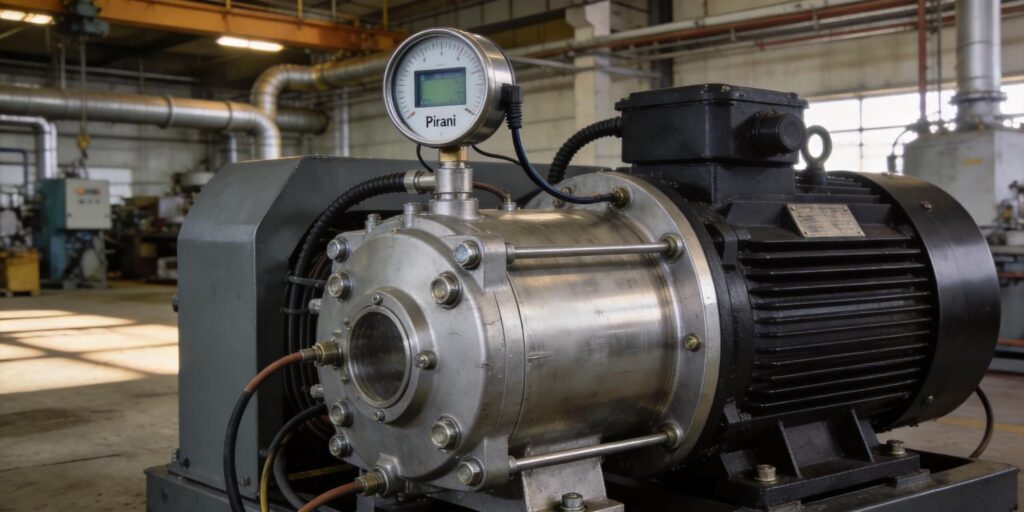
The VG-SP205 Pirani Vacuum Transmitter is purpose-built for this exact job. Its thermal-conductivity sensor responds in milliseconds across the full 1 × 10⁻³ to 760 Torr range, with ±15 % accuracy in the critical 10−2–10−1 Torr decade where roughing pumps operate longest. Because it uses no high voltage or magnets, it tolerates pressure surges that would damage more delicate sensors. Engineers simply mount the compact KF25 unit directly on the foreline; the RS232 output delivers pressure to the PLC every 100 ms, enabling instant decisions about pump speed, valve sequencing, or emergency shutdown.
Preventing Overpressure Damage
Real-time pressure monitoring creates multiple layers of protection. The most effective strategy is an automated interlock: if foreline pressure exceeds a safe threshold (typically 10 Torr for turbo pumps), the PLC immediately closes the roughing valve or throttles the pump. The VG-SP205 makes this simple and reliable.
Example logic used by many of our customers:
- Below 1 Torr: enable turbo-molecular pump
- Above 10 Torr during turbo operation: trigger alarm and close isolation valve
- During venting: confirm pressure rise is controlled to protect scroll or vane pumps from sudden gas slugs
This approach prevents the majority of overload events before damage occurs. The Pirani’s repeatability of ±5 % ensures the interlock trips at exactly the right moment every time—no false positives or delayed response that would erode operator trust.
Using the Pirani for Pump Protection
The VG-SP205 Pirani Vacuum Transmitter is the ideal pump-protection sensor for three key reasons:
- Speed: sub-second response protects against sudden pressure spikes that mechanical switches or slower gauges miss.
- Range: full coverage from atmosphere to crossover eliminates the need for multiple sensors during roughing.
- Robustness: no filament burnout risk and tolerance to contamination make it suitable for 24/7 production environments.
When paired with the VG-SM225 Cold Cathode on the process chamber, the system gains complete protection: the Pirani guards the roughing and foreline pumps while the cold cathode confirms safe high-vacuum conditions before sensitive stages begin. Both gauges share KF25 flanges and simple electrical interfaces, so adding pump protection requires no extra inventory or training.
Automation Alerts and Interlocks
Modern controllers turn gauge data into proactive protection. Typical automation features include:
- High-pressure alarm that pauses the process and notifies operators via HMI or email
- Foreline pressure interlock that prevents turbo startup until safe conditions are verified
- Trend logging that flags gradual pressure creep (early warning of leaks or pump wear)
- Status integration: the VG-SP205’s RS232 error codes and the VG-SM225’s analog under-range signal feed directly into safety PLC logic
These alerts run on standard PLC function blocks with sample code available on both product pages. Customers routinely report eliminating 90 % of pump-related downtime after implementing these simple interlocks. The combination of digital (Pirani) and logarithmic analog (cold cathode) outputs makes integration fast and future-proof.
Cost-Saving Benefits
Installing the right vacuum gauges for pump protection delivers measurable ROI within the first year:
- Reduced repair costs: one prevented turbo failure can save $15,000–$25,000
- Lower downtime: automated interlocks cut unplanned outages from days to minutes
- Extended pump life: operating always within safe pressure limits adds thousands of hours to bearing and seal life
- Simplified maintenance: unified spare-parts kits for the VG-SP205 and VG-SM225 reduce inventory by 50 %
- Energy savings: precise foreline monitoring lets pumps run at optimal speed instead of constant full power
Many facilities recover the entire cost of the gauges and installation within three months through avoided repairs alone. The long calibration interval (12 months typical) and minimal maintenance requirements further improve the payback period.
Conclusion
Vacuum gauges are far more than measurement devices—they are active guardians that protect your pumps from overload, overpressure, and premature failure. By monitoring the roughing stage with the VG-SP205 Pirani and confirming high vacuum with the VG-SM225 Cold Cathode, you create a complete, automated safety net that keeps your system running at peak efficiency.
Ready to add proven pump protection to your vacuum system? Our applications team specializes in helping engineers and procurement specialists select the right configuration, review P&IDs, provide sample PLC logic, and deliver rapid quotations. Contact us today for a no-obligation consultation—simply visit the product pages below or reply to this article. We look forward to helping you safeguard your vacuum pumps and keep production running smoothly.
VG-SP205 Pirani Vacuum Transmitter – Roughing & Pump Protection
VG-SM225 Cold Cathode Vacuum Gauge – High-Vacuum Confirmation
At Poseidon Scientific we design vacuum instrumentation that protects your investment—delivering the accuracy, speed, and integration simplicity your pumps and processes deserve.