Furnace Vacuum Stages
Industrial vacuum furnaces—whether for annealing, tempering, brazing, or sintering—operate through distinct vacuum stages that demand precise pressure monitoring at every step. The process begins with rough vacuum, where mechanical pumps evacuate the chamber from atmosphere down to approximately 10-3 Torr. This stage removes bulk air and moisture, establishes a controlled atmosphere, and prevents oxidation during heat-up. Accurate monitoring here protects the pump train, triggers interlocks, and confirms the system is ready for thermal ramp.
Once rough vacuum is achieved, the system transitions to high vacuum (typically 10-3 to 10-7 Torr) using turbomolecular or diffusion pumps. In this regime, mean free path increases dramatically, enabling contaminant-free heat treatment, uniform temperature distribution, and elimination of residual gases that could embrittle metals or degrade surface finish. Many furnace recipes hold high vacuum for hours or days, making continuous, drift-free measurement essential for process repeatability and quality certification.
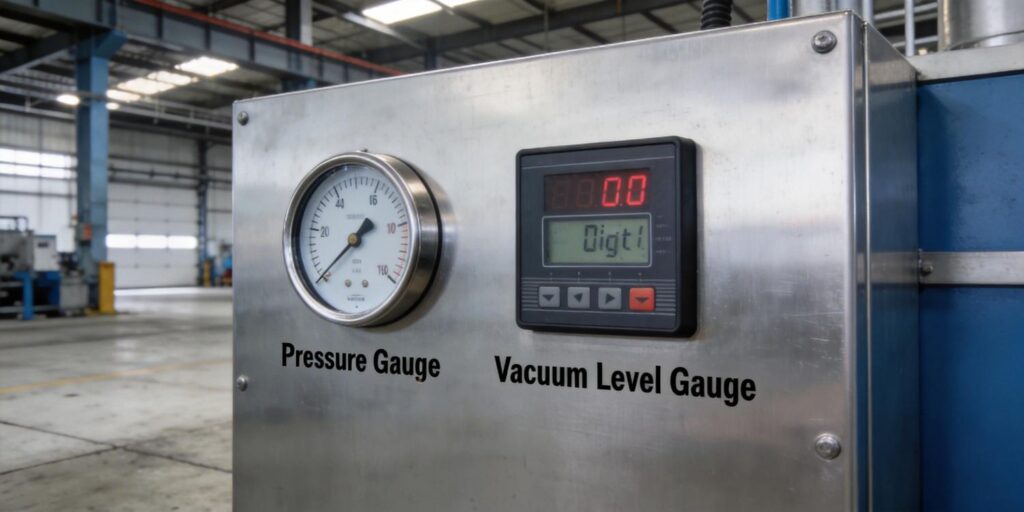
These two stages rarely overlap in a single gauge. A thermal conductivity device excels in the rough vacuum range, while an ionization gauge dominates the high-vacuum regime. Poseidon Scientific’s VG-SP205 Pirani Vacuum Transmitter covers atmosphere to 10-3 Torr with fast response and temperature compensation, while the VG-SM225 Cold Cathode Vacuum Gauge handles 10-3 to 10-7 Torr without filament-related outgassing. Pairing both on the same furnace chamber provides seamless full-range coverage and automatic crossover at the transition point.
Typical Vacuum Profile in Vacuum Heat Treatment
A standard annealing cycle might require:
- 0–10-2 Torr: initial pump-down and leak check
- 10-3 Torr: safe heat-up threshold
- 10-5 Torr or lower: process hold for metallurgical results
Real-time digital output from both Poseidon gauges allows PLC integration to automate these transitions and generate batch records for ISO or NADCAP compliance.
High Temperature Environment
Vacuum furnaces routinely exceed 800 °C in the hot zone, yet vacuum gauges must remain within their rated operating window of 15–50 °C. Excessive heat causes filament resistance drift in thermal conductivity gauges and alters discharge characteristics in ionization gauges, producing measurement errors that can exceed 50 % or prevent ignition entirely. More critically, prolonged exposure risks permanent damage to electronics, insulation, or permanent magnets.
Engineers address this challenge through physical isolation. The most reliable method is remote mounting via a KF16 or KF25 extension tube (typically 300–600 mm long) that positions the gauge head outside the thermal envelope while still measuring true chamber pressure. Conduction and radiation losses along the tube keep the gauge body well within specification. Additional options include water-cooled gauge mounts or radiation shields for extremely hot furnaces.
Gas composition also changes with temperature. At elevated furnace temperatures, outgassing from workpieces or fixtures can shift the effective gas mix, affecting both Pirani (thermal conductivity) and cold cathode (ionization efficiency) readings. Poseidon gauges mitigate this with factory calibration for air/N₂ and optional application-specific curves for argon, hydrogen, or nitrogen blends common in heat treating.
Installation flexibility is key. Both Poseidon models mount in any orientation—no gravity or flow-direction restrictions—allowing optimal placement on the cold chamber wall or manifold. Their compact footprints (smaller than most legacy competitors) fit tight furnace retrofits where space around the chamber is limited.
Gauge Durability
Industrial furnaces expose gauges to thermal cycling, occasional contamination from oils or scale, and repeated venting to atmosphere. Durability directly impacts total cost of ownership and production uptime.
The VG-SP205 Pirani Vacuum Transmitter uses a platinum filament chosen for its large temperature coefficient of resistance, excellent workability, and superior chemical stability. Unlike tungsten alternatives that oxidize readily, platinum resists corrosion from residual process gases and maintains stable calibration for 3–5 years in typical heat-treat environments. The sealed design is fully maintenance-free—no filament replacement or cleaning required. Built-in temperature compensation circuitry keeps drift below 5 % across the 15–50 °C operating range.
The VG-SM225 Cold Cathode Vacuum Gauge employs a traditional Penning discharge with positive magnetron geometry and removable sensor head. Electrodes are stainless steel for cost-effective corrosion resistance. When contamination from furnace outgassing or backstreaming occurs—manifested as ignition failure or decade-low readings—operators simply disassemble the head (without breaking the main vacuum seal), abrade electrodes with 500-mesh sandpaper until metallic luster returns, and reinstall. This field-serviceable design restores full sensitivity in minutes and extends lifetime to 3–5 years in clean operation or 1–2 years in moderately contaminated atmospheres.
Both gauges incorporate hardware and software protection: the cold cathode automatically shuts off high voltage above 10-3 Torr to prevent damage during roughing or venting, while status LEDs and digital error codes alert operators instantly. These features eliminate the frequent replacement cycles associated with hot-cathode alternatives and keep maintenance costs far below imported equivalents.
Durability Comparison Table
| Feature | VG-SP205 Pirani | VG-SM225 Cold Cathode |
|---|---|---|
| Maintenance | Zero (sealed) | Field-cleanable electrodes |
| Typical lifetime | 3–5 years | 3–5 years (clean) / 1–2 years (polluted) |
| Contamination tolerance | High (platinum filament) | Very high (removable head) |
| Thermal cycling resilience | Excellent | Excellent |
Integration
Modern vacuum furnaces rely on PLCs, SCADA systems, and Industry 4.0 data logging. Gauge output must integrate seamlessly without custom driver development or expensive converters.
Both Poseidon transmitters provide dual outputs: industry-standard 0–10 V analog (effective 2–8 V) for direct PLC connection and RS232 digital with fully customizable protocol. Customers ordering as few as 5–10 units can specify exact data frame structure, baud rate, and command set to match existing furnace controllers—eliminating the protocol rigidity common with imported brands. RJ45 connectors (industry standard) simplify field wiring; DB9 or DB15 adapters are available on request. RS485 is offered via minor board revision for multi-drop networks.
Physical integration is equally straightforward. Gauges mount directly to chamber ports or via KF flanges. The small size and low weight reduce stress on furnace manifolds, while any-orientation capability lets designers optimize cable routing away from heat sources. Digital trending and alarm thresholds can be programmed directly in the furnace PLC, enabling automatic shutdown on over-pressure or excessive drift.
For multi-zone furnaces, multiple gauges (one per zone or pump leg) stream data through a single RS232 bus, providing comprehensive vacuum mapping without additional hardware. This plug-and-play approach shortens commissioning time and supports remote diagnostics—critical for furnaces running 24/7 in aerospace, automotive, or medical implant production.
Make the Right Choice for Your Vacuum Furnace
Selecting vacuum gauges for industrial furnaces is not just about measuring pressure—it is about protecting product quality, maximizing uptime, and controlling total ownership cost. By matching gauge technology to each vacuum stage, isolating instruments from extreme heat, prioritizing field-serviceable durability, and demanding full integration flexibility, engineers achieve repeatable, certifiable heat-treatment results.
Poseidon Scientific designed the VG-SP205 Pirani Vacuum Transmitter and VG-SM225 Cold Cathode Vacuum Gauge specifically for these demanding environments. Compact, cost-effective, cleanable, and protocol-customizable, they deliver performance comparable to premium imported brands at 40–60 % lower cost—while supporting low-volume OEM customization that legacy suppliers often refuse.
Explore the VG-SP205 Pirani Vacuum Transmitter for reliable rough-vacuum monitoring and pump protection.
Discover the VG-SM225 Cold Cathode Vacuum Gauge for stable high-vacuum performance with easy field maintenance.
Ready to upgrade your furnace vacuum system? Our engineering team offers free application reviews, custom protocol development, and rapid evaluation-unit shipping—typically within two weeks. Contact us today to discuss your specific furnace requirements. Reliable vacuum measurement starts with the right gauge and the right partner.