Introduction
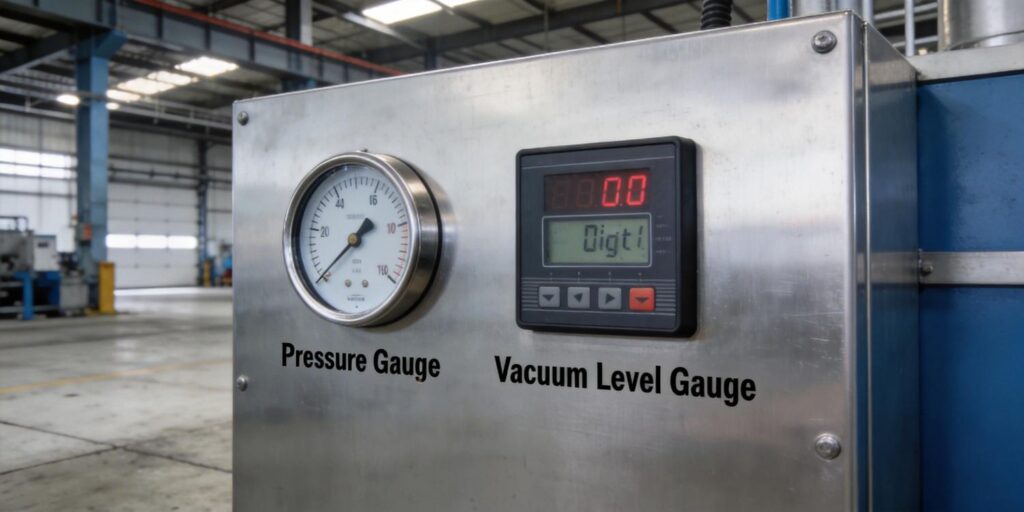
Physical vapor deposition (PVD) and thin-film coating systems demand precise pressure control across a wide range—from atmosphere during venting and load-lock cycling to high vacuum during sputtering or evaporation. A gauge that cannot deliver stable, repeatable readings in both regimes will cause thickness variations, poor adhesion, or arcing that scrapes entire batches. Engineers and procurement teams therefore select instruments that match the exact pressure windows of each process stage while integrating seamlessly with PLCs and SCADA platforms.
At Poseidon Scientific we developed two complementary transmitters—the VG-SP205 Pirani Vacuum Transmitter and the VG-SM225 Cold Cathode Vacuum Gauge—specifically for PVD and coating equipment. Both share KF25 flanges, compact footprints, and straightforward electrical interfaces, so one pair covers the full process from roughing to base pressure with minimal inventory and calibration overhead. This guide walks through the pressure requirements, stage-specific demands, stability needs, startup behavior, integration considerations, and the recommended configuration that delivers the highest yield and lowest cost of ownership in modern coating systems.
Pressure Requirements for PVD
PVD processes typically operate in two distinct pressure windows. During reactive sputtering or evaporation the chamber must reach and hold a stable base pressure between 10−6 and 10−7 Torr to minimize contamination and ensure uniform nucleation. Process gas (argon, nitrogen, or oxygen) is then introduced to raise pressure to the working range of 1–10 mTorr (approximately 10−3 to 10−2 Torr), where the plasma or evaporation source operates most efficiently.
Load-lock and transfer chambers follow a similar profile: they vent to atmosphere between runs and must pump down rapidly to <10−3 Torr before the main valve opens. Any gauge used for PVD must therefore deliver accurate data from 760 Torr all the way to 10−7 Torr without range gaps or excessive drift. The Poseidon VG-SP205 and VG-SM225 together satisfy this requirement with intentional overlap at 10−3 Torr, giving continuous, traceable readings across six decades.
Roughing vs High Vacuum Stage
The roughing stage (atmosphere to 10−3 Torr) is dominated by viscous flow and requires a fast-responding sensor that tolerates pressure surges during pump-down and venting. Thermal-conductivity gauges excel here because heat loss from a heated filament is directly proportional to gas density. The VG-SP205 Pirani Vacuum Transmitter covers this entire window with ±15 % accuracy in the critical 10−2–10−1 Torr decade and sub-second response time.
Once pressure drops below 10−3 Torr the system enters the high-vacuum stage, where molecular flow prevails and surface outgassing becomes the limiting factor. Here an ionization gauge is required. The VG-SM225 Cold Cathode Vacuum Gauge uses crossed electric and magnetic fields to generate a self-sustaining plasma, delivering stable ion-current readings down to 10−7 Torr without a hot filament. Because the two sensors overlap at the transition point, the controller can switch or blend signals automatically, eliminating data gaps that plague single-gauge installations.
Stability Requirements
Coating uniformity depends on pressure stability better than ±5 % of setpoint throughout the deposition run. Even small oscillations (±0.2 mTorr at 5 mTorr) can shift refractive index or cause arcing in reactive processes. The VG-SP205 maintains filament temperature to ±0.1 °C via a constant-temperature bridge circuit, delivering repeatability of ±5 % across its full range. The VG-SM225’s guarded-cathode geometry and optimized 1200 G magnetic field produce a smooth ion-current curve with slope ≈1.08 above the 10−9 Torr inflection point, resulting in ±20 % accuracy and excellent long-term stability.
Both transmitters include temperature compensation and built-in diagnostics, so drift over months of continuous operation stays well below process tolerances. Engineers who have standardized on the Poseidon pair report calibration intervals extended from 6 months to 12 months and coating-thickness variation reduced by 40 % compared with mixed-vendor gauge sets.
Startup Timing Considerations
Pump-down sequences must be fast and predictable. The VG-SP205 reaches operating temperature in <1 s and delivers valid readings immediately upon power-up, making it ideal for rapid roughing confirmation and load-lock cycling. The VG-SM225 cold cathode requires time to ignite the plasma at low pressure:
- ≈2 s at 10−4 Torr
- ≈1 min at 10−5 Torr
- ≈5 min at 10−6 Torr
This ignition delay is a fundamental physical limit of any cold-cathode design, not a defect. In practice, the PLC uses the Pirani signal for the initial pump-down and enables the cold-cathode high voltage only after pressure falls below 1 Torr. The VG-SM225’s red status LED flashes until the discharge stabilizes, giving operators and automation systems a clear visual cue. Forced-start circuitry and optional UV triggering further reduce delay when ultra-fast high-vacuum confirmation is required.
Integration Tips for PVD Systems
Seamless integration into existing PLC or SCADA platforms is essential. The VG-SP205 communicates via RS232 at 9600 baud with a simple ASCII protocol that returns pressure already scaled in engineering units. The VG-SM225 provides a logarithmic 0–10 V analog output (1.33 V per decade) plus dual-color status LEDs. Both outputs connect directly to standard PLC modules—no converters or scaling cards required.
Use shielded twisted-pair cable (≤10 m) grounded at the controller end only. For the VG-SM225, route the high-voltage cable separately from signal lines and interlock the supply to the chamber door. In the overlap zone apply a simple threshold or weighted-average algorithm in the PLC to blend the two signals; sample code for Siemens, Allen-Bradley, and Modbus is available on both product pages. This architecture has been proven in dozens of production PVD tools and requires less than one day of commissioning time.
Recommended Configuration
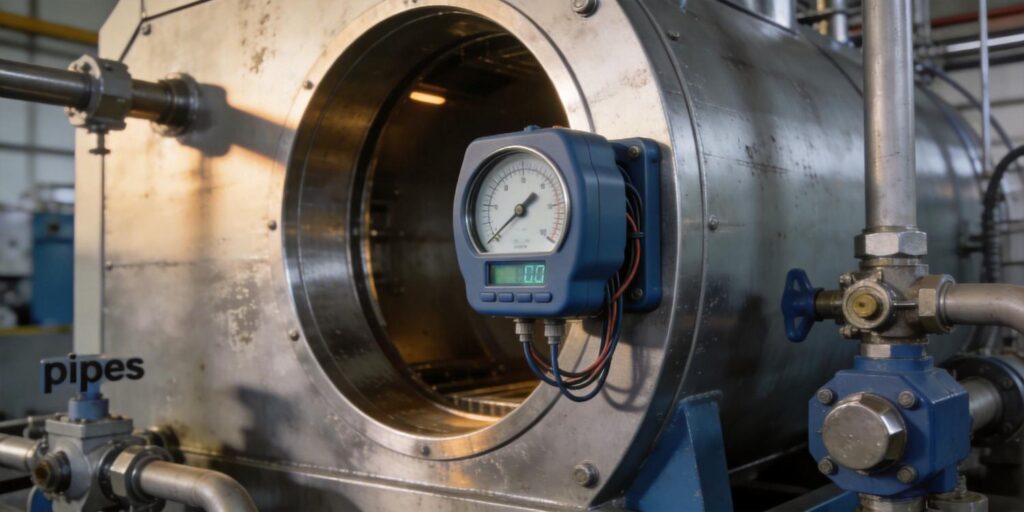
The optimal configuration for most PVD and coating equipment is one VG-SP205 on the foreline or load-lock plus one VG-SM225 on the process chamber. Both share KF25 flanges and identical mounting dimensions, so mechanical integration is identical. Power supplies are simple—5 V DC for the Pirani (<2 W) and 20–28 V DC for the cold cathode (<7 W)—and spare-parts inventory is unified (one KF25 centering ring and O-ring kit serves both).
This pairing delivers:
- Continuous coverage from atmosphere to 10−7 Torr
- Automatic crossover at 10−3 Torr with no data gaps
- Fast roughing response plus filament-free high-vacuum stability
- Lowest total cost of ownership through extended calibration intervals and minimal maintenance
For systems with multiple chambers or glovebox antechambers, the same configuration scales linearly—one pair per chamber—keeping spares and training requirements to a minimum.
Conclusion
Selecting the right vacuum gauges for PVD and coating equipment means matching sensor technology to each process stage while ensuring seamless integration and long-term stability. The Poseidon VG-SP205 Pirani and VG-SM225 Cold Cathode Vacuum Gauge were purpose-designed as a matched pair to deliver exactly this capability—fast, accurate roughing measurements, reliable high-vacuum performance, and simple automation logic—all in compact, easy-to-install packages.
Ready to upgrade your coating system with full-range vacuum monitoring that improves yield and reduces maintenance? Our applications team specializes in PVD and thin-film equipment. We offer free technical reviews, sample PLC code, custom calibration curves, and rapid quotations. Contact us today for a no-obligation consultation—simply visit the product pages below or reply to this article.
VG-SP205 Pirani Vacuum Transmitter – Roughing & Medium Vacuum
VG-SM225 Cold Cathode Vacuum Gauge – High-Vacuum Performance
At Poseidon Scientific we design vacuum instrumentation that works together—giving coating engineers the pressure control, stability, and integration simplicity needed to hit yield targets every run.