Vacuum Steps in Solar Production
Solar panel manufacturing—whether crystalline silicon or thin-film technologies—relies on vacuum processes at multiple critical stages to ensure high efficiency, uniform coatings, and long-term module reliability. Each step demands precise pressure control to eliminate oxygen, moisture, and contaminants that could degrade cell performance or cause delamination.
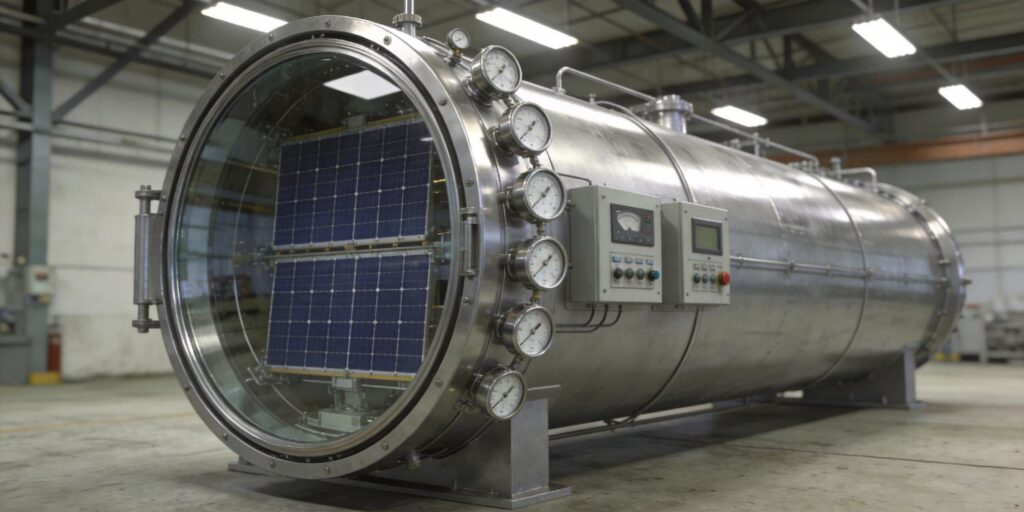
The production sequence typically begins with wafer or substrate preparation. In crystalline silicon lines, vacuum is used for plasma-enhanced chemical vapor deposition (PECVD) of silicon nitride (SiNx) anti-reflective and passivation layers. Thin-film lines (CIGS, CdTe, a-Si) employ sputtering or PECVD for transparent conductive oxide (TCO) layers, absorber deposition, and back contacts. Load-lock chambers evacuate incoming substrates from atmosphere to process pressure without breaking vacuum in the main chamber. Vacuum drying and degassing steps precede lamination to remove trapped moisture and volatiles. Final encapsulation under vacuum prevents micro-bubbles and ensures 25+ year field life.
These steps run 24/7 in high-volume fabs, making vacuum system uptime and measurement consistency essential for yield and throughput. A single pressure excursion can scrap an entire batch or trigger costly downtime. Compact, cost-effective gauges with customizable digital output have become the preferred choice for both new lines and retrofits.
Key Vacuum-Dependent Processes
- PECVD passivation and ARC deposition (SiNx, a-Si)
- DC/RF sputtering for TCO and metal contacts
- Load-lock pump-down and transfer
- Vacuum lamination and edge sealing
- Plasma texturing or cleaning steps in advanced PERC/TOPCon cells
Each process operates in a narrow pressure window where even small deviations affect film stoichiometry, adhesion, and optical properties.
Required Ranges
Solar manufacturing spans two distinct vacuum regimes that no single gauge covers optimally. Rough vacuum (atmosphere to 10-3 Torr) dominates load locks, initial pump-down, and foreline monitoring. High vacuum (10-3 to 10-6 Torr or lower) is required inside process chambers for contaminant-free deposition and uniform plasma density.
| Process Stage | Typical Pressure Range (Torr) | Primary Function | Recommended Poseidon Gauge |
|---|---|---|---|
| Load-lock roughing | Atmosphere to 10-2 | Substrate entry, moisture removal | VG-SP205 Pirani Vacuum Transmitter |
| Foreline / backing pump | 1 to 10-3 | Pump protection, crossover interlock | VG-SP205 Pirani Vacuum Transmitter |
| Process chamber (PECVD / sputtering) | 10-3 to 10-6 | Plasma stability, film quality | VG-SM225 Cold Cathode Vacuum Gauge |
| High-vacuum hold / transfer | 10-5 to 10-7 | Base pressure verification | VG-SM225 Cold Cathode Vacuum Gauge |
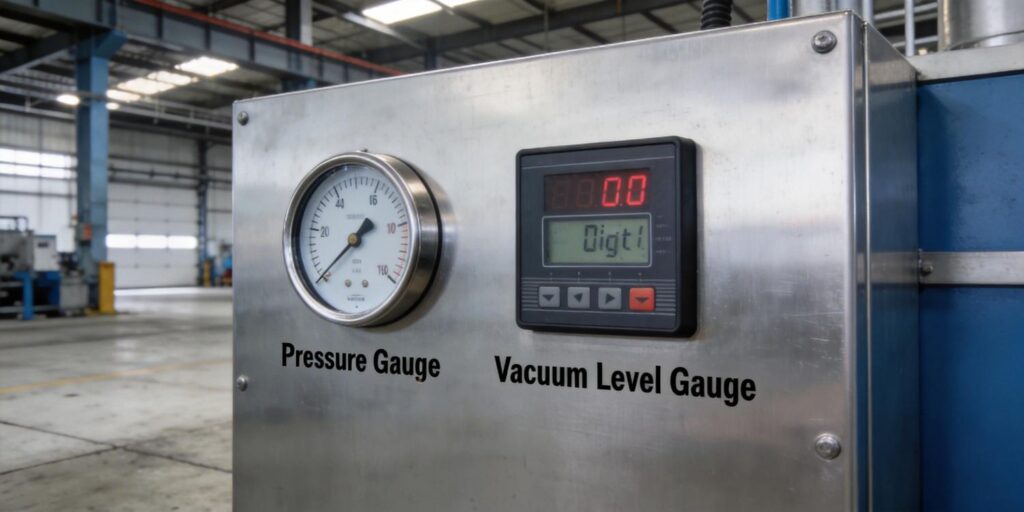
The VG-SP205 Pirani covers the full roughing range with fast response and temperature compensation, while the VG-SM225 Cold Cathode delivers stable, filament-free readings across the high-vacuum span. Pairing both on the same tool provides seamless crossover at ~10-3 Torr and continuous monitoring without blind spots.
Reactive process gases (silane, ammonia, hydrogen) common in solar PECVD further favor cold cathode technology—no hot filament means no outgassing or premature burnout, preserving film purity and extending sensor life.
Gauge Positioning
Strategic gauge placement maximizes measurement accuracy and enables rapid fault detection. In solar tools, engineers typically install gauges at three locations per chamber:
- Process chamber wall (KF16 or KF25 port): Direct measurement of actual deposition pressure. Mount the VG-SM225 Cold Cathode here for high-vacuum control; use a short extension tube if chamber temperature exceeds 50 °C.
- Load-lock or transfer chamber: Rough vacuum monitoring during substrate entry/exit. The VG-SP205 Pirani provides instant feedback for interlock logic and cycle-time optimization.
- Foreline (between roughing pump and turbo/diffusion pump): Protects high-vacuum pumps from overload. A second Pirani here triggers automatic crossover and detects backing-pump degradation early.
Both Poseidon gauges mount in any orientation and feature compact footprints ideal for crowded solar tool layouts. Their RJ45 connectors simplify wiring in multi-chamber cluster tools. For tools with multiple process zones (e.g., inline PECVD), install one cold cathode per zone and share digital output via a single RS232 bus—reducing cabling and PLC I/O count.
Digital trending from customizable RS232 protocol lets operators overlay pressure curves from every run, quickly spotting leaks, outgassing, or pump wear before they affect yield.
Long-Term Reliability
Solar fabs operate 24/7 with minimal scheduled downtime, so vacuum gauges must deliver years of stable performance in reactive, sometimes dusty environments. Poseidon’s design philosophy—low cost, small size, field maintainability—directly addresses these demands.
The VG-SP205 Pirani uses a platinum filament selected for chemical stability and large temperature coefficient of resistance. It is fully sealed and maintenance-free, with typical lifetime of 3–5 years even when exposed to residual process gases. Built-in temperature compensation keeps drift below 5 % across 15–50 °C, eliminating the need for frequent recalibration.
The VG-SM225 Cold Cathode employs stainless-steel electrodes and a removable sensor head. Contamination from silane or ammonia decomposition appears as ignition delay or decade-low readings—easily corrected by disassembling the head (no vacuum break required) and lightly abrading electrodes with 500-mesh sandpaper until metallic luster returns. This 10-minute field service restores full sensitivity and extends life to 3–5 years in clean operation or 1–2 years in heavy-duty PECVD lines.
Additional reliability features include:
- Automatic high-voltage shutdown above 10-3 Torr to prevent damage during venting or roughing
- Status LEDs and digital error codes transmitted over RS232 for predictive maintenance
- Protocol customization (minimum 5–10 units) to match existing solar-tool PLCs without driver development
Compared with imported hot-cathode gauges that require filament replacement every 6–12 months and full system venting, Poseidon cold cathode and Pirani transmitters reduce maintenance labor by 70–80 % and eliminate unplanned downtime associated with gauge failure. Their 40–60 % lower purchase price further improves ROI in high-volume solar manufacturing.
Optimize Your Solar Vacuum Monitoring Today
From PECVD passivation to vacuum lamination, precise pressure control directly impacts solar cell efficiency, yield, and long-term module reliability. Selecting the right gauges for each vacuum stage, positioning them strategically, and prioritizing field-serviceable designs ensures consistent performance in 24/7 production environments.
Poseidon Scientific’s VG-SP205 Pirani Vacuum Transmitter and VG-SM225 Cold Cathode Vacuum Gauge are engineered specifically for solar and thin-film applications: wide complementary ranges, compact size, reactive-gas tolerance, easy field maintenance, and full digital integration at a fraction of legacy costs.
Explore the VG-SP205 Pirani Vacuum Transmitter for reliable load-lock and foreline monitoring.
Discover the VG-SM225 Cold Cathode Vacuum Gauge for stable, filament-free high-vacuum performance in PECVD and sputtering chambers.
Need a multi-gauge package for your inline PECVD tool, custom RS232 protocol to match your SCADA system, or application-specific calibration for silane/hydrogen mixes? Our engineering team supports low-volume customization and typically ships evaluation units within two weeks. Contact us today—higher yield, lower maintenance, and faster ROI start with smarter vacuum measurement.