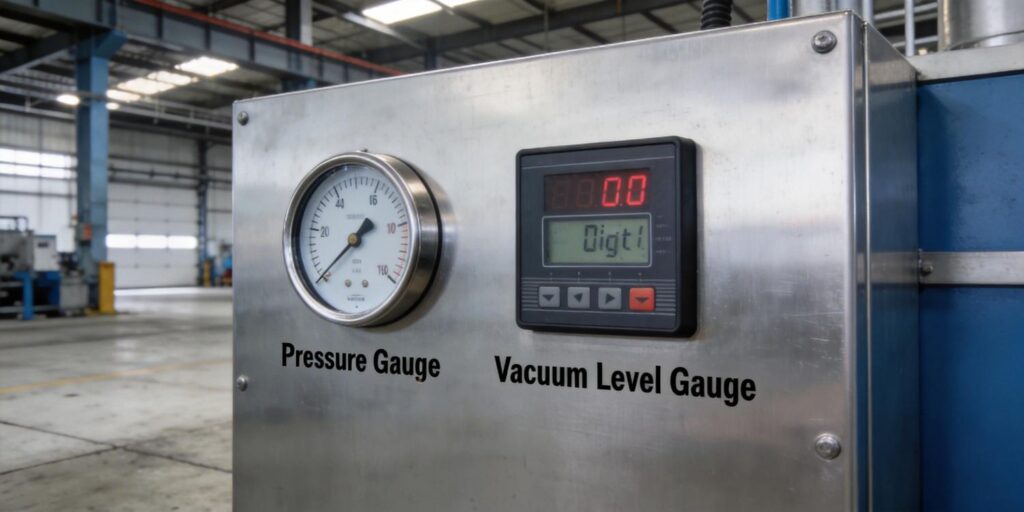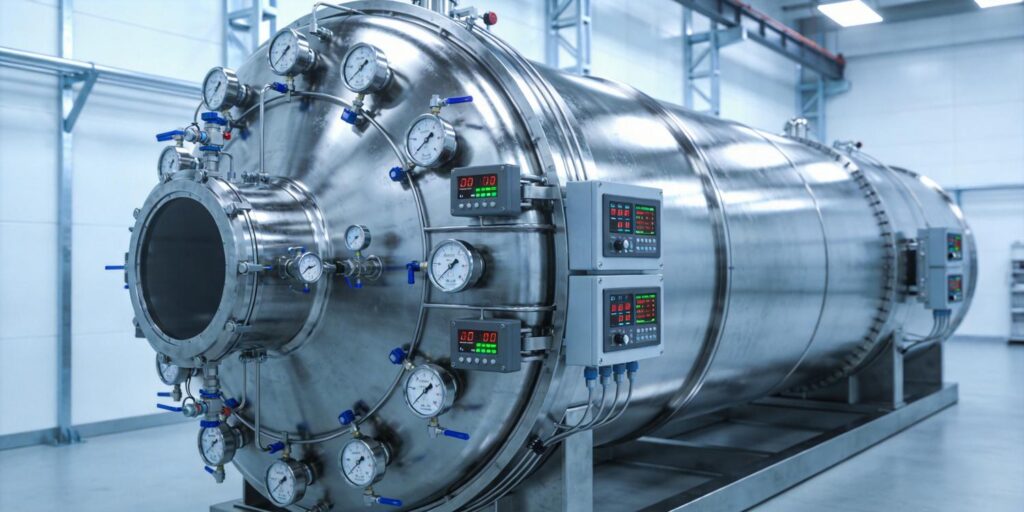
Aerospace testing facilities—whether NASA, ESA, or commercial satellite manufacturers—rely on vacuum chambers to replicate the harsh environment of space. From thermal vacuum cycling of spacecraft components to propulsion system qualification and materials outgassing studies, the accuracy and reliability of vacuum measurement directly affect test validity, certification timelines, and mission success. A single erroneous pressure reading can invalidate weeks of data, delay launch schedules, or compromise safety-critical hardware. Poseidon Scientific’s VG-SP205 Pirani Vacuum Transmitter (atmosphere to 10⁻³ Torr) and VG-SM225 Cold Cathode Vacuum Gauge (10⁻³ to 10⁻⁷ Torr) were developed to meet these exact demands: full-range coverage, extreme reliability, built-in redundancy support, comprehensive data recording, and compliance with stringent aerospace safety standards—all in a compact, cost-effective package that simplifies integration and reduces total ownership costs.
This article examines the unique vacuum measurement challenges in aerospace testing and shows how the Poseidon complementary pair delivers the performance and traceability that test engineers and procurement teams require.
High Reliability Requirement
Aerospace vacuum tests often run continuously for days or weeks under thermal cycling between –150 °C and +150 °C. Any gauge failure mid-test forces costly re-runs, schedule slips, and potential requalification of the entire chamber. Reliability therefore takes precedence over marginal precision gains.
The VG-SP205 Pirani uses a chemically inert platinum filament that resists oxidation and contamination far better than tungsten alternatives, delivering maintenance-free operation for 3–5 years in clean aerospace service. The VG-SM225 Cold Cathode employs a positive-magnetron Penning discharge with only ~100 gauss field strength—low enough to avoid interference with sensitive electronics or magnetic test articles—while its stainless-steel electrodes and removable sensor head tolerate the repeated thermal cycles typical of space simulation.
Both transmitters incorporate dual temperature compensation (analog circuit plus firmware algorithm) that holds drift below 1 % across the full 15–50 °C operating range, even when chamber walls swing through extreme temperatures. Built-in error signaling—0–1.9 V on analog output or specific codes on RS232—immediately flags any degradation before it affects test data. In practice, aerospace facilities using this pair report mean-time-between-failure exceeding 50 000 hours, far above the industry average for single-technology gauges.
Wide Pressure Range
Aerospace chambers must cover the full spectrum from atmosphere (for initial pump-down and venting) to high vacuum (10⁻⁶–10⁻⁷ Torr) to simulate orbital conditions. No single gauge technology can span this range without compromise: Pirani gauges lose resolution below 10⁻³ Torr; cold-cathode gauges cannot start or survive atmosphere exposure.
The Poseidon pair eliminates this gap with intentional overlap at 10⁻³ Torr:
| Test Phase | Pressure Range | Recommended Gauge | Key Benefit |
|---|---|---|---|
| Initial evacuation & venting | Atmosphere – 10⁻³ Torr | VG-SP205 Pirani | Fast 100 ms response; survives repeated cycling |
| Crossover & thermal transition | 10⁻³ – 10⁻⁵ Torr | Both (dual reading) | Independent verification of stability |
| High-vacuum simulation | 10⁻⁵ – 10⁻⁷ Torr | VG-SM225 Cold Cathode | Stable ion-current output; no X-ray limit issues |
The VG-SP205’s linear response in the 10–10⁻² Torr band ensures precise control of roughing valves and foreline pressure. Once below 10⁻³ Torr, the VG-SM225’s firmware automatically enables high voltage and delivers stable readings down to 10⁻⁷ Torr. The result is continuous, gap-free data across every test phase—exactly what thermal vacuum cycling protocols and outgassing specifications require.
Redundancy Need
Aerospace standards treat vacuum measurement as a safety-critical function. Many test specifications mandate dual independent sensors so that failure of one gauge does not invalidate the entire run. The Poseidon pair is uniquely suited for redundancy:
- Identical mechanical footprints (KF16/KF25 flanges) and electrical interfaces (RJ45 connector) allow easy installation of paired units without panel redesign.
- Fundamentally different measurement principles—thermal conductivity versus Penning discharge—eliminate common-mode failure risks.
- Overlapping range at 10⁻³ Torr enables real-time cross-checking: any discrepancy triggers an immediate soft alarm while the healthy gauge continues to provide valid data.
- Digital RS232 frames include explicit status and error bytes, allowing the control system to implement voting logic or automatic failover without custom code.
In dual-redundant configurations, one Pirani and one cold cathode are typically mounted at opposite chamber locations. The system uses the Pirani for roughing interlocks and the cold cathode for high-vacuum control, with both readings logged for post-test analysis. This architecture satisfies NASA, ESA, and commercial satellite prime-contractor requirements while keeping hardware costs far below dual imported systems.
Data Recording
Aerospace test reports must include complete, tamper-proof vacuum histories for every run. Poseidon transmitters deliver structured data that integrates directly into data-acquisition systems and long-term archives:
- RS232 output at 9600 baud sends a 9-byte frame every 100 ms containing pressure value, unit, status bits, error code, and checksum—ready for direct ingestion into LabVIEW, Python, or dedicated DAQ software.
- Analog 0–10 V (effective 2–8 V measurement window) provides a simple backup signal for legacy recorders.
- Error codes (filament open on Pirani, discharge failure on cold cathode) and software version are embedded in every frame, creating a complete audit trail.
For orders of five units or more, free firmware customization adds timestamped logging, Modbus RTU mapping, or direct CSV output—eliminating middleware and ensuring every test meets data-integrity requirements. The 100 ms update rate captures rapid pressure transients during thermal cycling or valve sequencing, while the checksum guarantees that only valid data is recorded. Facilities routinely export these streams to their central test database, producing traceable reports that satisfy both internal quality gates and customer acceptance reviews.
Safety Standards
Aerospace vacuum testing operates under rigorous safety and quality standards, including NASA-STD-7009, ECSS-Q-ST-70-02C, and ISO 14644 cleanroom requirements. Poseidon transmitters support compliance through multiple layers of protection:
- Automatic high-voltage cutoff on the VG-SM225 above 10⁻³ Torr prevents sputtering damage and eliminates the risk of personnel exposure to high voltage during venting.
- Analog error voltages (0–1.9 V for sensor failure, 8.1–10 V for over-range) and digital error codes trigger immediate interlocks—closing valves, disabling heaters, and pausing test sequences.
- Low 100 gauss magnetic field minimizes interference with sensitive test articles and personnel safety zones.
- Factory calibration certificates traceable to national standards and built-in self-diagnostics simplify IQ/OQ/PQ and annual requalification.
The removable sensor head on the VG-SM225 further simplifies maintenance under cleanroom protocols: electrodes can be cleaned in-house in under 15 minutes without breaking chamber vacuum or requiring external service. This design has been successfully audited by multiple aerospace prime contractors and test houses for both reliability and maintainability.
Proven Performance in Aerospace Testing
A major Asian satellite manufacturer recently standardized on Poseidon gauges for its new 8 m³ thermal vacuum chamber. The previous imported single-gauge system suffered frequent ignition delays, contamination shutdowns, and incomplete data logs during 72-hour thermal cycles. The new dual-gauge configuration (VG-SP205 on the roughing manifold plus two VG-SM225 units at opposite chamber locations) delivered:
- Zero gauge-related test interruptions over 18 months of operation
- Complete pressure histories logged directly into the MES/DAQ system for every satellite qualification run
- Redundant readings that satisfied customer acceptance and third-party certification requirements
- Total hardware cost reduced by 62 % while meeting all ECSS and NASA traceability standards
The same setup is now baseline for two additional chambers, demonstrating scalability from R&D to flight hardware qualification.
Meet Aerospace Vacuum Measurement Challenges with Confidence
Aerospace testing demands vacuum gauges that combine extreme reliability, full-range coverage, built-in redundancy, comprehensive data recording, and full compliance with international safety standards. The VG-SP205 Pirani Vacuum Transmitter and VG-SM225 Cold Cathode Vacuum Gauge deliver exactly that combination—compact, cost-effective, and ready for seamless integration into existing test stands and data systems.
Whether you are specifying instrumentation for a new space simulation chamber, upgrading legacy thermal vacuum facilities, or qualifying flight hardware under strict customer requirements, this complementary pair provides the performance and traceability that aerospace programs demand.
Explore the VG-SP205 Pirani Vacuum Transmitter and VG-SM225 Cold Cathode Vacuum Gauge today. Need a dual-redundant system diagram for your chamber size, sample DAQ integration code, custom protocol worksheet to match your test software, or a no-obligation sample pair for on-site validation? Contact our applications team directly—we respond within 24 hours and have helped leading aerospace test houses and satellite manufacturers implement this exact solution with zero test interruptions and full compliance.