Battery Production Vacuum Stages
In lithium-ion battery manufacturing, vacuum technology plays a pivotal role across multiple critical stages. Precise pressure control and monitoring ensure the removal of moisture, solvents, and trapped gases that can compromise electrode integrity, electrolyte wetting, and overall cell performance. Residual moisture levels below a few ppm are essential for battery longevity, safety, and energy density. Typical processes operate across a pressure spectrum from atmospheric down to 0.01 mbar or lower, requiring reliable measurement at every step.
The primary vacuum-dependent stages include:
- Slurry mixing and preparation: Vacuum is applied during electrode slurry mixing (active materials, binders, and solvents such as NMP) to eliminate air bubbles and achieve homogeneous dispersion. Pressures typically range from 100 mbar to atmospheric, preventing inclusions that could cause defects.
- Electrode vacuum drying: Coated electrode coils undergo thorough drying in vacuum ovens to remove residual solvents and absorbed moisture. This step often lasts 8–48 hours at 60–150 °C with working pressures between 0.07 mbar and 1,000 mbar, frequently cycled with inert gas flushing for optimal residual moisture control.
- Electrolyte filling and wetting: After cell assembly in dry rooms, electrolyte is introduced under vacuum. Dynamic pressure profiles (down to ≤0.01 mbar) activate capillary action for uniform distribution and bubble-free wetting. Precise control here directly impacts cell capacity and cycle life.
- Degassing and formation: During initial charging and aging, gases evolve inside the cell. Vacuum extraction at pressures below 0.1 mbar removes these volatiles under protective atmosphere, preventing pressure buildup and contamination.
- Final sealing and leak testing: Vacuum sealing of pouch or prismatic cells, followed by end-of-line tightness verification, ensures long-term hermeticity.
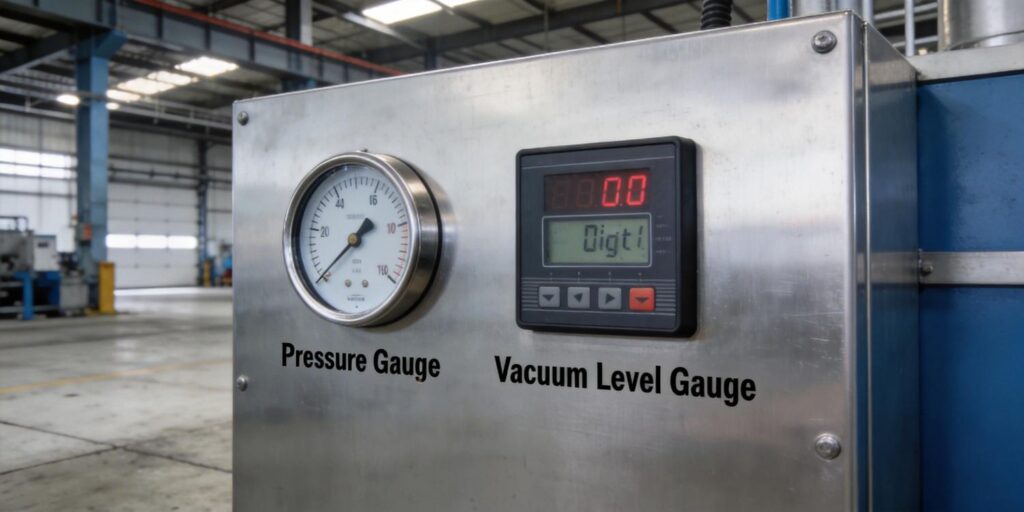
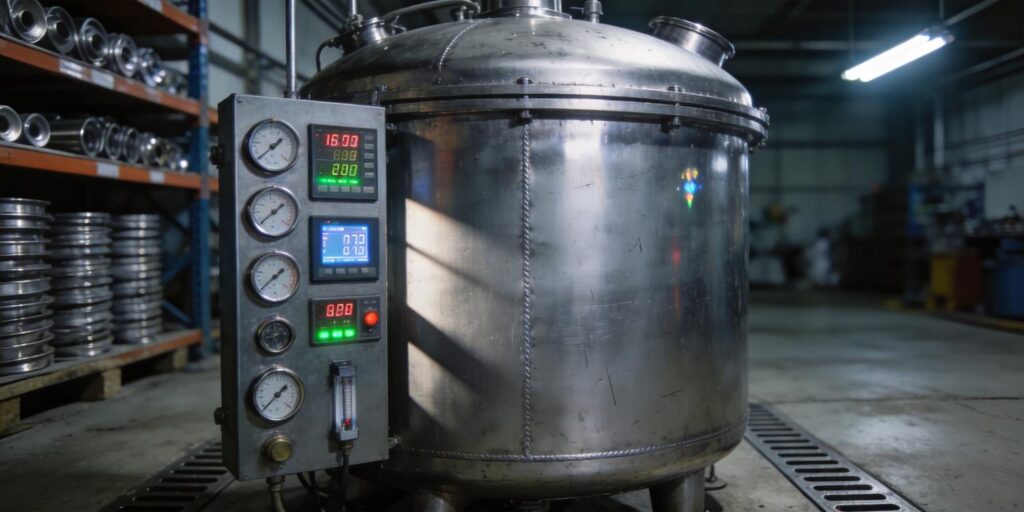
These stages demand vacuum gauges that deliver accurate, real-time data while withstanding the harsh chemical environment of battery production.
Stability Requirements for Reliable Vacuum Monitoring
Stability is non-negotiable in battery manufacturing, where even minor pressure fluctuations or drift can lead to inconsistent drying, incomplete wetting, or undetected contamination. Industry processes often require vacuum stability better than ±1 mbar in critical steps such as electrolyte degassing and filling. Gauges must maintain performance across temperature swings (process chambers reach 150 °C while sensors operate optimally at 15–50 °C) and varying gas compositions (air, NMP vapor, electrolyte volatiles).
Key stability factors include:
- Temperature compensation: Environmental or process-induced temperature changes alter thermal conductivity or discharge characteristics. Effective circuit and algorithmic compensation keeps readings reliable within the operating range.
- Gas independence or calibration: Battery processes involve multiple gases; thermal conductivity gauges (like Pirani) exhibit gas-specific responses, while ionization-based gauges show sensitivity variations. Factory calibration for air or process-specific mapping ensures traceability.
- Long-term reproducibility: In high-volume production lines running 24/7, gauges must resist drift from repeated thermal cycling or minor contamination. Linear response regions (e.g., 10 Torr to 10⁻² Torr for thermal gauges) provide the highest confidence.
Non-linear regions at pressure extremes introduce errors up to ±50 %, making proper gauge selection and placement essential to avoid false readings that could trigger unnecessary process interruptions or quality holds.
Contamination Control in Battery Vacuum Systems
Battery production is extremely sensitive to contamination. Moisture, solvent residues, and electrolyte vapors (e.g., LiPF₆, DME, dioxolane) can degrade electrodes, reduce capacity, or create safety risks. Vacuum gauges themselves must not introduce or accumulate contaminants while remaining easy to maintain.
Common contamination challenges and mitigation strategies:
| Contaminant Source | Impact on Measurement | Mitigation with Modern Gauges |
|---|---|---|
| Moisture and NMP solvent residues | Alters thermal conductivity or causes filament corrosion | Platinum filaments offer superior chemical stability; temperature compensation limits drift |
| Electrolyte volatiles and particulates | Deposits on electrodes, shifting discharge characteristics | Removable sensor heads allow in-situ cleaning with 200–500 grit abrasive without breaking vacuum seal |
| Outgassing from gauge materials | False high-pressure readings during low-pressure stages | Low-outgassing stainless steel, PEEK insulators, and vacuum-grade seals (leak rates ≤10⁻¹¹ Pa·m³/s) |
Cold-cathode designs eliminate hot filaments entirely, avoiding local outgassing and decomposition of sensitive gases. Pirani-type sensors with robust platinum filaments provide maintenance-free operation in less aggressive environments while maintaining 3–5 year lifetimes under typical battery conditions.
Optimal Sensor Configuration Recommendations
Effective vacuum measurement in battery lines requires thoughtful sensor placement, type selection, and integration. A single gauge rarely covers all stages; hybrid configurations deliver the best performance and cost efficiency.
Recommended approach:
- Rough-to-medium vacuum stages (mixing, drying, initial filling): Deploy Pirani vacuum transmitters. Their heat-loss principle excels from atmosphere to 10⁻³ Torr, with highest accuracy in the 10–10⁻² Torr linear range typical of electrode drying and wetting.
- Medium-to-high vacuum stages (deep degassing, final evacuation): Add cold-cathode ionization gauges for pressures below 10⁻³ Torr. Penning discharge operation (crossed E × B fields) provides fast response and wide dynamic range down to 10⁻⁷ Torr without x-ray limitations or hot-cathode outgassing.
- Placement strategies: Direct chamber mounting via KF16/KF25 flanges for true cavity pressure. Tube extensions for oven or dryer access while keeping electronics outside hot zones. Arbitrary orientation eliminates installation constraints.
- Signal integration: 0–10 V analog for PLC compatibility plus RS232 digital output. Protocol customization (5–10 unit minimum) allows seamless integration into existing SCADA or MES systems without custom driver development.
Dual-sensor setups (Pirani + cold cathode) on shared chambers provide continuous coverage and automatic range switching, minimizing operator intervention. Compact footprints (significantly smaller than traditional competitors) facilitate installation in space-constrained production cells and robotic lines.
Why Poseidon Scientific Vacuum Gauges Excel in Battery Applications
Engineered specifically for demanding industrial environments, the VG-SP205 Pirani Vacuum Transmitter and VG-SM225 Cold Cathode Vacuum Gauge address the exact pain points of battery manufacturers: oversized legacy instruments, high imported costs, and rigid communication protocols.
Key advantages include:
- Compact positive-magnetron design for the cold-cathode model—smaller than most market offerings while delivering full 10⁻³ to 10⁻⁷ Torr coverage.
- Platinum filament in the Pirani model for exceptional corrosion resistance and measurement accuracy.
- Field-cleanable cold-cathode sensor (simple abrasive cleaning restores performance without tools or downtime).
- Cost-effective manufacturing (30–50 % below premium imports) with domestic supply-chain stability.
- Built-in temperature compensation and software protection against over-pressure operation.
These transmitters meet or exceed the stability, contamination tolerance, and integration needs of modern gigafactories. Their maintenance-friendly design—Pirani is essentially maintenance-free, cold cathode cleans in minutes—reduces total cost of ownership while supporting high-throughput production.
Optimize Your Battery Production Vacuum Measurement Today
Whether scaling pilot lines or optimizing gigafactory throughput, selecting the right vacuum gauges directly impacts yield, cycle time, and product quality. The VG-SP205 and VG-SM225 deliver the precision, reliability, and flexibility battery engineers demand—at a price point that supports volume deployment.
Contact the Poseidon Scientific team for application-specific configuration, custom protocol development, or a no-obligation performance evaluation. Our engineers stand ready to review your process parameters and recommend the optimal sensor layout for your drying ovens, filling stations, and degassing chambers.
Explore the full specifications:
Take the next step toward tighter process control and higher battery performance. Reach out today—your vacuum measurement optimization starts here.