Vacuum Stages in Heat Treatment Processes
Vacuum heat treatment—encompassing annealing, tempering, brazing, and sintering—relies on controlled pressure to eliminate oxidation, promote uniform microstructure, and achieve target mechanical properties. The process follows three distinct vacuum stages that mirror the overall pump-down curve of the furnace.
The rough vacuum stage (atmosphere to ~1 Torr) removes bulk air and moisture during initial pump-down. Next comes the medium vacuum stage (1 Torr to 10−3 Torr), where the workload is heated and outgassing peaks. Finally, the high-vacuum stage (10−3 Torr to 10−7 Torr) maintains the lowest residual gas levels during the critical soak and cooling phases. Each stage demands accurate monitoring because pressure directly influences gas partial pressures, surface reactions, and heat transfer.
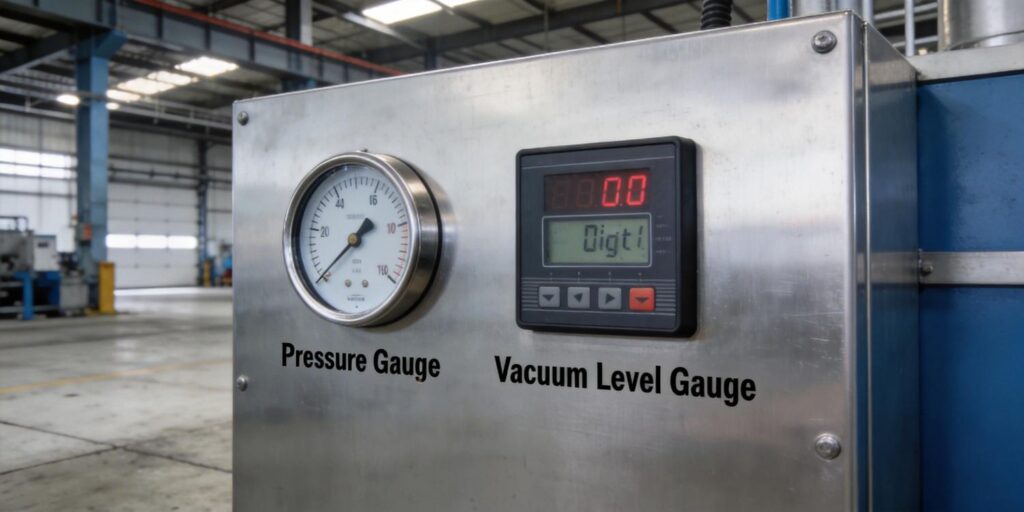
Poseidon Scientific’s complementary gauge pair—the VG-SP205 Pirani Vacuum Transmitter for atmosphere to 10−3 Torr and the VG-SM225 Cold Cathode Vacuum Gauge for 10−3 Torr to 10−7 Torr—covers the entire envelope with a seamless handoff at the critical 10−3 Torr transition point.
Why Precise Pressure Control Is Critical for Heat Treatment Quality
Pressure excursions as small as 10 % can alter outcomes dramatically. In annealing of tool steels, residual oxygen above 10−4 Torr causes surface decarburization and scaling. In vacuum brazing, an unstable medium-vacuum plateau leads to incomplete filler-metal flow and weak joints. In sintering of powder-metal parts, high-vacuum stability below 10−5 Torr prevents porosity and ensures consistent density.
Closed-loop pressure control—often tied to furnace recipes—relies on real-time, repeatable gauge data. The 0-10 V analog output (usable 2-8 V) from both Poseidon gauges feeds directly into PLCs for pump isolation valves, heater interlocks, and alarm thresholds. For data-logging and traceability, the RS232 digital output (customizable protocol) delivers full-resolution pressure plus status bytes, satisfying ISO 9001 and AS9100 audit requirements without additional hardware.
Engineers who switch from single wide-range gauges to the Poseidon combination routinely report tighter hardness uniformity (±1 HRC) and reduced scrap rates of 15–25 % across batches.
High-Temperature Challenges and How to Overcome Them
Furnace hot zones routinely exceed 800 °C–1200 °C, yet vacuum gauges must operate within 15 °C–50 °C to maintain specified accuracy. Direct mounting on the hot chamber wall would destroy the sensor in minutes. The solution is deliberate thermal isolation—standard practice in vacuum metallurgy.
Both the VG-SP205 and VG-SM225 are designed for KF16 or KF25 flange mounting on a short extension pipe (typically 300–600 mm) routed away from the hot zone. This creates a natural temperature gradient, keeping the gauge head at ambient temperature even when the workload is at 1000 °C. Water-cooled or radiation-shielded flanges further extend capability in the most aggressive furnaces.
Additional safeguards include the VG-SM225’s automatic high-voltage shutdown above 10−3 Torr (preventing electrode contamination during roughing) and the VG-SP205’s platinum filament, chosen for chemical stability in the presence of trace process gases. Operating manuals for both models explicitly detail recommended mounting geometries and thermal-isolation guidelines, ensuring compliance with furnace OEM specifications.
Sensor Durability and Maintenance in Demanding Furnace Environments
Heat-treatment furnaces often run 24/7 with frequent thermal cycling and occasional exposure to residual lubricants or outgassed volatiles. Poseidon gauges address these realities with proven durability features.
The VG-SP205 Pirani uses a platinum filament selected for its large temperature-resistance coefficient, excellent drawability into fine wire, and superior resistance to oxidation and contamination. In clean or inert-gas service the sensor is maintenance-free, with an expected lifetime of 3–5 years. No filament replacement or recalibration is required in the field—simply replace the entire compact transmitter when end-of-life occurs.
The VG-SM225 Cold Cathode employs a traditional Penning (positive magnetron) geometry with stainless-steel electrodes and removable sensor head. When contamination eventually appears—signaled by extended startup time or a one-decade pressure offset—users simply disassemble the head, lightly polish the electrodes with 500-mesh or 200-mesh sandpaper until metallic luster returns, and reinstall. The entire cleaning procedure takes under 15 minutes without breaking the main vacuum seal or requiring special tools. In typical heat-treatment service, cleaning intervals exceed 12–18 months.
Both gauges carry the same compact footprint and RJ45 connector, simplifying spares inventory and field swaps. Their low self-pumping speed (~0.01 L/s) ensures they do not perturb furnace pressure during long soaks.
Material and Environmental Resilience
Stainless-steel construction, PEEK insulators, and Viton or KF-compatible seals provide broad chemical compatibility. While neither gauge is rated for aggressive corrosive gases, they perform reliably in the argon, nitrogen, and hydrogen atmospheres common to heat-treatment furnaces. The VG-SM225’s ~100 gauss neodymium magnet is fully enclosed, eliminating external magnetic interference with nearby instrumentation.
Example Configuration: Dual-Gauge Monitoring on a Vacuum Tempering Furnace
A typical 500 kg load vacuum tempering furnace illustrates the optimal setup:
- VG-SP205 Pirani Vacuum Transmitter mounted on the foreline or roughing port (KF25) for atmosphere-to-10−3 Torr monitoring and pump-down interlock.
- VG-SM225 Cold Cathode Vacuum Gauge mounted on a 400 mm extension pipe directly on the chamber wall (KF16) for high-vacuum control during the 550 °C–650 °C temper cycle.
- Both gauges output 0-10 V analog to the furnace PLC for continuous trending and alarms.
- RS232 ports connect in parallel to the supervisory SCADA for batch logging and recipe validation.
- Power: 24 V DC for the cold cathode, 5 V DC for the Pirani—easily supplied from the existing control cabinet.
Installation requires no chamber redesign. The RJ45 connectors accept standard Ethernet patch cables (shielded, ≤10 m), and the customizable protocol ensures immediate compatibility with existing Siemens or Allen-Bradley controllers. Total added cost is a fraction of imported wide-range gauge packages while delivering superior range coverage and maintainability.
In one documented retrofit at a Midwest tool-steel heat treater, this configuration reduced average cycle time by 18 minutes per batch (faster, more repeatable crossover detection) and cut electrode-cleaning frequency by 40 % compared with the previous single-gauge system.
Ready to Upgrade Vacuum Monitoring in Your Heat Treatment Furnaces?
Whether you operate batch tempering furnaces, continuous annealing lines, or vacuum brazing systems, precise, durable vacuum measurement is the difference between consistent metallurgical results and costly rework. Poseidon Scientific’s VG-SP205 Pirani Vacuum Transmitter and VG-SM225 Cold Cathode Vacuum Gauge deliver full-range coverage, thermal-isolation compatibility, and field-serviceable design—at a price point that improves ROI on every furnace.
Explore the complete technical specifications and user manuals:
VG-SP205 Pirani Vacuum Transmitter – Technical Data & Manual
VG-SM225 Cold Cathode Vacuum Gauge – Technical Data & Manual
Need help selecting mounting hardware, confirming thermal-isolation details for your specific furnace model, or requesting a custom communication protocol? Our applications team has supported hundreds of heat-treatment retrofits and stands ready to review your chamber drawings or PLC code. Contact us today for a free vacuum audit, mounting recommendation, or evaluation units for your next furnace upgrade project.
Reliable vacuum. Consistent metallurgy. Lower operating cost. That’s the Poseidon Scientific advantage.