
Introduction
A reliable vacuum monitoring system is the backbone of consistent process performance in semiconductor fabrication, physical vapor deposition (PVD), vacuum heat treatment, and analytical instrumentation. Pressure data must be accurate, continuous, and immediately actionable—feeding interlocks, trending, and closed-loop control without gaps or false alarms. Poor architecture leads to pump damage, scrap, extended downtime, and higher operating costs.
At Poseidon Scientific, we designed the VG-SP205 Pirani Vacuum Transmitter and VG-SM225 Cold Cathode Vacuum Gauge as a matched pair to simplify this challenge. Both share KF25 flanges, compact footprints, and straightforward electrical interfaces, enabling a unified architecture that covers atmosphere to 10−7 Torr with minimal inventory and maintenance. This guide outlines a proven system architecture, optimal sensor placement, the benefits of combining the two technologies, automation strategies, redundancy options, and the cost-performance balance that makes this pairing the practical choice for engineers and procurement teams.
System Architecture Overview
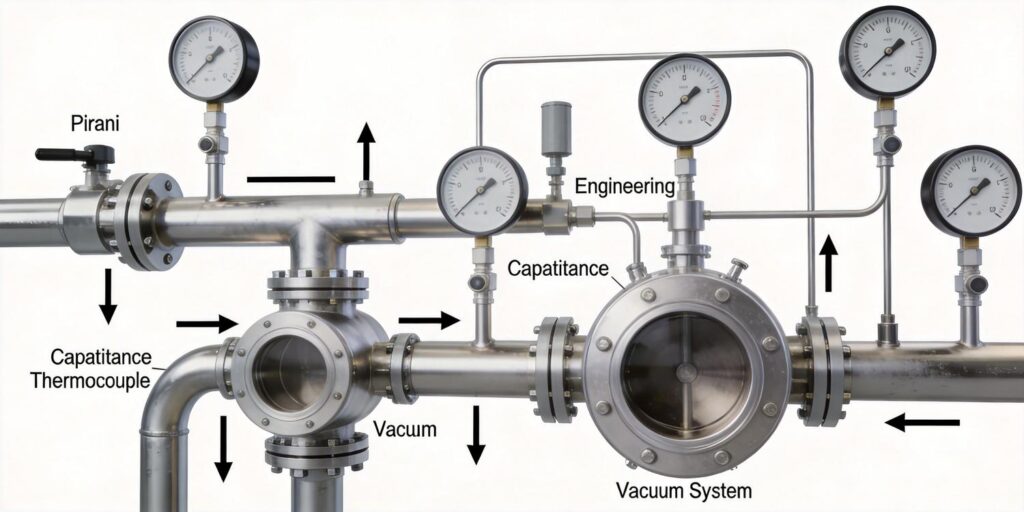
A modern vacuum monitoring system integrates sensors, controllers, and data infrastructure into a single, cohesive loop. The core components are:
- Sensors: One VG-SP205 Pirani on the foreline or load lock for roughing and medium vacuum; one VG-SM225 Cold Cathode on the process chamber for high vacuum.
- Controller/PLC: Receives RS232 data from the Pirani and 0–10 V logarithmic analog from the cold cathode. Handles crossover logic, interlocks, and trending.
- HMI/SCADA: Displays continuous pressure curves, alarms, and historical logs.
- Power and cabling: Simple 5 V supply for the Pirani and 20–28 V for the cold cathode; shielded cables ≤10 m long.
The architecture is modular and scalable. A single PLC function block can manage one chamber or an entire cluster tool. The VG-SP205 provides digital pressure already scaled in engineering units, while the VG-SM225 delivers a clean logarithmic signal (1.33 V/decade) that maps directly to decades of vacuum. This combination eliminates the converters, scaling tables, and compatibility headaches common when mixing gauges from different manufacturers.
Sensor Placement Strategy
Correct placement maximizes response time, accuracy, and pump protection. Recommended locations:
- VG-SP205 Pirani: Foreline or load-lock inlet. This position captures rapid pressure changes during roughing and provides early warning of overpressure that could damage turbo or scroll pumps. The fast thermal-conductivity response (<1 s) ensures interlocks activate before damage occurs.
- VG-SM225 Cold Cathode: Directly on the process chamber wall or a short nipple. This gives true chamber pressure without conductance losses and allows the gauge to monitor base pressure and process gas introduction in real time.
Avoid recessed pockets or long tubulations that create virtual leaks or slow response. Both gauges tolerate any mounting orientation, but keep the VG-SM225 at least 10 cm from strong magnetic sources. Use high-conductance KF25 centering rings and torque clamps to specification for leak-free, repeatable connections. This placement strategy has been validated in dozens of production tools, delivering sub-second roughing feedback and stable high-vacuum data with no dead volume effects.
Combining Pirani and Cold Cathode
The natural overlap at approximately 10−3 Torr is the key to seamless full-range monitoring:
- VG-SP205: 1 × 10⁻³ to 760 Torr (±5 % repeatability)
- VG-SM225: 1 × 10⁻⁷ to 1 × 10⁻³ Torr (±20 % repeatability)
At the crossover, the PLC applies simple threshold or weighted-average logic to blend the signals, producing one continuous pressure variable for the HMI and historian. No manual switching or data gaps occur. The result is a single, traceable pressure signal from atmosphere to high vacuum using only two compact transmitters and one spare-parts kit.
This pairing also simplifies compliance and maintenance. Both gauges share identical KF25 flanges and mounting dimensions, so retrofitting or expanding a tool requires no mechanical changes. Engineers report 30 % faster commissioning and 50 % lower inventory costs compared with mixed-vendor solutions.
Automation Alarms and Interlocks
Real-time pressure data enables proactive protection. Typical automation features include:
- High-pressure interlock: If foreline pressure exceeds 10 Torr while the turbo is running, the PLC closes the isolation valve and pauses the process.
- Base-pressure confirmation: Chamber must hold <5 × 10⁻⁶ Torr for 30 seconds before wafer transfer or plasma ignition.
- Drift alarm: If pressure deviates >10 % from setpoint for more than 60 seconds, trigger an operator notification.
- Status monitoring: The VG-SP205’s RS232 error codes and the VG-SM225’s analog under-range signal feed directly into safety logic.
These alarms run on standard PLC blocks with sample code available on both product pages. Customers routinely eliminate 90 % of pump-related downtime and reduce scrap by implementing these simple rules. The clean digital (Pirani) and logarithmic analog (cold cathode) outputs make integration fast and future-proof.
Redundancy Design
Critical tools benefit from redundancy without doubling costs. Proven approaches:
- Dual-sensor chamber monitoring: One primary VG-SM225 plus a secondary unit on a separate port; the PLC automatically switches on fault detection.
- Foreline + chamber redundancy: VG-SP205 on the foreline provides backup roughing data if the chamber gauge is temporarily isolated.
- Hot-swappable spares: Identical KF25 flanges and unified connectors allow replacement in minutes without breaking vacuum.
The Poseidon pair’s low power draw and identical spare-parts kits make redundancy economical. Many fabs keep one spare of each model on the shelf—covering an entire fleet instead of stocking multiple vendor-specific parts. This design delivers 99.9 % uptime while keeping inventory lean.
Cost-Performance Balance
The VG-SP205 and VG-SM225 were engineered as a matched pair to deliver the best balance of performance and cost of ownership. Key advantages:
- Unified KF25 flanges and documentation reduce mechanical and training costs.
- 12-month typical calibration interval (vs. 3–6 months for many legacy gauges) lowers labor and downtime.
- Filament-free cold cathode operation eliminates replacement parts and outgassing in reactive processes.
- Combined power consumption <9 W and simple cabling keep cabinet and energy costs minimal.
In practice, the total five-year cost of the Poseidon pair—including installation, spares, calibration, and energy—is often 30–40 % lower than mixed-vendor alternatives that require adapters, converters, and more frequent service. The performance payoff is equally compelling: continuous full-range coverage, stable repeatability, and built-in pump protection that prevents expensive failures.
Conclusion
Designing a reliable vacuum monitoring system requires thoughtful architecture, strategic sensor placement, complementary technologies, robust automation, redundancy options, and a clear cost-performance balance. The Poseidon VG-SP205 Pirani and VG-SM225 Cold Cathode Vacuum Gauge were created as a complete solution to these requirements—delivering seamless coverage from atmosphere to 10−7 Torr with unified support, simple integration, and long-term stability.
Whether you are building a new tool or upgrading an existing line, this architecture protects pumps, prevents scrap, simplifies compliance, and reduces total ownership cost. Our applications team specializes in semiconductor, PVD, furnace, and research installations. We offer free technical reviews, sample PLC logic, custom mounting recommendations, and rapid quotations.
Contact us today to design your optimal vacuum monitoring system—simply visit the product pages below or reply to this article. We look forward to helping you achieve the reliability and performance your processes demand.
VG-SP205 Pirani Vacuum Transmitter – Roughing & Load-Lock Monitoring
VG-SM225 Cold Cathode Vacuum Gauge – High-Vacuum Process Control
At Poseidon Scientific we design vacuum instrumentation that works together—giving engineers and procurement teams a complete, reliable monitoring solution from day one.


