
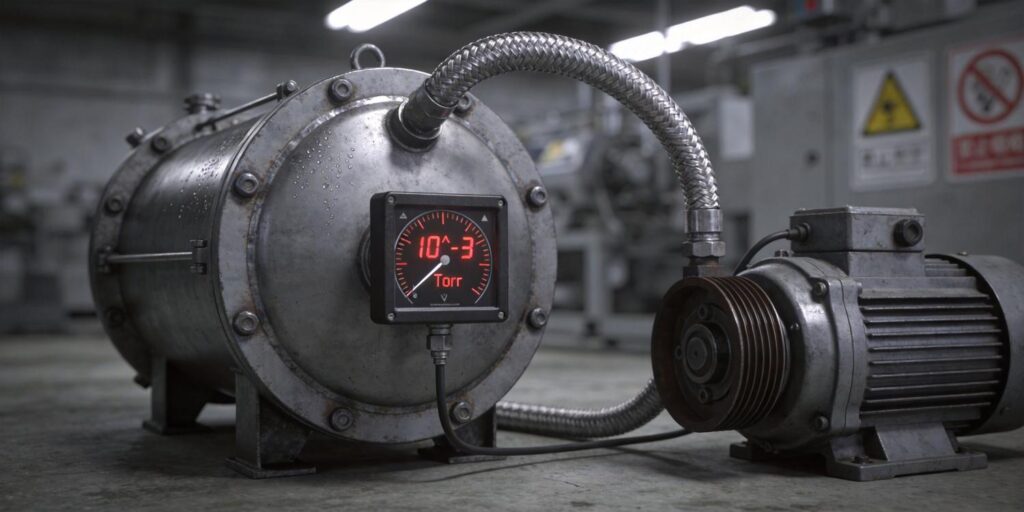
Pump-down Curve Basics
Every vacuum system follows a characteristic pump-down curve: a plot of pressure versus time that reveals how quickly the chamber reaches target vacuum levels. The curve is typically plotted on a logarithmic pressure scale against linear time, showing three distinct phases driven by gas-flow regimes.
In the initial viscous-flow stage (atmosphere down to ~1 Torr), gas behaves like a fluid. Mechanical roughing pumps remove bulk air rapidly, producing a steep initial drop. The transition region (~1 Torr to 10-3 Torr) marks the shift to molecular flow, where mean free path approaches chamber dimensions and conductance limits become critical. Finally, the molecular-flow stage (below 10-3 Torr) is governed by surface outgassing, virtual leaks, and the ultimate speed of high-vacuum pumps—turbomolecular, diffusion, or cryogenic.
Typical pump-down time for a 100-liter chamber with a 10 L/s roughing pump might reach 10-3 Torr in 5–10 minutes, while base pressure of 10-6 Torr can take 30–90 minutes depending on surface area, material, and cleanliness. Factors that flatten the curve include excessive chamber volume, restricted conductance (long or narrow tubing), leaks, and outgassing from elastomers or contaminated walls. Understanding this curve is the first step toward optimization: real-time pressure data turns it from a post-process diagnostic into an active control tool.
Gauge Role in Each Stage
Accurate, stage-specific monitoring is essential because no single gauge covers the entire range with optimal performance. Thermal conductivity and cold-cathode ionization technologies complement each other perfectly.
Rough vacuum stage (atmosphere to 10-3 Torr): The VG-SP205 Pirani Vacuum Transmitter excels here. Its platinum-filament thermal conductivity principle delivers fast response (<0.1 s) and repeatable readings across the full roughing range. Engineers use Pirani data to confirm pump-down speed, verify leak-tightness before heat-up, and trigger turbomolecular pump start at safe crossover pressure. The gauge’s temperature-compensated output prevents false alarms during ambient swings common in industrial environments.
Transition and high-vacuum stage (10-3 to 10-7 Torr): The VG-SM225 Cold Cathode Vacuum Gauge takes over. Operating on the Penning discharge principle with positive magnetron geometry, it provides stable ion-current readings without filament outgassing or burnout risks. At crossover, the cold cathode confirms the turbopump has achieved molecular flow; during the hold phase it verifies base pressure for process quality. Automatic high-voltage shutdown above 10-3 Torr protects the sensor during venting or roughing.
Pairing both gauges on the same chamber—connected via standard RJ45—delivers continuous coverage. Digital RS232 output (customizable protocol) feeds both readings into a single PLC trend log, eliminating blind spots and enabling automated sequencing. This dual-gauge strategy is standard in vacuum furnaces, coating systems, and analytical instruments where pump-down time directly affects throughput.
Why Single-Gauge Strategies Fail
Relying on one gauge forces compromises: a Pirani loses sensitivity below 10-3 Torr (±50 % error), while a cold cathode struggles to ignite or risks damage during roughing. The result is extended pump-down times, unnecessary operator intervention, or undetected problems that waste energy and reduce equipment life.
Detecting Bottlenecks with Real-Time Data
Modern gauges turn the pump-down curve into a diagnostic dashboard. Unexpected plateaus or slope changes pinpoint root causes before they become costly downtime.
- Slow roughing (flat initial slope): Real leaks (O-ring damage, scratched flanges) or excessive conductance restrictions. Pirani readings stabilize above 1 Torr; helium leak testing confirms. Digital rate-of-rise calculation in the PLC flags issues instantly.
- Extended transition plateau (~10-2 to 10-3 Torr): Virtual leaks from trapped volumes (blind holes, porous welds) or high outgassing. Pirani shows slower-than-expected drop; switching to cold cathode reveals the true base pressure lag.
- High-vacuum stall (pressure refuses to drop below 10-5 Torr): Contamination, backstreaming, or insufficient pumping speed. Cold cathode readings drift or show decade-low values after electrode carbon buildup; removable sensor head allows quick confirmation via cleaning test.
- Erratic fluctuations: Temperature drift or gas composition change (process gas introduction). Both Poseidon gauges include active compensation, but trending data isolates the source.
With RS232 streaming at user-defined intervals, engineers can overlay pump-down curves from multiple runs, calculate time-to-target metrics, and set automated alarms. This data-driven approach routinely cuts pump-down time by 20–40 % through early bottleneck detection.
Practical Optimization Tips
Small changes in gauge strategy and system design yield large reductions in cycle time and energy use.
- Optimize gauge location: Mount the Pirani near the chamber (not directly at the pump inlet) to measure true chamber pressure. For the cold cathode, use a short KF extension tube to keep the sensor head cool while maintaining fast response.
- Implement dual-gauge automation: Program the PLC to start the turbopump only when Pirani confirms <5 × 10⁻³ Torr and cold cathode is ready. This prevents premature turbo operation and reduces wear.
- Use digital trending and rate-of-rise tests: Log both gauges continuously. A simple 1-minute isolated rate-of-rise test (valve off the pump) quantifies leak rate in Torr·L/s—far more useful than static pressure snapshots.
- Schedule preventive maintenance: Clean cold-cathode electrodes quarterly with 500-mesh sandpaper; inspect Pirani filament integrity annually. Poseidon’s field-serviceable design keeps downtime under 15 minutes.
- Customize communication for your controller: Poseidon supports full RS232 protocol customization at just 5–10 units. Match data frames, units (Torr/Pa), and alarm thresholds to existing SCADA—no middleware required.
- Minimize virtual leaks upstream: Eliminate blind holes, use vented screws, and perform 80–120 °C bake-outs. Gauge data will confirm faster pump-down immediately.
- Monitor temperature and gas load: Both Poseidon transmitters include built-in compensation; pair with chamber thermocouples for predictive adjustments.
These practices, validated across vacuum heat-treatment and analytical OEM systems, typically reduce pump-down time by 15–50 % while extending pump life and improving process repeatability.
Ready to Shorten Your Pump-Down Cycles?
Optimizing pump-down time is not about buying faster pumps—it is about intelligent monitoring that turns pressure data into actionable decisions. The right gauge strategy reveals hidden bottlenecks, automates safe transitions, and delivers repeatable, energy-efficient cycles.
Poseidon Scientific’s VG-SP205 Pirani Vacuum Transmitter and VG-SM225 Cold Cathode Vacuum Gauge are purpose-built for exactly this task: wide-range coverage, fast response, field maintainability, and full digital integration at a fraction of imported costs.
Explore the VG-SP205 Pirani Vacuum Transmitter for precise rough-vacuum monitoring and rapid leak detection.
Discover the VG-SM225 Cold Cathode Vacuum Gauge for stable high-vacuum performance and easy electrode cleaning.
Need a dual-gauge package, custom protocol for your PLC, or application-specific pump-down analysis? Our engineering team offers free system reviews and typically ships evaluation units within two weeks. Contact us today—shorter cycles, lower costs, and higher throughput start with smarter vacuum measurement.


