
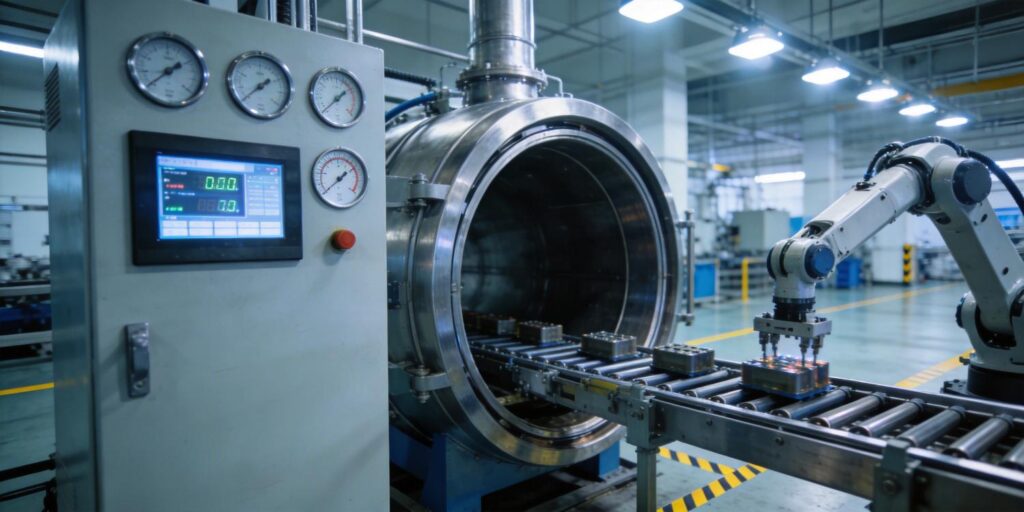
Importance of Continuous Vacuum Monitoring in Automated Manufacturing Lines
In high-volume automated manufacturing—semiconductor fabrication, thin-film deposition, vacuum heat treatment, and precision assembly—vacuum levels must remain within tight tolerances 24/7. A single undetected pressure excursion can trigger scrap, downtime, or out-of-spec parts that cascade through downstream stations. Continuous monitoring with dedicated vacuum gauges is therefore not optional; it is the foundation of process stability and line uptime.
Poseidon Scientific’s VG-SP205 Pirani Vacuum Transmitter (atmosphere to 10−3 Torr) and VG-SM225 Cold Cathode Vacuum Gauge (10−3 Torr to 10−7 Torr) were developed specifically for these environments. Their complementary ranges deliver uninterrupted coverage across every pump-down, process, and vent cycle without gaps or manual intervention. Compact footprints (KF16/KF25) and low power draw allow direct mounting on tool chambers or forelines, while built-in temperature compensation (15 °C–50 °C) keeps readings stable despite the thermal cycling typical of automated lines.
Engineers who integrate these gauges report measurable gains: tighter process windows, reduced variability in film thickness or hardness, and the data foundation required for Industry 4.0 traceability. Continuous monitoring transforms vacuum from a background variable into a controlled, logged process parameter.
Seamless Signal Integration into PLC Systems
Modern automated lines rely on PLCs (Allen-Bradley, Siemens, Omron, etc.) for real-time decision making. Both Poseidon gauges provide dual outputs—0-10 V analog (usable 2-8 V) and RS232 digital—active simultaneously, giving engineers complete flexibility without additional converters.
The analog signal connects directly to any standard PLC analog input card for fast safety interlocks: pump isolation valves, heater enable, or alarm thresholds. Scaling is straightforward (0 V ≈ atmosphere, 10 V ≈ lower limit), and galvanic isolation eliminates ground-loop noise in electrically dense production floors.
For full data intelligence, the RS232 port (RJ45 connector) streams pressure, status codes, error flags, and software version at user-selectable baud rates. Poseidon’s customizable protocol (minimum 5–10 units) matches existing PLC or SCADA drivers without middleware. A single cable carries both analog and digital signals, simplifying panel wiring and reducing points of failure. In practice, integration takes hours rather than days, and the same code base scales across every tool in the fleet.
Result: the PLC sees continuous, high-resolution vacuum data alongside temperature, gas flow, and position sensors—enabling true multi-variable closed-loop control.
Reducing Production Interruptions with Reliable Gauge Performance
Every unplanned stop on an automated line costs thousands in lost output. Traditional wide-range gauges often drift, require frequent replacement, or trigger false alarms during the critical 10−3 Torr transition. Poseidon’s dual-gauge strategy eliminates these interruptions through intelligent design and field-proven durability.
The VG-SP205 Pirani is maintenance-free (3–5 year lifetime in clean service) with a platinum filament selected for chemical stability. The VG-SM225 Cold Cathode features automatic high-voltage shutdown above 10−3 Torr, preventing electrode contamination during roughing, and a removable sensor head that can be cleaned in 15 minutes with 500-mesh sandpaper—no vacuum break required. Both gauges self-report status via RS232, allowing the PLC to detect anomalies (extended startup, contamination offset) before they affect product quality.
Compact size and any-orientation mounting fit existing KF ports without chamber redesign. Low self-pumping speed (~0.01 L/s) ensures the gauges never disturb process equilibrium. In high-throughput deposition and heat-treatment lines, these features routinely extend mean time between interventions from weeks to months, directly translating to higher overall equipment effectiveness (OEE).
Building a Robust Data Feedback Loop
Today’s automated lines demand more than simple monitoring—they require closed-loop feedback that adjusts parameters in real time. Poseidon gauges close that loop with precision.
The PLC receives continuous pressure data and compares it against recipe setpoints. Deviations trigger immediate actions: throttle-valve adjustment, gas-flow correction, or heater power ramping. RS232 status bytes add predictive intelligence—flagging electrode contamination before it shifts readings by a decade or alerting operators to power-supply ripple that could introduce noise.
Because both gauges support parallel analog and digital output, engineers can use the fast 0-10 V path for safety loops and the high-resolution RS232 path for trending and recipe optimization. Data logging at 1 Hz or higher satisfies audit requirements while feeding machine-learning models that predict maintenance intervals or detect subtle process drift.
One semiconductor tool manufacturer using this architecture reduced pressure-related scrap by 18 % and shortened cycle times by 12 % through tighter feedback control—results directly attributable to the stable, high-resolution vacuum signal.
Quantifying ROI: Cost Savings and Performance Gains
Procurement and engineering teams evaluate vacuum gauges on total cost of ownership, not just purchase price. Poseidon’s combination delivers clear, measurable ROI in automated lines.
Capital cost is 40–60 % lower than imported wide-range alternatives while providing equivalent or better functionality. Maintenance is minimal: the VG-SP205 requires none; the VG-SM225 needs only occasional electrode polishing. Custom protocol support eliminates third-party converters or software licenses that can add thousands per tool.
Operational gains compound quickly. Reduced scrap (typically 15–25 % improvement), higher OEE from fewer interruptions, and extended electrode life (12–18 months between cleanings) deliver payback in under six months for most installations. Energy savings from optimized pump and heater control add further value. In a 20-tool production line, the annual savings from one fewer unplanned shift per month easily exceed the entire gauge investment.
These figures are conservative; actual returns depend on line utilization and scrap value, but the pattern is consistent across Poseidon customer installations in semiconductor, optical coating, and vacuum metallurgy facilities.
Ready to Elevate Vacuum Performance in Your Automated Lines?
Continuous, reliable vacuum monitoring is the invisible enabler of consistent output, lower scrap, and higher throughput in automated manufacturing. Poseidon Scientific’s VG-SP205 Pirani Vacuum Transmitter and VG-SM225 Cold Cathode Vacuum Gauge deliver the full-range coverage, PLC-ready signals, and low-maintenance design that engineers need—at a price point that improves ROI from day one.
Explore the complete technical specifications and user manuals:
VG-SP205 Pirani Vacuum Transmitter – Technical Data & Manual
VG-SM225 Cold Cathode Vacuum Gauge – Technical Data & Manual
Need help mapping the dual-output signals to your specific PLC platform, calculating ROI for your line configuration, or requesting a custom communication protocol? Our applications engineers have supported hundreds of automated installations and can review your P&ID drawings or existing code in minutes. Contact us today for a free vacuum-system audit, integration guidance, or evaluation units for your next production line upgrade.
Stable vacuum. Seamless integration. Higher throughput. That’s the Poseidon Scientific advantage.


