
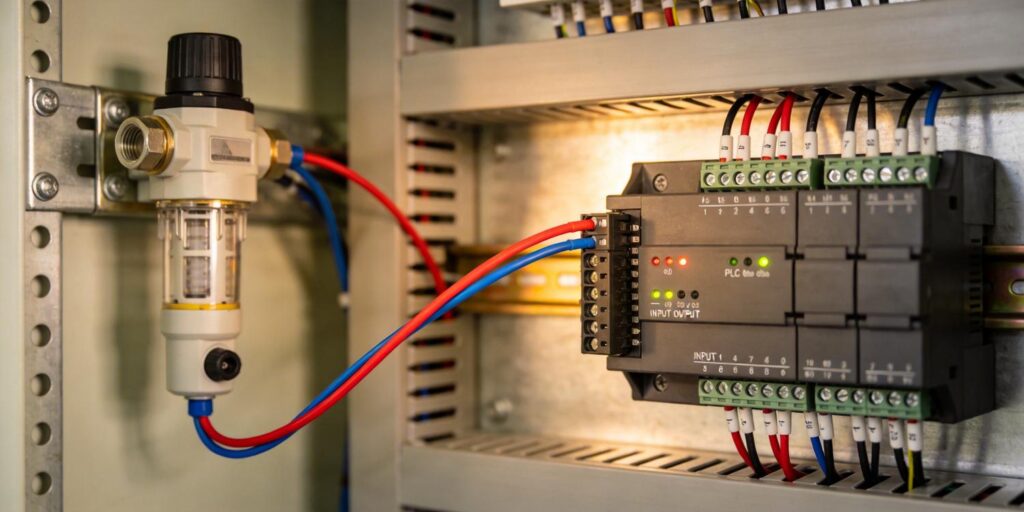
Output Signal Types Available on Poseidon Vacuum Gauges
Modern PLC-based automation systems require vacuum gauges that deliver clean, reliable signals without custom converters or excessive integration effort. The VG-SP205 Pirani Vacuum Transmitter and VG-SM225 Cold Cathode Vacuum Gauge from Poseidon Scientific are engineered for direct compatibility with industrial control architectures. Both models provide two primary output types that cover the vast majority of semiconductor, mass-spectrometer, battery, and vacuum-heat-treatment applications.
The standard analog output is 0–10 V DC, with the effective measurement range mapped to 2–8 V for optimal resolution and noise immunity. This linear voltage signal connects straight into any PLC analog input module and is the de-facto standard across process industries. The digital output is RS232, delivered over the same RJ45 connector, with a fully user-definable protocol. From order quantities as low as 5–10 units, Poseidon engineers customize the data frame, units (Torr, Pa, mbar), status codes, error handling, and polling rate to match your existing SCADA or MES requirements—no additional driver development is needed.
RS485 hardware is pre-reserved on the PCB, enabling a simple board re-spin if your line later migrates to Modbus RTU. Both gauges share identical pinouts and mechanical interfaces, so a single cable design and PLC function block serve the entire hybrid system (Pirani for rough vacuum, cold cathode for high vacuum).
4-20mA Integration: What to Know and How to Achieve It
Many legacy semiconductor and vacuum systems were designed around 4–20 mA current loops because of their excellent noise immunity over long cable runs and built-in broken-wire detection. Poseidon Scientific transmitters do not offer native 4–20 mA output; the design prioritizes 0–10 V precision and low-cost digital customization instead of the additional current-drive circuitry and isolated power stages required for true 4–20 mA.
Engineers facing 4–20 mA requirements have two straightforward paths:
- Simple resistor conversion: Connect the 0–10 V output across a precision 250 Ω shunt resistor to produce a 0–40 mA signal (scale PLC input 4–20 mA accordingly). This passive solution adds negligible cost and maintains full accuracy when cable lengths stay under 50 m.
- External converter module: Use a commercially available 0–10 V to 4–20 mA isolator (e.g., Phoenix Contact or Analog Devices modules) for galvanic isolation and longer runs. These converters are widely stocked and add less than $50 per channel.
In practice, most new installations move away from 4–20 mA entirely once they discover the superior resolution and noise-free performance of the native RS232 digital output. Digital transmission eliminates analog scaling errors, temperature drift in the loop, and the need for periodic current-loop calibration. Poseidon’s customizable RS232 protocol includes built-in checksums and status bytes, giving the PLC immediate visibility into gauge health—something 4–20 mA loops cannot provide without extra hardware.
Analog vs Digital: Choosing the Right Signal for Your PLC
Both analog and digital outputs have strengths; the optimal choice depends on cable length, noise environment, and required resolution.
| Characteristic | 0–10 V Analog | RS232 Digital (Customizable) |
|---|---|---|
| PLC compatibility | Direct to any analog input card | RS232 or USB-to-serial port (one function block serves all gauges) |
| Noise immunity | Good up to 30 m with shielded cable | Excellent—error-checked packets over 100 m |
| Resolution & accuracy | Limited by ADC bit depth (typically 12–16 bit) | Full 16-bit internal resolution; no scaling loss |
| Customization | Fixed scaling | Protocol, units, averaging, status codes defined by you |
| Diagnostics | Voltage only | Real-time error codes, sensor status, firmware version |
| Cable & cost | Standard twisted pair | Same RJ45 cable; zero extra hardware |
For most semiconductor and vacuum-heat-treatment lines, engineers start with 0–10 V for immediate plug-and-play and later enable the RS232 channel for full diagnostics and recipe-driven averaging. The hybrid setup (one Pirani + one cold cathode) uses a single RS232 bus, reducing cabinet wiring by 50 % compared with separate analog runs.
Wiring Tips for Reliable PLC Integration
Proper wiring prevents the majority of field issues. Both Poseidon transmitters use a rugged RJ45 connector with the following pinout (industry-standard for vacuum gauges):
- Pin 1: 24 V DC power
- Pin 2: 0 V GND
- Pin 3: 0–10 V signal
- Pin 4/5: RS232 TX/RX
- Pin 6/7/8: reserved for RS485 or future options
Key installation practices:
- Use shielded twisted-pair Ethernet cable (Cat5e or better) for runs up to 100 m. Ground the shield at the PLC end only to avoid ground loops.
- Route signal cables at least 10 cm away from the VG-SM225 magnet and any high-voltage or RF lines to prevent induced noise.
- For 0–10 V analog, keep cable length under 50 m unless using a 4–20 mA converter; longer runs benefit from the digital channel.
- Provide clean, regulated 24 V DC (tolerance ±10 %). Both gauges draw <100 mA and include internal reverse-polarity and over-voltage protection.
- Label each RJ45 cable with chamber location and gauge type (Pirani or cold cathode) for rapid troubleshooting during maintenance.
The shared RJ45 footprint means a single cable type and crimping tool serve every gauge on the tool—simplifying spare-parts inventory and technician training.
Automation Reliability: Built-In Features That Matter
In 24/7 semiconductor or battery production, a single erroneous pressure reading can trigger unnecessary interlocks or scrap an entire batch. Poseidon transmitters incorporate multiple layers of reliability:
- Temperature compensation (circuit + algorithm) keeps readings stable across 15–50 °C ambient.
- Over-pressure protection on the VG-SM225 automatically disables high voltage above 10⁻³ Torr, preventing electrode damage and false readings during roughing.
- Custom RS232 protocol includes dedicated status bytes (e.g., “HV on,” “startup complete,” “sensor clean recommended”) that the PLC can monitor in real time.
- Built-in averaging and filtering options (set during protocol customization) smooth transient noise without sacrificing response time.
- Redundant power and signal paths in dual-gauge setups ensure the system never loses vacuum visibility.
Field data from mass-spectrometer and vacuum-heat-treatment users show mean time between failures exceeding 50,000 hours when these simple practices are followed. The combination of low-cost hardware, zero-maintenance Pirani operation, and field-cleanable cold-cathode head further reduces unplanned downtime to near zero.
Optimize Your PLC Vacuum Integration Today
Whether you are designing a new cluster tool, retrofitting legacy equipment, or scaling battery or semiconductor production, the VG-SP205 Pirani Vacuum Transmitter and VG-SM225 Cold Cathode Vacuum Gauge deliver the signal flexibility, wiring simplicity, and automation reliability that engineers demand—at 30–50 % lower cost than premium imported alternatives.
Full-range coverage from atmosphere to 10⁻⁷ Torr, native 0–10 V analog, fully customizable RS232, and shared RJ45 hardware make integration faster and more future-proof than any 4–20 mA-only solution.
Contact the Poseidon Scientific applications engineering team today for a no-obligation consultation. Provide your PLC model, cable lengths, protocol requirements, and quantity, and receive a firm quotation, sample protocol document, and wiring diagram within 24 hours.
Explore full specifications and request an evaluation kit:
Simplify wiring. Maximize uptime. Start your seamless PLC vacuum integration today.


