
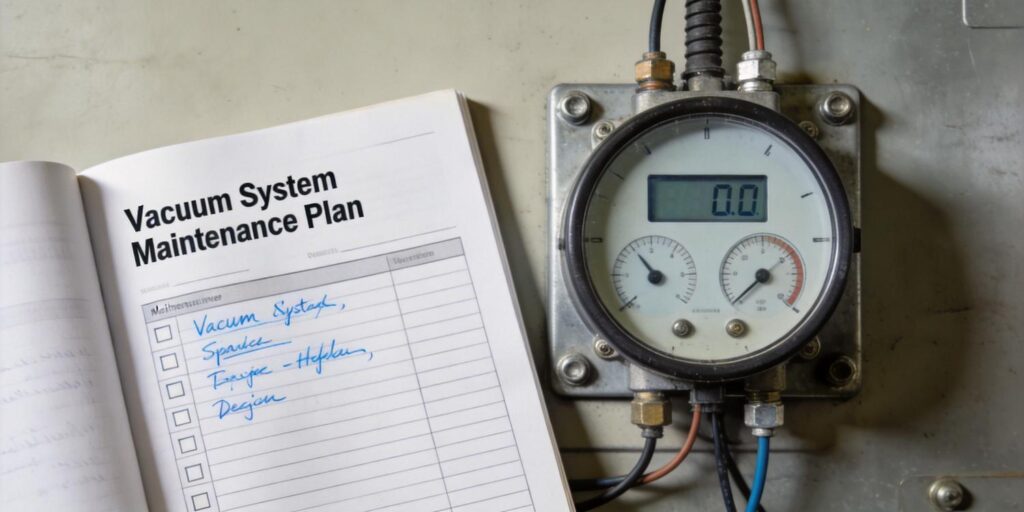
In vacuum-dependent industries—from semiconductor PVD tools and pharmaceutical lyophilizers to vacuum metallurgy furnaces and aerospace test chambers—preventive maintenance of vacuum gauges is not optional. It is the difference between predictable uptime and costly unplanned downtime. A single contaminated or drifted gauge can invalidate an entire batch, extend cycle times, or trigger false interlocks. Poseidon Scientific designed the VG-SP205 Pirani Vacuum Transmitter and VG-SM225 Cold Cathode Vacuum Gauge with field serviceability in mind: the Pirani is truly maintenance-free, while the cold cathode features a removable sensor head that restores performance in under 15 minutes. This article provides a practical, ready-to-implement preventive maintenance plan that engineers and facility managers can adopt immediately to maximize gauge life, ensure measurement reliability, and protect production schedules.
Inspection Intervals
Routine visual and functional inspections catch problems early, before they affect process data. The recommended schedule balances risk with operational practicality and is scalable for both clean analytical labs and moderately contaminated industrial environments.
Daily / Shift-Start Checks (5 minutes)
- Verify the green status LED is lit (discharge active on VG-SM225; normal operation on VG-SP205).
- Compare the gauge reading with any companion gauge in the overlap zone (10⁻³ Torr) or against a known reference pressure.
- Confirm analog output sits within the 2–8 V valid window and digital RS232 frames show error code = 0.
Weekly Checks (10 minutes)
- Review the last 24–48 hours of pressure trends in your SCADA or MES historian for unexplained jumps or slow response.
- Inspect cable connections and RJ45 strain relief for looseness or contamination.
- Log any instances where the VG-SM225 high-voltage protection activated (red LED flashing).
Monthly Deep Inspection (20 minutes)
- Visually check the gauge port for process residue buildup.
- Perform a quick functional test at two known pressures (atmosphere and a stable mid-range point) and record deviation from expected values.
- Download and archive the last month’s digital error codes and software version for trend analysis.
In clean environments (mass spectrometry, SEM), these intervals can be relaxed to weekly and quarterly. In contaminated service (PVD, metallurgy), increase frequency by 50 %. The VG-SP205’s platinum filament and the VG-SM225’s low-field magnet make these checks fast and non-invasive.
Cleaning Schedule
The VG-SP205 Pirani requires zero routine cleaning—its platinum filament is chemically stable and rated maintenance-free for 3–5 years. The VG-SM225 Cold Cathode, however, benefits from scheduled electrode cleaning to prevent carbon or oxide buildup that lengthens ignition delay or drops readings by a full decade.
Recommended Cleaning Frequency
| Environment | Cleaning Interval | Trigger for Earlier Action |
|---|---|---|
| Clean analytical (mass spec, SEM) | Every 12–18 months | Ignition delay >10 min at 10⁻⁶ Torr |
| Moderate contamination (PVD, optical coating) | Every 4–6 months | Reading drops one decade or red LED stays on |
| Heavy contamination (vacuum metallurgy, heat treatment) | Every 1–3 months | Discharge failure error code 128 |
Quick Field Cleaning Procedure (15 minutes)
- Confirm pressure >10⁻³ Torr and high voltage is disabled.
- Remove the sensor head (tool-free bayonet release; chamber vacuum remains intact).
- Lightly abrade cathode column and anode cylinder with 500-mesh or 200-mesh paper until metallic luster returns (no mirror finish required).
- Wipe with isopropyl alcohol, air-dry completely, and reinstall.
- Re-energize—the gauge typically ignites within normal time limits for current pressure.
No recalibration is needed after cleaning. The removable-head design is a key advantage over competing cold-cathode gauges that require full factory return.
Calibration Timeline
Both Poseidon transmitters ship with factory calibration certificates traceable to national standards. Because every unit is individually mapped for geometry and compensation constants, field adjustment is neither possible nor necessary. Recommended calibration intervals for critical applications:
- Annual for GMP, aerospace, or semiconductor production (supports IQ/OQ/PQ and audit readiness).
- Every 24 months for general research or non-regulated industrial use.
- After any major process change that introduces new gases or higher contamination levels.
Calibration is performed by exchanging only the sensor head (VG-SM225) or the complete transmitter (VG-SP205) while the electronics remain in place—minimizing downtime and requalification effort. Many customers rotate a spare head through the calibration lab so the production gauge is never offline.
Spare Parts Planning
A lean spare-parts strategy keeps inventory costs low while guaranteeing rapid recovery. Recommended minimum stock for a facility running 10–20 gauges:
| Item | Quantity | Typical Lead Time | Notes |
|---|---|---|---|
| VG-SP205 complete transmitter | 1 per 10 installed | 2 weeks | Plug-and-play replacement |
| VG-SM225 sensor head only | 1 per 5 installed | 1 week | Field-cleanable and swappable |
| Shielded RJ45 cable (10 m) | 2 spares | Stock | Standard industrial grade |
| 500-mesh abrasive paper + IPA wipes | 1 kit per 10 gauges | Stock | For cold-cathode cleaning |
Because both models share identical KF16/KF25 flanges and RJ45 connectors, a single spare cable type serves the entire fleet. Keep one pre-cleaned VG-SM225 head on the shelf for immediate swap during scheduled maintenance windows.
Documentation Best Practice
Consistent records transform preventive maintenance from a checklist into a strategic asset for audits and continuous improvement. Recommended digital-first approach:
- Use your existing MES, CMMS (e.g., SAP PM, Maximo), or a simple shared spreadsheet/Excel template to log every event.
- Record: gauge serial number, installation date, last cleaning/calibration date, error codes observed, and post-maintenance pressure verification reading.
- Attach photos of electrodes before and after cleaning for the VG-SM225.
- Export digital RS232 logs (error codes, pressure trends) monthly and attach to the gauge record.
- Review trends quarterly: rising ignition delay or increasing error frequency signals the need to adjust cleaning intervals or investigate process contamination sources.
This documentation satisfies ISO 9001, GMP, and NADCAP requirements while providing data for predictive maintenance algorithms in IIoT platforms. Many customers request free firmware customization that automatically appends a “maintenance due” flag when error frequency exceeds thresholds.
Build Your Preventive Maintenance Plan Today
A well-executed preventive maintenance plan for vacuum gauges delivers measurable returns: extended sensor life, reduced unplanned downtime, consistent process data, and simplified compliance. The VG-SP205 Pirani Vacuum Transmitter and VG-SM225 Cold Cathode Vacuum Gauge were designed to make that plan easy to implement—maintenance-free operation where possible, tool-free cleaning where needed, and full digital diagnostics for proactive scheduling.
Whether you manage a high-volume production line or a multi-user research facility, adopting the intervals, procedures, and documentation practices outlined here will protect your vacuum investment and keep your processes running at peak efficiency.
Explore the VG-SP205 Pirani Vacuum Transmitter and VG-SM225 Cold Cathode Vacuum Gauge today. Need a ready-to-use Excel/Word preventive maintenance template, customized cleaning checklist for your environment, spare-parts recommendation based on your fleet size, or a no-obligation on-site audit of your current gauge maintenance practices? Contact our applications team directly—we respond within 24 hours and have helped laboratories and production facilities worldwide implement these exact plans with immediate improvements in gauge reliability and process uptime.


