
Introduction
High-voltage vacuum gauges play a vital role in modern industrial and laboratory systems, enabling precise measurement in the high-vacuum regime where hot-cathode alternatives cannot operate safely or reliably. The Poseidon Scientific VG-SM225 Cold Cathode Vacuum Gauge, for example, applies up to 2500 V to sustain its Penning discharge, delivering stable readings from 10−7 to 10−3 Torr without filament-related limitations. While this technology offers exceptional performance, it also introduces electrical shock hazards that must be actively managed through design, installation, and operating practices.
As the product manager who developed both the VG-SM225 and its low-voltage companion, the VG-SP205 Pirani Vacuum Transmitter, I have seen how proper safety measures prevent incidents while maintaining full measurement capability. This guide outlines the primary high-voltage risks, the critical role of safety interlocks, casing precautions, wiring best practices, and industrial compliance requirements. Following these recommendations helps engineers and procurement teams deploy high-voltage gauges confidently, protecting personnel and ensuring uninterrupted operation in semiconductor, PVD, vacuum furnace, and analytical applications.
High Voltage Risks in Cold Cathode Gauges
The VG-SM225 operates its cathode at negative voltages up to 2500 V to accelerate electrons and maintain the self-sustaining plasma discharge. Although the internal current is limited to under 600 µA for safety, the stored energy in the high-voltage circuit can still deliver a painful or injurious shock if contact occurs while the gauge is energized. Risks increase during installation, maintenance, or troubleshooting when personnel may inadvertently touch exposed connectors or cables.
Additional hazards include:
- Capacitive discharge after power-off if the circuit is not properly bled.
- Arcing or insulation breakdown if cables are damaged or improperly seated.
- Indirect injury from involuntary reaction (e.g., dropping tools or falling) when a shock occurs.
The VG-SP205 Pirani, by contrast, operates at only 5 V DC and presents no shock hazard, making it the preferred choice for roughing and medium-vacuum stages. When high-voltage measurement is required, the VG-SM225’s risks are fully manageable through layered safeguards that begin with system design and extend to daily operating procedures.
The Importance of Safety Interlocks
Safety interlocks are the most effective way to prevent accidental contact with live high-voltage circuits. Modern vacuum systems should never allow the VG-SM225 high voltage to be enabled unless the chamber is under vacuum and all access points are secured. Typical interlock strategies include:
- Door or cover switches that disable high voltage whenever the chamber is open.
- Pressure interlocks that prevent high-voltage activation until the VG-SP205 confirms pressure is below 1 Torr.
- Timed bleed circuits that discharge internal capacitance within 30 seconds of power-off.
These interlocks integrate directly with the VG-SM225 status output and the companion VG-SP205 RS232 signal, creating a fail-safe chain that protects personnel without compromising process automation. In practice, facilities using properly interlocked systems report zero high-voltage incidents over years of continuous operation, while still achieving the fast plasma ignition and stable readings the cold cathode technology provides.
Casing Precautions and Physical Protection
The VG-SM225 enclosure is designed with multiple layers of protection. The outer aluminum housing is fully grounded and rated for the applied voltage, while the high-voltage connector uses industry-standard MHV-style locking to prevent accidental disconnection under power. Nevertheless, best practices include:
- Never remove the gauge or open its casing while powered. The internal current limit reduces severity, but contact with the cathode pin can still cause injury.
- Install the gauge so the connector faces away from routine access paths. Use protective covers or guards over the high-voltage cable entry when the system is in an open area.
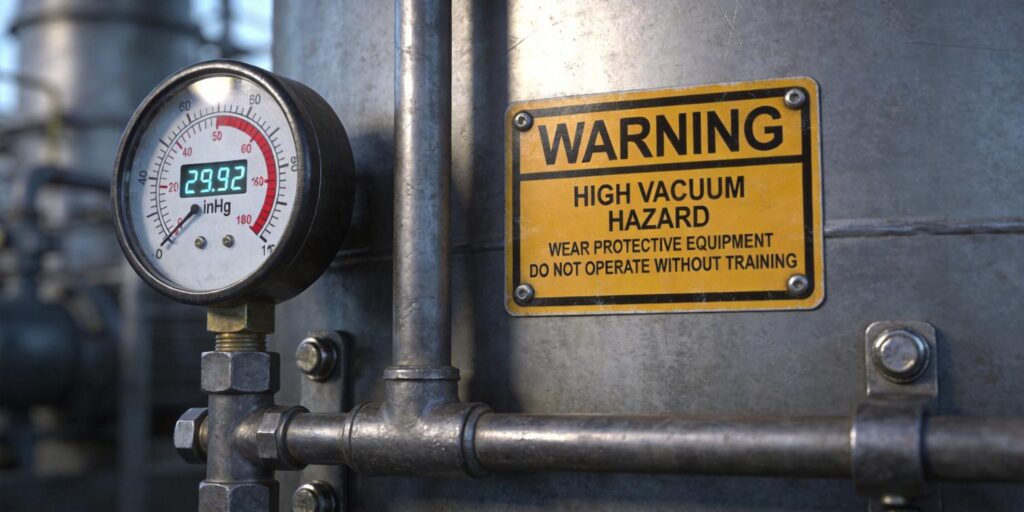
- Label the gauge and surrounding area with clear high-voltage warning stickers. Train all operators and maintenance personnel on the specific hazards of the cold cathode supply.
- After power-off, wait the manufacturer-recommended discharge time (30 seconds for the VG-SM225) and verify zero voltage with a meter before handling the connector.
These simple physical precautions, combined with the gauge’s low stored energy, keep shock risk negligible when standard safety protocols are followed. The VG-SP205, operating at safe low voltage, requires no special casing precautions beyond normal industrial practice.
Wiring Best Practices for High-Voltage Safety
Proper wiring is the first line of defense against electrical shock and ensures long-term reliability. For the VG-SM225:
- Use only Poseidon-supplied or equivalent MHV-rated high-voltage cables. These are double-insulated and strain-relieved to prevent insulation failure.
- Route the high-voltage cable separately from signal and low-voltage lines, maintaining at least 10 cm separation to avoid capacitive coupling or accidental contact.
- Secure all connectors fully—MHV plugs must click into the locked position. Loose connections can arc or expose live pins.
- Ground the gauge housing and cable shield at the power-supply end only, eliminating ground loops that could elevate chassis voltage.
- Install an emergency stop circuit that removes power from the high-voltage supply when activated.
The VG-SP205 uses a simple RJ45 connector at 5 V DC, requiring only standard shielded Ethernet cable and basic grounding. Its low voltage eliminates the need for special high-voltage wiring practices, further simplifying mixed-gauge installations where the Pirani handles roughing and the cold cathode manages high vacuum.
Industrial Compliance and Regulatory Considerations
High-voltage equipment must meet stringent safety standards. The VG-SM225 is designed to comply with IEC 61010-1 laboratory safety requirements and carries CE marking for electrical safety. Facilities operating under OSHA, SEMI, or ISO 9001/14001 should verify the following:
- Documented risk assessment for high-voltage components, including lockout/tagout procedures.
- Annual training for personnel who install or maintain the gauges.
- Regular inspection of cables and connectors for insulation damage or wear.
- Integration of the gauge into the facility’s overall electrical safety program, with clear interlock verification during commissioning.
Using a purpose-designed gauge such as the VG-SM225—rather than adapting general-purpose high-voltage supplies—simplifies compliance because the instrument already incorporates current limiting, grounding, and diagnostic features that meet these standards. Pairing it with the low-voltage VG-SP205 further reduces the scope of high-voltage safety requirements across the system.
Conclusion
Preventing electrical shock in high-voltage vacuum gauges requires a layered approach that begins with proper system design and extends through installation, operation, and maintenance. The Poseidon VG-SM225 Cold Cathode Vacuum Gauge incorporates multiple safety features—current limiting, grounded casing, status diagnostics, and MHV connectors—while the companion VG-SP205 Pirani Vacuum Transmitter operates safely at low voltage, making the pair an ideal solution for full-range monitoring.
By implementing safety interlocks, following casing and wiring best practices, and meeting industrial compliance requirements, engineers and procurement teams can deploy high-voltage gauges with confidence. The result is safe, reliable high-vacuum measurement that protects personnel and keeps production running without interruption.
Need assistance designing interlocks, reviewing your installation for compliance, or selecting the right gauge configuration for your application? Our applications team offers free technical reviews, safety checklist templates, wiring diagrams, and rapid quotations. Contact us today for a no-obligation consultation—simply visit the product pages below or reply to this article.
VG-SM225 Cold Cathode Vacuum Gauge – High-Vacuum Performance with Built-in Safety
VG-SP205 Pirani Vacuum Transmitter – Safe Low-Voltage Roughing Companion
At Poseidon Scientific we design vacuum instrumentation that prioritizes both performance and safety—giving engineers and procurement teams the confidence to operate high-voltage systems without compromise.


