
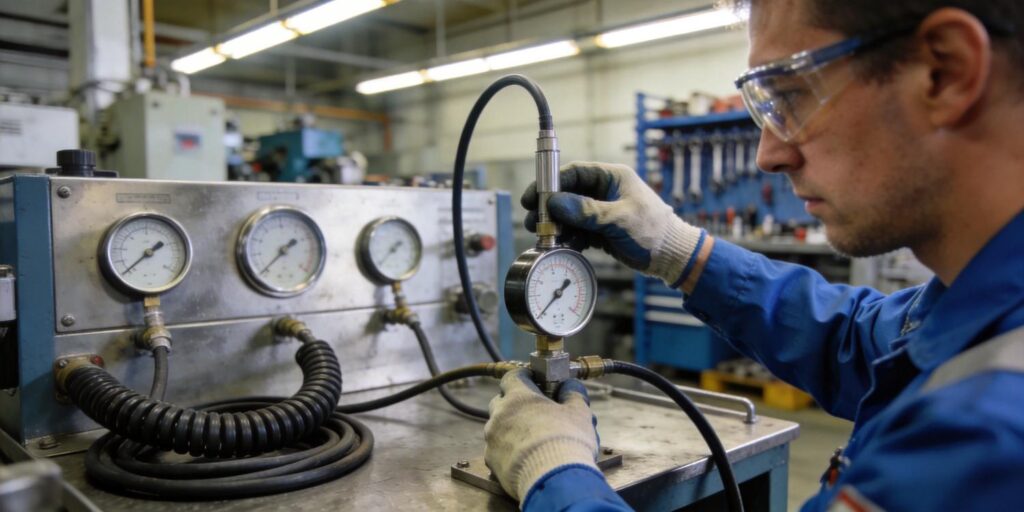
Calibration Standards: Achieving Traceable Accuracy
Vacuum gauge calibration is the foundation of reliable process control in mass spectrometry, PVD coating, vacuum heat treatment, battery manufacturing, and semiconductor applications. Without traceability to recognized standards, even the most expensive gauge can produce misleading data that compromises yield or experimental integrity.
Industry best practice requires calibration against a primary or transfer standard whose accuracy is traceable to a national metrology institute (NIST in the United States, PTB in Germany, or equivalent). For the rough-to-medium vacuum range (atmosphere to 10⁻³ Torr), capacitance diaphragm gauges (CDGs) or spinning-rotor gauges serve as the transfer standard because they measure pressure directly via force or rotor deceleration, independent of gas type. In the high-vacuum range (10⁻³ to 10⁻⁷ Torr), calibrated cold-cathode or hot-cathode reference gauges with known sensitivity factors are used.
At Poseidon Scientific, every VG-SP205 Pirani Vacuum Transmitter and VG-SM225 Cold Cathode Vacuum Gauge undergoes multi-point factory calibration in a dedicated vacuum system. Pressure is stepped across the full operating range while filament power (Pirani) or ion current (cold cathode) is recorded against a NIST-traceable CDG reference. Temperature compensation coefficients are also mapped across the entire 15–50 °C operating window. The resulting lookup table is burned into non-volatile memory, delivering out-of-the-box accuracy of ±5–10 % in the linear zone for air-calibrated units.
Because both gauges are gas-dependent, Poseidon offers free custom gas mapping (minimum 5–10 units) for dominant process gases such as helium, argon, or nitrogen. This eliminates the need for external correction factors and ensures the transmitter reports true pressure directly to your PLC or DAQ system.
Calibration Frequency: Balancing Risk and Cost
There is no universal “one-size-fits-all” interval. Frequency depends on usage intensity, process gas aggressiveness, contamination level, and regulatory requirements (ISO 17025, IATF 16949, or internal quality systems).
Recommended guidelines for Poseidon gauges:
| Application | Recommended Interval | Trigger for Earlier Action |
|---|---|---|
| Research / low-volume labs | Annual verification | Drift >10 % at reference point |
| Semiconductor / PVD production | Every 6–12 months | After 500 process cycles or visible electrode discoloration |
| Battery or heat-treatment lines | Quarterly spot-check + annual full calibration | Startup time increase or decade shift after cleaning |
The VG-SP205 Pirani is sealed and cannot be field-calibrated; any significant drift indicates filament aging or contamination and requires transmitter replacement. The VG-SM225 cold cathode, however, benefits from field electrode cleaning that restores performance in >95 % of cases, often extending the interval between full factory calibrations to 18–24 months. Built-in status indicators and customizable RS232 protocol allow real-time monitoring of drift trends, enabling predictive rather than calendar-based scheduling.
Equipment Required for Accurate Calibration
A proper calibration bench replicates the gauge’s actual operating environment. Essential components include:
- Reference standard: NIST-traceable CDG (0.1 % accuracy) for rough vacuum; calibrated ionization gauge for high vacuum.
- Vacuum chamber: Stainless-steel test dome with multiple ports, turbo pump, and gas inlet manifold.
- Gas handling: Mass-flow controllers for pure air, N₂, He, Ar, etc., plus temperature-stabilized lines.
- Thermal control: Enclosure or fluid bath to cycle the gauge across 15–50 °C while logging compensation performance.
- Data acquisition: High-resolution multimeter or DAQ for analog output; serial terminal for RS232 protocol verification.
Poseidon Scientific’s factory system meets these requirements and includes automated pressure stepping and statistical analysis to generate a full calibration certificate with uncertainty budget. For customers needing on-site verification, a portable CDG reference kit combined with the gauge’s RS232 output allows quick spot-checks without sending units back.
On-Site vs. Laboratory Calibration: Choosing the Right Approach
Laboratory (factory) calibration remains the gold standard for both Poseidon models. The controlled environment, NIST-traceable references, and multi-point thermal cycling produce the lowest uncertainty. Turnaround is typically 5–7 business days, with full certificates and before/after data provided.
On-site verification is practical for trend monitoring and non-critical applications. Using a portable reference CDG and the gauge’s own analog or digital output, engineers can confirm performance at one or two known pressures (e.g., 1 Torr and 10⁻⁵ Torr in air) in under 30 minutes. This approach catches drift early without removing the gauge from the tool.
Key differences:
| Aspect | Laboratory Calibration | On-Site Verification |
|---|---|---|
| Uncertainty | ±2–5 % (full multi-point) | ±5–10 % (spot check) |
| Traceability | Full NIST certificate | Internal record only |
| Downtime | 5–7 days (swap spare) | <1 hour |
| Best for | Annual compliance, new installations | Monthly trend checks |
Most high-volume users keep one spare VG-SP205 or VG-SM225 head on the shelf, swap during annual factory calibration, and perform on-site verifications quarterly. The removable sensor head on the VG-SM225 makes this workflow especially efficient—no full gauge removal required.
Documentation: Building an Audit-Ready Calibration History
Complete records are non-negotiable for ISO audits, customer qualification, and internal continuous-improvement programs. Every calibration event should capture:
- Gauge serial number and firmware version
- Date, technician, and reference standard ID
- Before-and-after data tables (pressure vs. output at 5–10 points)
- Temperature compensation verification
- Uncertainty statement and pass/fail criteria
- Corrective actions (e.g., electrode cleaning performed)
Poseidon provides a digital calibration certificate with every factory service and a simple Excel template for on-site verifications. Customers using the customizable RS232 protocol can automatically log calibration events and drift trends directly into their MES or maintenance database. This digital thread simplifies compliance and helps predict when the next service is required.
Ready to Implement World-Class Vacuum Gauge Calibration Practices?
Following these best practices—traceable standards, appropriate frequency, proper equipment, the right mix of on-site and lab calibration, and rigorous documentation—ensures your vacuum gauges deliver repeatable, trustworthy data for years. The VG-SP205 Pirani Vacuum Transmitter and VG-SM225 Cold Cathode Vacuum Gauge from Poseidon Scientific were designed with these exact requirements in mind: factory multi-point NIST-traceable calibration, field-cleanable high-vacuum head, free custom gas mapping, and full protocol customization from just 5–10 units.
Whether you are managing a research core facility, scaling semiconductor production, or optimizing battery manufacturing lines, Poseidon gauges reduce calibration burden while delivering performance that rivals instruments costing twice as much.
Contact the Poseidon Scientific applications engineering team today for a no-obligation calibration consultation. Share your current gauge models, process gases, and compliance requirements, and receive a firm quotation, sample calibration certificate, and customized maintenance schedule within 24 hours.
Explore full specifications and request an evaluation unit:
Calibrate with confidence. Maintain compliance. Maximize gauge life. Your vacuum measurement excellence starts here.


