
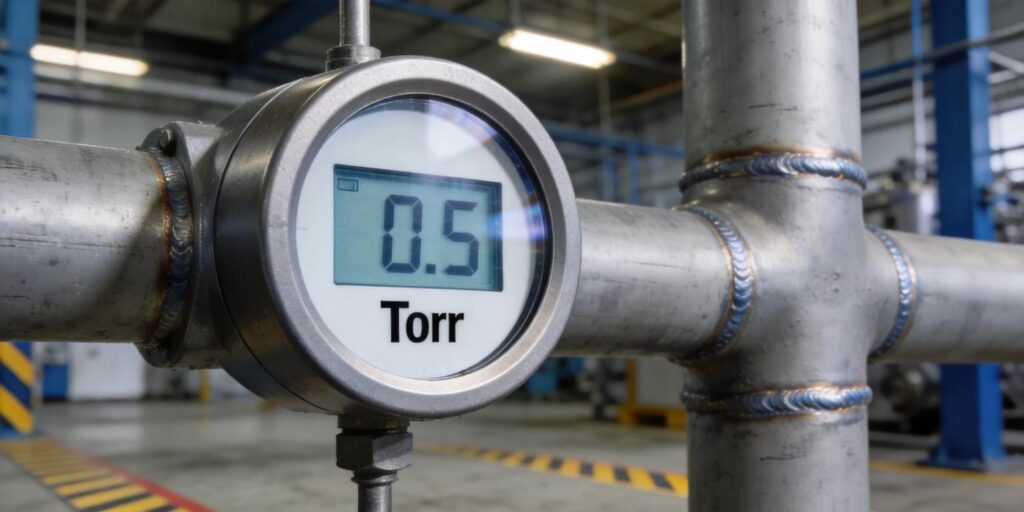
Cold Cathode Ignition Threshold: The Physics Behind Premature “Zero” Readings
High-vacuum cold cathode gauges, such as the VG-SM225 Cold Cathode Vacuum Transmitter from Poseidon Scientific, rely on a Penning discharge to generate a measurable ion current. A compact NdFeB magnet produces an axial field of ~100 Gauss while a high negative voltage (–2500 V for startup, then –2000 V steady-state) creates a radial electric field. Electrons emitted by field emission follow long spiral trajectories in the crossed E × B fields, ionizing residual gas molecules even at extremely low pressures.
The discharge only becomes self-sustaining once enough ionizing collisions occur. At pressures below 10⁻⁶ Torr, molecular density is so low that electrons may travel for minutes before striking a molecule. This creates a natural ignition threshold. If the discharge fails to ignite—or ignites only after a long delay—the gauge electronics interpret the absence of ion current as “zero pressure” (the bottom of the scale). Many operators see this as the gauge “showing zero too early,” when in reality the plasma has simply not yet established itself.
The VG-SM225 mitigates this with an automatic high-voltage boost at startup and software that disables the high voltage above 10⁻³ Torr to protect electrodes. However, the fundamental threshold remains: at 10⁻⁶ Torr ignition typically takes ~5 minutes; at 10⁻⁷ Torr it can reach 30 minutes. Understanding this threshold prevents misdiagnosis of system problems when the gauge simply needs time or a brief pressure pulse to ignite.
Pump-Down Curve: When the Gauge Should (and Should Not) Reach Zero
A typical high-vacuum pump-down curve is not linear. Roughing pumps quickly drop pressure from atmosphere to ~10⁻³ Torr, after which turbomolecular or cryogenic pumps take over. The curve flattens as outgassing and wall desorption become the limiting factors.
During this transition the cold cathode gauge should remain silent or show its minimum value until the pressure actually crosses the ignition threshold. If the gauge suddenly drops to zero while the system is still at 10⁻⁴ or 10⁻⁵ Torr, something is wrong. Common causes include:
- Contamination shifting the ignition curve higher (electrode deposits raise the work function and reduce secondary-electron yield).
- Insufficient startup voltage or a weak magnet field after prolonged use.
- Partial pressure of heavy gases (argon, solvent vapors) that suppress the avalanche.
Pairing the VG-SM225 with the VG-SP205 Pirani Vacuum Transmitter provides the full picture. The Pirani tracks the roughing phase accurately down to 10⁻³ Torr, confirming the system is still pumping while the cold cathode waits for ignition. Automatic range switching in the PLC prevents false “zero” alarms and gives operators confidence that the high-vacuum stage is proceeding normally.
System Leaks: The Invisible Reason the Gauge Appears to Reach Zero Prematurely
Even a small leak can keep true chamber pressure higher than the gauge indicates. In a contaminated cold cathode, electrode deposits reduce ion current for any given pressure, so the gauge reports a lower pressure (higher vacuum) than actually exists. The system may appear to reach “zero” (10⁻⁷ Torr) on the display while the Pirani or a reference gauge still shows 10⁻⁵ Torr.
Leads to classic symptoms:
- Gauge reads one full decade lower than expected during pump-down.
- Startup time extends dramatically or fails entirely (red indicator stays on).
- Base pressure never improves despite longer pump-down times.
Common leak sources in research and production systems include O-ring degradation, loose KF clamps, virtual leaks from trapped volumes, or permeation through elastomers. Because the cold cathode is more sensitive to surface condition than to absolute molecular density, contamination and leaks often masquerade as each other—making systematic diagnosis essential.
Diagnostic Steps: Identify the Root Cause in Under 15 Minutes
Follow this proven sequence before replacing any component. It resolves the majority of “zero too early” complaints without tools or downtime.
- Check the indicator lamp. Steady red = high voltage disabled or discharge not ignited. Flashing = normal protection mode. Green = discharge active. If red persists after 10 minutes at target pressure, proceed to cleaning.
- Cross-check with a rough-vacuum reference. If your system includes a Pirani (VG-SP205), confirm it still reads above 10⁻³ Torr while the cold cathode shows minimum. This proves the chamber is not yet at ultra-high vacuum.
- Perform a brief pressure pulse test. Introduce a small burst of dry nitrogen to ~10⁻⁴ Torr, then pump down again. If the cold cathode ignites immediately and tracks normally, contamination is confirmed.
- Inspect and clean the sensor head. Remove the VG-SM225 head (no chamber venting required). Lightly abrade cathode and anode plates with 200–500 grit sandpaper until metallic luster returns. Reinstall and retest. Performance restores in >95 % of cases.
- Leak-check the system. Use the Pirani or a helium leak detector on all flanges, O-rings, and feedthroughs. Tighten or replace any suspect seals.
- Verify magnet and voltage. Confirm the ~100 Gauss field (simple compass test) and that the supply reaches –2500 V briefly at startup. Both are factory-set and rarely drift.
The removable-head design of the VG-SM225 makes step 4 trivial—unlike sealed legacy gauges that require full replacement or return for service. Documenting the before-and-after ion-current curve (via RS232) provides objective proof of restoration.
Prevent Future “Zero Too Early” Issues and Maximize System Uptime
The VG-SM225 Cold Cathode Vacuum Gauge was engineered specifically for demanding high-vacuum environments where contamination and startup delays are everyday realities. Its compact positive-magnetron structure, field-cleanable sensor head, built-in over-pressure protection, and free protocol customization from just 5–10 units eliminate the classic frustrations of oversized, expensive, and non-serviceable imported instruments.
Pair it with the maintenance-free VG-SP205 Pirani Vacuum Transmitter for seamless full-range monitoring from atmosphere to 10⁻⁷ Torr. Both share the same RJ45 connector, 0–10 V analog output, and customizable RS232 protocol—simplifying integration with any PLC, DAQ, or SCADA system while cutting total cost of ownership by 30–50 % versus premium alternatives.
Contact the Poseidon Scientific applications engineering team today for a no-obligation consultation. Share your pump-down curve data, chamber type, or current gauge symptoms, and receive a firm quotation, custom protocol sample, and diagnostic checklist within 24 hours.
Explore full specifications and request an evaluation unit:
Stop guessing why your gauge shows zero too early. Diagnose, clean, and prevent—your reliable high-vacuum monitoring solution starts here.


