
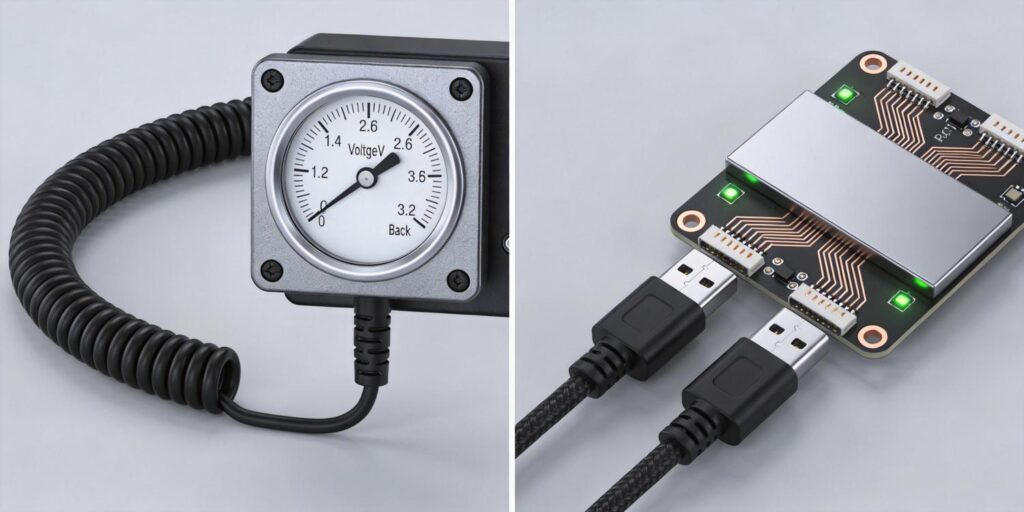
Understanding the 0-10V Analog Output for Vacuum Gauges
In vacuum systems for thin-film deposition, semiconductor processing, and analytical instrumentation, the choice of signal output directly affects integration speed, long-term reliability, and total system cost. Poseidon Scientific’s VG-SP205 Pirani Vacuum Transmitter and VG-SM225 Cold Cathode Vacuum Gauge both provide a standard 0-10 V DC analog output (usable range 2-8 V) that has become the de-facto interface for PLCs and data-acquisition systems worldwide. This linear voltage scales proportionally with pressure: typically 0 V at atmosphere and 10 V at the lower measurement limit, with the most accurate portion falling between 2 V and 8 V to avoid edge nonlinearity.
The analog signal requires no protocol, no software drivers, and no serial-port configuration. A simple shielded twisted-pair cable carries the signal directly to an analog input card. For engineers building basic pump-down interlocks or pressure-threshold alarms, this simplicity eliminates coding overhead and reduces commissioning time to minutes. The output is galvanically isolated in both gauges, minimizing ground-loop noise in electrically noisy production environments. However, analog transmission is inherently susceptible to electromagnetic interference over long cable runs and offers limited resolution—typically constrained by the 12-bit or 16-bit ADC in the receiving PLC.
RS232 Digital Communication: Full Data, Full Control
For applications demanding higher fidelity and system intelligence, both Poseidon gauges also output pressure data via RS232 serial communication through the industry-standard RJ45 connector. The protocol is fully customizable at the factory (minimum order 5–10 units), allowing seamless integration into existing tool software without middleware. Each data frame includes not only the pressure value but also real-time status codes, error flags, and software version—information impossible to convey with a single analog line.
RS232 transmission is noise-immune over distances up to 15 m (extendable with simple repeaters) and supports full 32-bit floating-point resolution. Engineers receive the exact pressure in Torr or Pa, plus diagnostic data that enables predictive maintenance. For example, the VG-SM225 can report high-voltage shutdown events or startup delays, while the VG-SP205 flags filament-health indicators. Because the protocol is open and documented in the user manual, integration into LabVIEW, Python, or SCADA platforms takes only a few dozen lines of code.
Integration Complexity: Analog vs. Digital Trade-offs
Analog integration wins on simplicity. Connect the 0-10 V pins, scale the PLC register, and the system is live. No baud-rate settings, no parity checks, no firmware updates. This approach dominates cost-sensitive OEM builds and retrofit projects where the controller already has spare analog channels. Procurement teams appreciate the zero software-validation overhead and immediate compatibility with legacy Allen-Bradley or Siemens PLCs.
Digital RS232 integration requires slightly more upfront effort—serial-port configuration and protocol parsing—but delivers exponential long-term benefits. Poseidon’s customizable protocol eliminates the need for third-party converters or custom drivers required by many imported gauges. Once implemented, the same code base scales across every gauge in the fleet, and the extra diagnostic bytes dramatically reduce troubleshooting time. For systems already using Ethernet or USB-to-serial bridges, the incremental complexity is negligible. In practice, most engineers who start with analog for prototypes migrate to RS232 for production to gain logging, closed-loop control, and remote monitoring capabilities.
Data Resolution Comparison: When Every Digit Matters
Resolution differences become critical in high-precision processes. A typical 12-bit PLC analog input provides roughly 2.4 mV steps across 0-10 V, translating to pressure resolution of only 0.024 % of full scale at best—often masked by noise. In the VG-SP205’s medium-vacuum band (1–10 Torr), this can mean ±0.1 Torr uncertainty, enough to affect sputtering rate repeatability.
RS232 digital output, by contrast, delivers 16-bit or higher internal resolution with floating-point transmission. Engineers receive pressure values resolved to 0.001 % of reading, plus temperature-compensated accuracy that stays within the published specifications (±5 % for Pirani, ±20 % for cold cathode across the full range). The digital stream also carries status bytes that flag out-of-range conditions, cable faults, or sensor contamination—diagnostics that simply do not exist in analog form. For closed-loop pressure control in atomic-layer deposition or mass-spectrometer foreline monitoring, the digital path eliminates the quantization errors and drift that plague analog chains.
| Feature | 0-10 V Analog | RS232 Digital |
|---|---|---|
| Resolution | Limited by ADC (typically 12-bit) | Full 16-bit floating point |
| Noise immunity | Susceptible to EMI | Excellent over 15 m |
| Diagnostic data | None | Status, error codes, version |
| Integration effort | Minutes (wiring only) | Hours (protocol parsing) |
| Custom protocol support | N/A | Standard at Poseidon (5–10 units) |
Industrial Application Examples: Matching Output to Process Needs
In vacuum heat-treatment furnaces, the 0-10 V analog output of the VG-SP205 Pirani is the clear choice. A simple threshold comparator triggers the high-vacuum pump when pressure drops below 1 Torr—no software required. The same analog signal drives LED bar-graph displays on the operator panel, giving shop-floor personnel instant visual feedback.
Semiconductor PVD tools and scanning-electron-microscope systems favor RS232. Engineers log every pressure point with timestamps for traceability, implement recipe-based pressure ramps, and receive instant alerts if the VG-SM225 cold cathode shows contamination-induced startup delay. One major optical-coating customer reported reducing scrap by 22 % after switching to digital output and using the extra status bytes to trigger automated electrode-cleaning cycles.
Hybrid systems are increasingly common: use the 0-10 V line for fast safety interlocks and RS232 for supervisory SCADA monitoring. Poseidon’s dual-output design (both signals active simultaneously) makes this architecture trivial—no additional hardware or splitters needed. The RJ45 connector even supports future migration to RS485 if the plant standard evolves.
Choosing the Right Output for Your Vacuum System
The decision ultimately hinges on three questions: Do you need only basic pressure thresholds or full process intelligence? Is your controller analog-native or already networked? And how important will data traceability become in the next 24 months? For simple, cost-driven applications, the 0-10 V analog output delivers immediate value. For Industry 4.0 readiness, predictive maintenance, and highest measurement fidelity, RS232 digital communication—especially with Poseidon’s customizable protocol—future-proofs the investment.
Both the VG-SP205 Pirani Vacuum Transmitter and VG-SM225 Cold Cathode Vacuum Gauge give you both outputs as standard, so you never have to compromise or pay a premium for flexibility.
Ready to Select the Optimal Vacuum Gauge Output?
Whether your next project demands plug-and-play analog simplicity or full-featured digital intelligence, Poseidon Scientific has the exact solution—backed by compact size, low cost, and factory-customizable protocols that imported brands simply cannot match.
Download the complete user manuals and protocol specifications:
VG-SP205 Pirani Vacuum Transmitter – Full Specifications & Manual
VG-SM225 Cold Cathode Vacuum Gauge – Full Specifications & Manual
Need help deciding which output best fits your PLC, SCADA, or LabVIEW architecture? Our applications engineers can review your wiring diagram, recommend the ideal configuration, and even supply sample code or custom-protocol firmware. Contact us today for a free integration consultation or to request evaluation units for your next vacuum tool build.
Choose once. Measure accurately. Scale confidently. That’s the Poseidon Scientific advantage.


