Working Principles
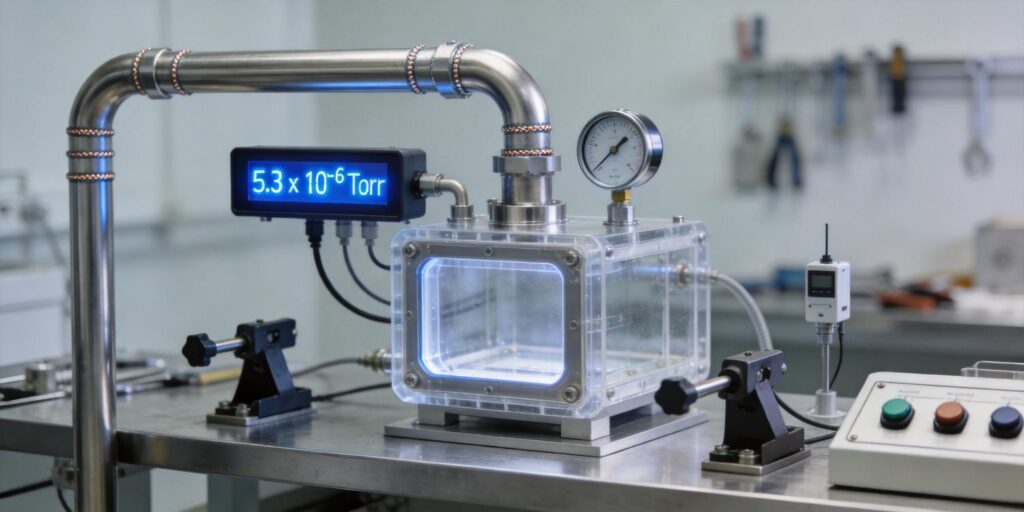
Thermal conductivity gauges and ionization gauges represent two fundamentally different approaches to vacuum measurement, each leveraging distinct physical phenomena to infer pressure. Understanding these mechanisms helps engineers select the right technology for reliable process control and system protection.
Thermal Conductivity Gauges (Pirani Principle)
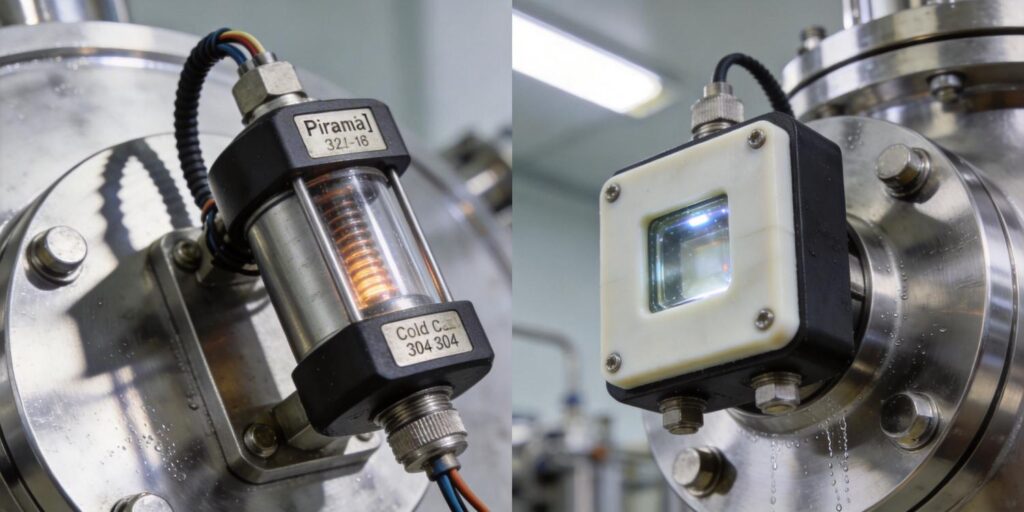
A Pirani gauge measures pressure through the thermal conductivity of the residual gas. A thin metal filament—typically platinum in modern designs—is heated to a constant temperature within a Wheatstone bridge circuit. Gas molecules collide with the hot filament and transfer heat to the cooler chamber walls. At higher pressures, more molecules are present, increasing heat loss and requiring greater electrical power to maintain the filament temperature. The power (or resulting voltage across the bridge) is therefore directly related to gas density and pressure in the molecular-flow regime.
This relationship holds best between approximately 10 Torr and 10-2 Torr, where heat transfer is proportional to pressure. Outside this range, convection or conduction through the supports dominates, reducing sensitivity. The gauge is gas-dependent because different gases carry heat at different rates; calibration is usually performed for nitrogen or air.
Ionization Gauges (Cold Cathode / Penning Discharge)
Cold cathode gauges generate ions without a hot filament. A high voltage (typically 2 kV) applied between anode and cathode, combined with a permanent magnet (~100 gauss), creates a Penning discharge. Electrons emitted by field emission or cosmic rays follow long spiral paths in the crossed electric and magnetic fields, colliding with gas molecules and producing positive ions through avalanche multiplication. The resulting ion current collected at the cathode is proportional to the number of gas molecules—and thus to pressure.
Because the discharge is self-sustaining down to very low pressures, cold cathode gauges excel where hot-filament devices would fail due to burnout or outgassing. No thermionic emission means negligible additional gas load and immunity to reactive process gases that would degrade filaments.
Measurement Range
The usable pressure ranges of the two technologies are complementary rather than overlapping, enabling seamless full-range monitoring when paired.
| Gauge Type | Full Range (Torr) | Linear / Optimal Range (Torr) | Typical Poseidon Model |
|---|---|---|---|
| Thermal Conductivity (Pirani) | Atmosphere to 10-3 | 10 to 10-2 | VG-SP205 Pirani Vacuum Transmitter |
| Ionization (Cold Cathode) | 10-3 to 10-7 | 10-3 to 10-6 | VG-SM225 Cold Cathode Vacuum Gauge |
The Pirani covers roughing and backing-pump stages, while the cold cathode handles the high-vacuum analyzer region. Crossover at ~10-3 Torr allows continuous monitoring without gaps. Advanced convection-enhanced Pirani designs extend readability to atmosphere, but standard thermal conductivity performance drops sharply below 10-3 Torr.
Accuracy Comparison
Both gauge families are indirect instruments whose readings depend on gas composition, temperature, and operating conditions. Absolute accuracy is secondary to repeatability and stability in most industrial and analytical applications.
| Parameter | Pirani (VG-SP205) | Cold Cathode (VG-SM225) |
|---|---|---|
| Optimal-range accuracy (air/N₂) | ±10–20 % | ±15–25 % |
| Full-range accuracy | ±50 % at extremes | ±20–30 % below 10-6 Torr |
| Repeatability | ±5 % | ±10–15 % (after cleaning) |
| Gas dependence | High (He vs N₂ differs by factor of ~1.7) | Moderate (factor of 2–3 across common gases) |
| Temperature effect (15–50 °C) | Compensated to <±5 % | Minimal drift with voltage regulation |
Pirani gauges offer excellent short-term stability and fast response (<0.1 s) in their linear region but suffer non-linearity and higher errors near atmosphere and 10-3 Torr. Cold cathode gauges exhibit slight hysteresis between pump-down and vent cycles and may require 5–30 minutes to start at 10-7 Torr, yet they maintain usable accuracy across their entire high-vacuum span once ignited. Both benefit from factory calibration against reference standards; Poseidon units include built-in temperature compensation and digital linearization for improved field performance.
Application Scenarios
Thermal conductivity and ionization gauges serve distinct roles across vacuum systems.
- Roughing and foreline monitoring: Pirani gauges track pump-down from atmosphere, protect turbomolecular pumps from overload, and provide interlock signals. Their fast response and wide range make them ideal for backing lines in analytical instruments, vacuum furnaces, and coating systems.
- High-vacuum analyzer chambers: Cold cathode gauges monitor pressures critical for mean-free-path integrity in mass spectrometers, scanning electron microscopes, and surface-analysis tools. Absence of a hot filament eliminates outgassing and filament replacement downtime in reactive or solvent-rich environments.
- Combined full-range systems: Many OEMs mount both gauges on the same chamber—one for rough vacuum, one for high vacuum—using shared digital protocols for unified data acquisition.
- Harsh or portable applications: Cold cathode designs tolerate vibration and contamination better; their removable sensors allow simple field cleaning without breaking vacuum integrity.
In cost-sensitive OEM instruments, the small footprint and low material cost of Poseidon gauges enable integration into benchtop analyzers where traditional imported units would exceed budget or space constraints.
Selection Advice
Choose based on the pressure regime, environmental demands, and system integration requirements.
- Define the operating window: Use Pirani below 10-2 Torr and cold cathode above 10-4 Torr for optimal accuracy and longevity.
- Evaluate gas composition: For known process gases, request application-specific calibration curves. Both Poseidon models are factory-set for air/N₂; corrections for helium, argon, or mixtures are available.
- Consider maintenance and lifetime: Pirani units are sealed and maintenance-free (3–5 year typical life). Cold cathode sensors are user-cleanable with 500-mesh sandpaper, extending service life in contaminated environments.
- Integration flexibility: Both support 0–10 V analog output plus RS232 digital communication. Poseidon’s custom-protocol capability (minimum 5–10 units) eliminates driver development for proprietary PLCs or instrument controllers—unlike many legacy brands.
- Size and cost constraints: Poseidon’s compact positive-magnetron design and domestic manufacturing deliver 40–60 % lower cost than equivalent imported gauges while maintaining comparable performance.
For most analytical and industrial vacuum systems, the optimal solution is a dual-gauge setup: VG-SP205 for foreline protection and VG-SM225 for analyzer monitoring. This combination provides continuous coverage, built-in protection logic, and digital output for SCADA or instrument control software.
Ready to Optimize Your Vacuum Monitoring?
Thermal conductivity and cold cathode gauges each bring unique strengths to vacuum systems. By matching the technology to the pressure range and application, engineers achieve reliable, cost-effective measurement without compromise.
Discover Poseidon’s purpose-built solutions:
VG-SP205 Pirani Vacuum Transmitter – robust rough-vacuum monitoring with fast response and zero maintenance.
VG-SM225 Cold Cathode Vacuum Gauge – compact, filament-free high-vacuum performance with easy field service.
Need a custom communication protocol, special flange, or multi-gauge package? Our engineering team supports low-volume customization and typically ships evaluation units within two weeks. Contact us today—accurate vacuum measurement starts with the right gauge.