Introduction to Vacuum Measurement
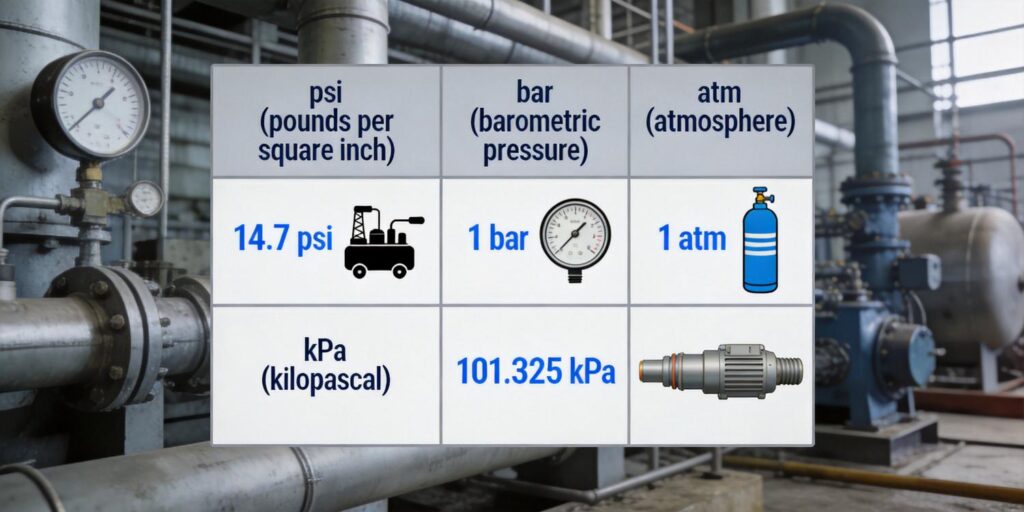
Vacuum measurement is the process of determining the pressure exerted by residual gas molecules inside a sealed system below standard atmospheric pressure (760 Torr). Accurate vacuum readings are essential for process repeatability, product quality, equipment longevity, and personnel safety across a wide range of industrial applications. Without reliable pressure data, contamination risks increase, deposition rates vary, and critical processes such as thin-film coating or semiconductor wafer processing can fail.
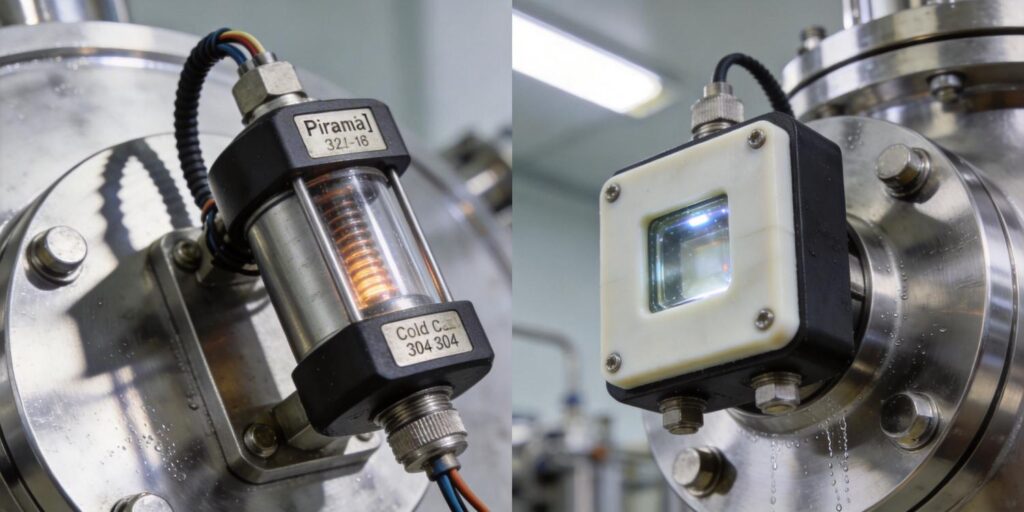
Industries from semiconductor fabrication to physical vapor deposition (PVD) and vacuum heat treatment rely on precise vacuum control to meet stringent specifications. As the product manager at Poseidon Scientific who designed both the VG-SP205 Pirani Vacuum Transmitter and the VG-SM225 Cold Cathode Vacuum Gauge, I have focused on delivering instruments that combine proven physics with modern electronics to give engineers and procurement teams the confidence they need in high-stakes environments.
The Working Principle of Pirani Vacuum Gauges
The Pirani gauge, embodied in our VG-SP205, operates on the principle of thermal conductivity. A heated resistance wire loses heat to surrounding gas molecules through conduction and convection. At higher pressures (more molecules per unit volume), heat dissipation increases, lowering the wire’s temperature and resistance. At lower pressures, fewer collisions occur, so the wire retains more heat.
Our VG-SP205 employs a thermostatic control circuit that maintains constant wire temperature by adjusting the applied voltage or current to compensate for gas-induced heat loss. This voltage (or current) is directly proportional to pressure. The result is a robust, fast-responding gauge well-suited for the rough-to-medium vacuum regime. Key advantages include simple construction, low cost, and immunity to the x-ray limit that affects ionization gauges.
For full specifications and installation guidance, see the VG-SP205 Pirani Vacuum Transmitter product page.
The Working Principle of Cold Cathode Vacuum Gauges
Cold cathode ionization gauges, such as our VG-SM225, generate ions without a hot filament. A high negative voltage (typically < −2500 V) applied to the cathode releases free electrons. These electrons undergo helical motion under the combined influence of a radial electric field and an axial magnetic field (Lorentz force). The extended flight path dramatically increases the probability of electron–gas-molecule collisions, producing positive ions and secondary electrons in a self-sustaining plasma discharge.
Ions are collected at the cathode, generating a measurable current that is proportional to gas density (and therefore pressure). Because the gauge contains no heated filament, it tolerates aggressive gases, eliminates outgassing from hot cathodes, and avoids the x-ray limit that constrains hot-cathode Bayard-Alpert gauges at ultra-high vacuum. Our inverted-magnetron-style design delivers stable operation down to 10−7 Torr with minimal maintenance.
Detailed performance data and wiring diagrams are available on the VG-SM225 Cold Cathode Vacuum Gauge product page.
Measurement Ranges: Covering 10−3 to 10−7 Torr and Beyond
Selecting the correct gauge requires matching the instrument’s range to the process window:
- VG-SP205 Pirani: 1 × 10⁻³ to 7.6 × 10² Torr (air). Accuracy ±15 % in the 10−2–10−1 Torr decade; repeatability ±5 %.
- VG-SM225 Cold Cathode: 1 × 10⁻⁷ to 1 × 10⁻³ Torr (air). Accuracy ±20 % from 10−6 to 10−3 Torr, ±30 % from 10−7 to 10−6 Torr.
The overlap at approximately 10−3 Torr allows seamless handoff between the two sensors. Together they provide continuous coverage from atmosphere down to high vacuum (10−7 Torr), eliminating the gaps common when mixing gauges from different manufacturers. Engineers appreciate the logarithmic analog output (1.33 V/decade) on the VG-SM225, which simplifies PLC integration and data logging.
Industrial Applications in Semiconductor, PVD, and Vacuum Furnace Systems
In semiconductor manufacturing, vacuum levels directly control etch rates, deposition uniformity, and particle generation. The VG-SP205 monitors roughing and load-lock stages, while the VG-SM225 ensures base pressure in process chambers remains below 10−6 Torr before plasma ignition.
Physical vapor deposition (PVD) systems require stable high vacuum for reactive sputtering and evaporation. The VG-SM225’s magnetic-field-confined discharge tolerates argon and reactive gases without filament degradation, delivering reliable pressure feedback throughout long coating runs.
Vacuum furnaces for brazing, annealing, and sintering demand repeatable pressure profiles from roughing to high vacuum. Pairing the Pirani and cold cathode gauges allows operators to track pump-down curves, detect leaks early, and maintain process setpoints with minimal drift—critical for metallurgical quality and furnace uptime.
These applications align with the fundamental principles outlined in classic references such as Foundations of Vacuum Science and Technology (Lafferty, 1998), where both thermal-conductivity and cold-cathode ionization methods receive detailed treatment.
How the VG-SP205 and VG-SM225 Complement Each Other
System designers often integrate both transmitters for full-range monitoring. The VG-SP205 provides rapid response during initial pump-down and foreline protection, while the VG-SM225 takes over once pressure drops below 10−3 Torr—precisely where Pirani sensitivity begins to roll off. Because both units share compatible KF25 flanges and simple electrical interfaces (RJ45 for Pirani, 4-pin + 1-pin for cold cathode), retrofitting or expanding existing systems is straightforward.
Engineers who have specified these gauges report reduced calibration frequency, lower spare-parts inventory, and simplified PLC programming thanks to standardized output scaling. The absence of a hot filament in the VG-SM225 further extends mean time between maintenance in dirty or corrosive processes.
As the engineer who developed both products, I ensured mechanical and electrical compatibility so that a single controller or PLC channel set can manage the entire vacuum train without custom scaling or signal conditioning.
Conclusion: Selecting the Optimal Vacuum Solution
Understanding the physics behind Pirani and cold cathode gauges—and matching their strengths to your pressure window—delivers measurable improvements in yield, throughput, and equipment reliability. The VG-SP205 and VG-SM225 form a cost-effective, high-performance pair that covers the critical range from 10−3 to 10−7 Torr with industry-leading stability and ease of integration.
To discuss your specific vacuum requirements, review system drawings, or request technical selection support—including custom calibration, mounting options, or controller compatibility—please reach out to the Poseidon Scientific applications team. We stand ready to help you specify the right gauge configuration for your next project.