Introduction
Vacuum measurement units are more than labels—they directly affect how engineers interpret data, configure controllers, and specify process setpoints. In semiconductor fabrication, PVD coating, vacuum drying, and analytical instruments, a single misplaced decimal or misunderstood conversion can shift deposition rates, trigger false interlocks, or invalidate compliance records. The three most common units—Torr, Pa, and mbar—each have distinct origins and practical applications, yet all three appear regularly in datasheets, PLCs, and international standards.
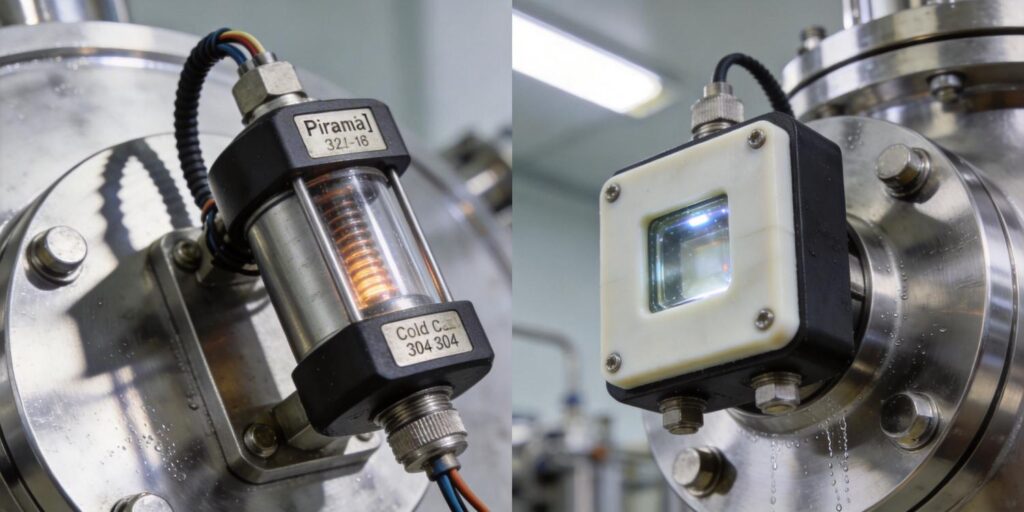
The Poseidon Scientific VG-SP205 Pirani Vacuum Transmitter and VG-SM225 Cold Cathode Vacuum Gauge support all three units natively (selectable at the factory or via RS232 on the Pirani). This guide defines each unit, provides exact conversion relationships, reviews industry preferences, explains output configuration options, and highlights practical steps to avoid misinterpretation. Whether you are designing a new tool or troubleshooting an existing line, mastering these fundamentals ensures accurate, traceable vacuum data across your entire process chain.
Defining the Three Common Units
Torr (mmHg)
The Torr is the traditional vacuum unit, defined as the pressure exerted by a 1 mm column of mercury at 0 °C under standard gravity. One standard atmosphere equals exactly 760 Torr. Because it originated from mercury manometers, the Torr remains intuitive for many engineers and is still the default unit in North American semiconductor and PVD specifications. It provides convenient decade spacing on logarithmic charts—10−3 Torr, 10−4 Torr, etc.—making process setpoints easy to remember and communicate.
Pascal (Pa)
The Pascal is the SI unit of pressure, defined as one newton per square meter (1 N/m²). It is the preferred unit in scientific literature and European standards. One atmosphere equals 101 325 Pa. In vacuum work, engineers typically use the millipascal (mPa) or simply report values in scientific notation (e.g., 10−4 Pa). The Pa is exact, internationally consistent, and required for ISO-compliant documentation and metrology traceability.
Millibar (mbar)
The millibar equals one-thousandth of a bar and is numerically very close to the Torr (1 mbar ≈ 0.75006 Torr). It is widely used in Europe, Asia, and many analytical instrument manuals. Because 1 mbar = 100 Pa exactly, conversion to SI units is straightforward. The mbar offers the same convenient decade spacing as the Torr while aligning closely with European process specifications and older European vacuum pump rating plates.
Conversion Basics
Accurate conversion between units is essential for controller scaling, recipe transfer, and cross-vendor comparisons. The exact relationships are:
- 1 Torr = 133.322 Pa
- 1 Torr = 1.33322 mbar
- 1 mbar = 100 Pa
- 1 Pa = 0.00750062 Torr
For quick field reference, the following table is commonly used (rounded for practical engineering calculations):
| From → To | Torr | Pa | mbar |
|---|---|---|---|
| Torr | 1 | 133.322 | 1.33322 |
| Pa | 0.00750062 | 1 | 0.01 |
| mbar | 0.750062 | 100 | 1 |
In practice, most modern controllers and the Poseidon gauges perform these conversions internally. The VG-SP205 and VG-SM225 can be ordered pre-configured in any of the three units, and the Pirani’s RS232 output returns values already scaled—no manual conversion is required in the PLC or data logger.
Industry Preferences
Different sectors have converged on preferred units based on history, standards, and global supply chains:
- North American semiconductor and PVD: Torr remains dominant. Recipes, setpoints, and gauge readouts are almost always expressed in Torr or mTorr.
- European and Asian analytical instruments: mbar is the everyday unit, with Pa used for formal documentation and ISO compliance.
- International research and metrology: Pa (or scientific notation) is required for traceability to national standards and publication.
- Vacuum furnace and drying systems: Torr or mbar, depending on the region of manufacture.
The Poseidon pair accommodates all preferences without compromise. Engineers working across global supply chains often standardize on Torr for internal documentation while enabling mbar or Pa output for customer-facing reports or European subsystems. This flexibility eliminates conversion errors during technology transfer and simplifies training for multinational teams.
Output Configuration on Poseidon Gauges
Both the VG-SP205 and VG-SM225 ship with the unit pre-configured to your specification at the factory. The VG-SP205 also allows unit selection via RS232 command, giving field flexibility without recalibration. The logarithmic 0–10 V analog output on the VG-SM225 is scaled to the chosen unit (1.33 V per decade), so the PLC always receives a voltage that maps directly to decades of pressure in the selected unit.
Typical configuration options include:
- Torr (default for North American customers)
- mbar (common in Europe and Asia)
- Pa (required for ISO-traceable systems)
When both gauges are used together, they are configured to the same unit at the factory, ensuring seamless crossover logic at 10−3 Torr. The RS232 output of the VG-SP205 includes the current unit in the data frame, eliminating any ambiguity during data logging or HMI display.
Avoiding Common Misinterpretation Pitfalls
Even experienced engineers occasionally misread vacuum units. The most frequent mistakes and how to prevent them:
- Decimal point errors on log scales: 1.0 × 10⁻³ Torr is not the same as 1.0 mTorr. Always verify the exponent and unit on trend charts.
- Assuming 1 mbar ≈ 1 Torr: The 0.75 % difference is negligible for most control loops but matters in high-precision metrology. Use the exact conversion when comparing gauges from different manufacturers.
- Gas correction confusion: Correction factors apply after unit conversion. The Poseidon gauges apply gas correction internally when configured; always confirm the reference gas (air/nitrogen) before interpreting raw values.
- Controller scaling mismatch: If the PLC expects Pa but receives Torr values, readings will be off by a factor of 133.322. Always verify the unit setting on both the gauge and the controller during commissioning.
Best practice: display the unit explicitly on every HMI screen and trend plot. The Poseidon gauges embed the current unit in RS232 data frames, making automated validation straightforward.
Conclusion
Understanding Torr, Pa, and mbar—and how they convert—is fundamental to accurate vacuum system design and operation. The Poseidon VG-SP205 Pirani and VG-SM225 Cold Cathode Vacuum Gauge remove the guesswork by supporting all three units natively, with clean digital and analog outputs that map directly to your preferred engineering system. Whether your facility standardizes on Torr for production or Pa for metrology, these instruments deliver consistent, traceable data without conversion errors or integration overhead.
Need help selecting the right unit configuration, verifying PLC scaling, or building a full-range monitoring system for your process? Our applications team offers free technical reviews, sample scaling code, custom calibration reports, and rapid quotations. Contact us today for a no-obligation consultation—simply visit the product pages below or reply to this article.
VG-SP205 Pirani Vacuum Transmitter – Multi-Unit RS232 Output
VG-SM225 Cold Cathode Vacuum Gauge – Logarithmic 0–10 V in Your Chosen Unit
At Poseidon Scientific we design vacuum instrumentation that speaks your language—delivering accurate, ready-to-use pressure data in Torr, Pa, or mbar so you can focus on results, not conversions.