Pa, mbar, Torr: The Three Core Units of Vacuum Pressure
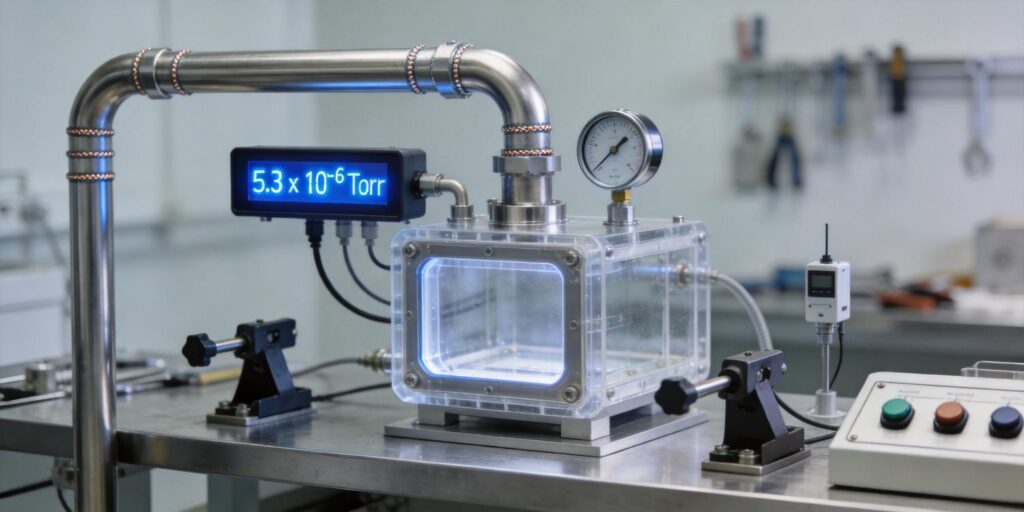
Vacuum technology spans an enormous dynamic range—from atmospheric pressure down to ultra-high vacuum levels below 10−7 Torr. Because no single unit can conveniently express every value across this six-order-of-magnitude spectrum, three primary units have become industry standards: the pascal (Pa), millibar (mbar), and torr (Torr). Engineers and procurement teams working with vacuum gauges must understand these units to interpret specifications, compare instruments, and ensure process compatibility.
The pascal is the SI base unit of pressure, defined as one newton per square meter (N/m²). It is the preferred unit in scientific literature and international standards because it aligns directly with fundamental physics. In vacuum work, values are often expressed in scientific notation, such as 10−3 Pa for moderate vacuum or 10−5 Pa for high vacuum.
The millibar originated from meteorology and remains dominant in European vacuum equipment catalogs and process documentation. One millibar equals exactly 100 Pa, making conversions straightforward. It provides a convenient scale for rough to medium vacuum regimes (1–10−3 mbar) commonly encountered in industrial freeze-drying, coating, and analytical instruments.
The torr, named after Evangelista Torricelli, is defined as exactly 1/760 of standard atmospheric pressure. It is the traditional unit in North American vacuum practice and appears in the majority of U.S. semiconductor, mass-spectrometry, and laboratory equipment datasheets. One torr is approximately 133.322 Pa, and the unit is especially practical because 1 atm = 760 Torr exactly—a round number that simplifies everyday calculations.
Understanding these three units is foundational because vacuum gauge output—whether analog voltage or digital protocol—is typically scaled to one or more of them. Mismatched units can lead to specification errors during procurement or misinterpretation during system commissioning.
Unit Conversions: Precise Formulas and Quick Reference
Accurate conversion is essential for cross-referencing datasheets, validating process recipes, and integrating gauges from different suppliers. The relationships are exact or defined by international agreement:
| From | To Pa | To mbar | To Torr |
|---|---|---|---|
| 1 Pa | 1 | 0.01 | 0.00750062 |
| 1 mbar | 100 | 1 | 0.750062 |
| 1 Torr | 133.322 | 1.33322 | 1 |
In equation form (using KaTeX for precision):
- \( P_{\text{Pa}} = P_{\text{Torr}} \times 133.322 \)
- \( P_{\text{mbar}} = P_{\text{Pa}} / 100 \)
- \( P_{\text{Torr}} = P_{\text{mbar}} \times 0.750062 \)
Common vacuum ranges expressed in all three units help engineers visualize scale:
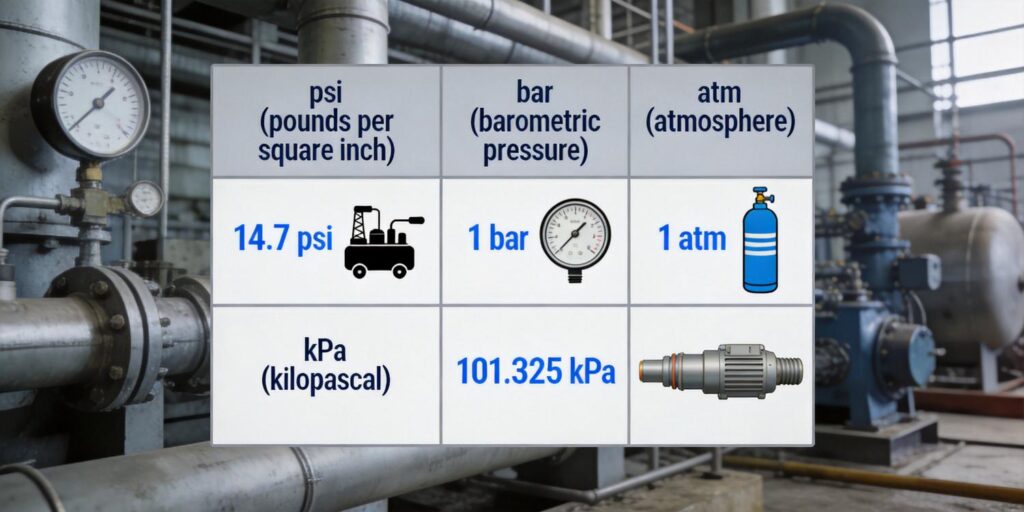
- Atmosphere: 101325 Pa = 1013.25 mbar = 760 Torr
- Rough vacuum (Pirani operating band start): 1000 Pa = 10 mbar = 7.5 Torr
- Typical freeze-drying primary drying: 13.3 Pa = 0.133 mbar = 0.1 Torr
- High-vacuum transition (Cold Cathode start): 0.133 Pa = 0.00133 mbar = 0.001 Torr
- Ultra-high vacuum limit: 1.33 × 10⁻⁵ Pa = 1.33 × 10⁻⁷ mbar = 10−7 Torr
Modern vacuum transmitters, including the Poseidon VG-SP205 Pirani and VG-SM225 Cold Cathode models, internally compute these conversions and can be configured to report pressure in any of the three units via their customizable RS232 protocol. This flexibility eliminates manual conversion errors in mixed-unit facilities.
Industrial Standards and Regulatory Context
Industry bodies have codified unit preferences to ensure consistency across global supply chains. The International Organization for Standardization (ISO 3529 series) defines vacuum technology vocabulary exclusively in pascal, promoting SI traceability for calibration laboratories and metrology institutes. In Europe, manufacturers such as INFICON and Pfeiffer list specifications primarily in mbar, aligning with EU pressure-equipment directives (PED 2014/68/EU).
North American practice, governed by the American Vacuum Society (AVS) and SEMI standards for semiconductor equipment, retains torr as the default. This convention appears in MKS, Agilent, and legacy INFICON documentation. Pharmaceutical lyophilization under FDA 21 CFR 211 and EU Annex 1 similarly references torr or mbar depending on the dryer OEM, but process validation protocols require documented unit traceability regardless of choice.
For procurement teams, the key takeaway is dual-unit specification: always request both the native unit used in the datasheet and the equivalent in the plant’s dominant unit. Poseidon Scientific transmitters ship with factory-default torr scaling (matching most U.S. and Asian mass-spectrometer OEMs) but support one-command switching to mbar or Pa via the digital interface—ideal for export equipment or multinational sites.
Calibration traceability further reinforces these standards. National metrology institutes (NIST in the U.S., PTB in Germany) maintain primary standards in Pa; secondary transfer standards for vacuum gauges are certified in the customer’s preferred unit with documented conversion factors traceable to the SI definition of the pascal.
Practical Examples: How Units Appear in Real Applications
Consider a typical mass-spectrometer system—the original driver for Poseidon’s low-cost gauge development. The foreline (rough vacuum) operates from atmosphere down to approximately 10−3 Torr (0.133 Pa or 0.00133 mbar). Here the VG-SP205 Pirani Vacuum Transmitter provides continuous, maintenance-free monitoring with ±15 % repeatability in its linear band (10–10−2 Torr). Operators see live pressure displayed in torr on the SCADA screen; the same value converts automatically to 1.33 Pa when exported to an EU-based data archive.
In pharmaceutical freeze-drying, primary drying targets 50–200 mTorr (6.67–26.7 Pa or 0.067–0.267 mbar). The Pirani’s thermal-conductivity principle actually reads higher in water-vapor-rich atmospheres, creating a deliberate offset versus a capacitance manometer that engineers exploit for precise sublimation endpoint detection. When the Pirani signal converges within 10 % of the reference, the cycle advances to secondary drying—typically below 50 mTorr—where the VG-SM225 Cold Cathode gauge takes over, delivering linear ion-current response down to 10−7 Torr for base-pressure verification before backfill.
Semiconductor PVD chambers often specify base pressure as < 5 × 10⁻⁷ Torr (6.67 × 10⁻⁵ Pa). Cold-cathode gauges excel here because their Penning-discharge principle remains linear well below the x-ray limit that constrains hot-cathode alternatives. Maintenance teams clean electrodes when pressure readings drift by one order of magnitude—an event flagged in mbar on European tools or torr on U.S. platforms—yet the physical criterion (ion current drop) is unit-independent.
These examples illustrate why gauge selection must consider both the operating range and the unit convention of the end user. Poseidon’s compact, customizable transmitters bridge these conventions without added cost or complexity.
CTA
Mastering vacuum pressure units is the first step toward specifying the right gauge for your process. Whether you work in torr-dominant North American labs, mbar-based European facilities, or Pa-focused research institutions, Poseidon Scientific delivers cost-effective, high-durability solutions with native support for all three units.
Explore the VG-SP205 Pirani Vacuum Transmitter for reliable rough-to-medium vacuum monitoring (atmosphere to 10−3 Torr) and the VG-SM225 Cold Cathode Vacuum Gauge for high-vacuum extension to 10−7 Torr. Both feature RJ45 connectivity, fully customizable RS232 protocols, and hygienic stainless-steel construction—engineered for the exact needs of mass spectrometry, lyophilization, and vacuum heat treatment.
Need help converting your process recipe to the correct units, selecting the optimal gauge combination, or requesting a 5–10 unit custom-protocol prototype? Contact our applications team today. We provide free unit-conversion worksheets, performance-comparison data against legacy INFICON and MKS models, and rapid-response technical support that procurement and engineering teams rely on to keep projects on schedule and under budget.