
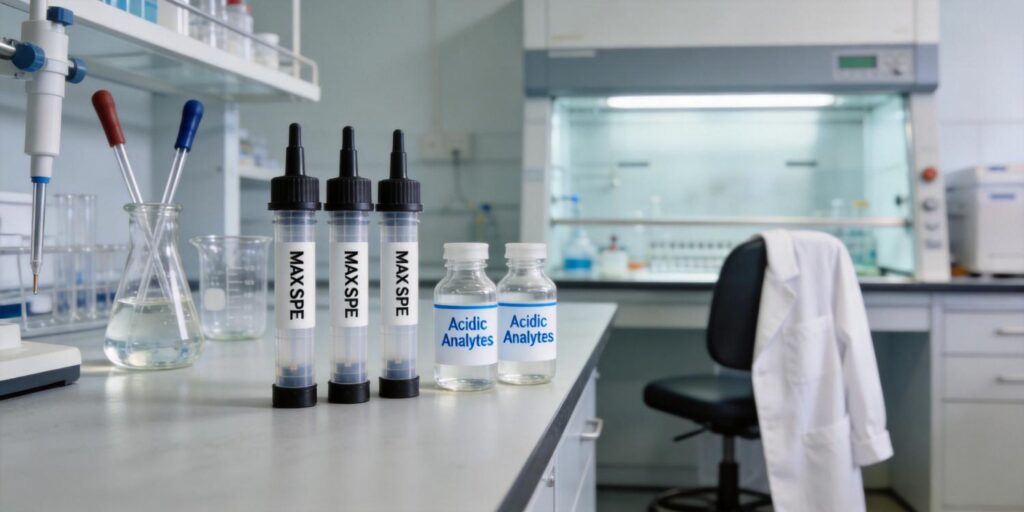
Chemistry of MAX Sorbents
MAX (Mixed-mode Anion eXchange) SPE cartridges represent a sophisticated approach to acidic compound extraction through their unique polymeric architecture. Unlike traditional silica-based sorbents, MAX utilizes a water-wettable polymeric backbone that eliminates problematic silanol groups, which can complicate retention mechanisms and method development.
The core chemistry involves a tightly controlled ion-exchange capacity of 0.25 meq/g, ensuring reproducible extraction protocols across different batches and applications. This precision-engineered sorbent maintains stability across the entire pH range (0-14), providing exceptional flexibility in method development. The polymeric structure offers several advantages over silica-based alternatives, including reduced secondary interactions and improved wettability for aqueous samples.
MAX sorbents operate through a dual-mechanism approach: strong anion exchange interactions combined with reversed-phase hydrophobic interactions. This mixed-mode functionality allows for selective retention of acidic compounds while providing excellent sample cleanup through the simultaneous removal of neutral and basic interferences.
Polymeric vs. Silica-Based Advantages
The polymeric nature of MAX sorbents offers several practical benefits:
- No silanol interactions: Eliminates secondary interactions that can complicate method development and reduce reproducibility
- pH stability: Maintains performance across the entire pH range (0-14)
- Water-wettable: No need for extensive conditioning protocols
- Consistent capacity: Tightly controlled ion-exchange capacity ensures batch-to-batch reproducibility
Strong Anion Exchange Interactions
The primary retention mechanism in MAX cartridges involves strong anion exchange interactions between the positively charged quaternary amine groups on the sorbent and negatively charged acidic analytes. This interaction is particularly effective for compounds with pKa values between 2-8, making MAX ideal for a wide range of acidic substances.
The strong anion exchange functionality provides several key advantages:
- Selective retention: Acidic compounds are retained through ionic interactions while neutral and basic compounds pass through
- High capacity: The 0.25 meq/g ion-exchange capacity allows for efficient extraction of acidic analytes even in complex matrices
- pH-dependent elution: Acidic compounds can be selectively eluted by changing the pH to neutralize the ionic interaction
- Clean extracts: The combination of anion exchange and reversed-phase interactions provides excellent sample cleanup
Mixed-Mode Retention Mechanism
MAX sorbents employ a sophisticated mixed-mode retention mechanism that combines:
- Ionic interactions: Strong anion exchange between quaternary amine groups and acidic analytes
- Hydrophobic interactions: Reversed-phase retention through the polymeric backbone
- Hydrogen bonding: Secondary interactions that can enhance retention of certain acidic compounds
This multi-mechanism approach allows for superior selectivity compared to single-mode sorbents, particularly when dealing with complex biological matrices containing multiple classes of compounds.
Examples of Acidic Analytes
MAX SPE cartridges are particularly effective for extracting a wide range of acidic compounds across various application areas:
Pharmaceutical Applications
Non-Steroidal Anti-Inflammatory Drugs (NSAIDs):
- Ibuprofen (pKa ~4.9)
- Naproxen (pKa ~4.2)
- Diclofenac (pKa ~4.0)
- Ketoprofen (pKa ~4.5)
- Flurbiprofen (pKa ~4.2)
- Indomethacin (pKa ~4.5)
Other Acidic Pharmaceuticals:
- Barbiturates (phenobarbital, pentobarbital)
- Salicylic acid and derivatives
- Warfarin and related anticoagulants
- Furosemide and other loop diuretics
Environmental Applications
Acidic Pesticides and Herbicides:
- Phenoxy acid herbicides (2,4-D, MCPA)
- Sulfonylurea herbicides
- Acidic organophosphorus pesticides
- Chlorophenoxy acids
Industrial Chemicals:
- Phthalate metabolites
- Bisphenol A and related compounds
- Perfluorinated compounds (PFCs)
Clinical and Forensic Applications
Drugs of Abuse Metabolites:
- THC-COOH (Δ9-tetrahydrocannabinol-11-oic acid)
- Benzoylecgonine (cocaine metabolite)
- Acidic drug metabolites
Endogenous Compounds:
- Fatty acids and prostaglandins
- Bile acids
- Organic acids in metabolic disorders
Application Workflow
A typical MAX SPE workflow involves several critical steps designed to maximize recovery and minimize matrix effects:
1. Cartridge Conditioning
Step 1: Condition with 2 mL methanol to wet the polymeric surface and penetrate the bonded phase
Step 2: Condition with 2 mL water or appropriate buffer (typically pH 6-7) to prepare for sample loading
Critical Note: Never allow the cartridge to dry between conditioning and sample loading
2. Sample Loading
Sample Preparation: Adjust sample pH to 6-7 to ensure acidic analytes are in their ionized form for optimal retention
Loading Conditions: Apply sample at a controlled flow rate (typically 1-2 mL/min) under light vacuum
Volume Considerations: For biological fluids, typical sample volumes range from 1-5 mL, diluted with appropriate buffer
3. Washing Steps
Wash 1: 1-2 mL water or dilute buffer to remove salts and polar interferences
Wash 2: 1-2 mL methanol or methanol/water mixture to remove neutral compounds while retaining acidic analytes through ionic interactions
pH Adjustment: Optional wash with 0.5 mL 0.01 M acetic acid (pH ~3.3) to protonate weakly basic compounds and enhance cleanup
4. Cartridge Drying
Vacuum Drying: Apply high vacuum (≥10 in Hg) for 3-4 minutes to remove residual water
Solvent Treatment: Add 50 μL methanol followed by additional vacuum drying for 1 minute to ensure complete water removal
Importance: Critical for GC applications and to prevent water interference in subsequent analysis
5. Elution of Acidic Analytes
Elution Strategy: Acidic compounds are eluted using solvents that disrupt both ionic and hydrophobic interactions
Typical Elution Solvents:
- Methanol containing 2-5% formic acid
- Acetonitrile with acid modifier
- Acetone/chloroform mixtures (1:1) for less polar acidic compounds
- Methanol with ammonium hydroxide for certain applications
Elution Volume: Typically 2-4 mL, collected in appropriate collection tubes
6. Sample Concentration and Analysis
Evaporation: Concentrate eluate under nitrogen or vacuum evaporation at 40°C
Reconstitution: Reconstitute in appropriate solvent compatible with analytical instrumentation
Analysis: Proceed with LC-MS, GC-MS, HPLC-UV, or other analytical techniques
Method Optimization Considerations
pH Optimization: The pH during sample loading significantly affects recovery. For most acidic compounds, pH 6-7 provides optimal ionization and retention.
Flow Rate Control: Maintain controlled flow rates (1-2 mL/min) during all steps to ensure proper interaction between analytes and sorbent.
Solvent Selection: Choose elution solvents based on analyte polarity and subsequent analytical method requirements.
Matrix Effects: For complex matrices, additional wash steps or pH adjustments may be necessary to improve selectivity.
Quality Control Measures
Recovery Assessment: Include fortified samples to monitor extraction efficiency
Blank Controls: Process blank samples to monitor for contamination
Internal Standards: Use appropriate internal standards to correct for variability in extraction and analysis
Carryover Testing: Ensure no carryover between samples by processing solvent blanks between samples
Practical Applications and Case Studies
NSAID Extraction from Biological Fluids
MAX cartridges have demonstrated excellent performance in extracting NSAIDs from plasma and urine. Comparative studies show that mixed-mode SPE provides cleaner extracts than traditional liquid-liquid extraction methods, with recoveries often exceeding 90% for compounds like ibuprofen, naproxen, and diclofenac.
Environmental Water Analysis
For environmental applications, MAX cartridges effectively extract acidic pesticides from water samples. The mixed-mode retention allows for concentration of trace-level analytes while removing humic acids and other matrix interferences that can complicate analysis.
Forensic Toxicology
In forensic applications, MAX sorbents are particularly valuable for extracting acidic drug metabolites like THC-COOH and benzoylecgonine. The strong anion exchange mechanism provides selective retention even in complex matrices like urine and blood.
Comparison with Other SPE Sorbents
MAX vs. WAX: While both are designed for acidic compounds, MAX uses strong anion exchange (quaternary amine) while WAX employs weak anion exchange (primary/secondary amine). MAX typically provides stronger retention for moderately acidic compounds (pKa 2-8).
MAX vs. C18: Traditional reversed-phase sorbents rely primarily on hydrophobic interactions, which may not provide sufficient retention for polar acidic compounds. MAX’s mixed-mode approach offers superior retention through ionic interactions.
MAX vs. SAX: Traditional strong anion exchange sorbents may suffer from silanol interactions and pH limitations. MAX’s polymeric structure eliminates these issues while providing additional hydrophobic retention.
Conclusion
MAX SPE cartridges represent a sophisticated solution for acidic compound extraction, combining strong anion exchange interactions with reversed-phase retention in a stable polymeric format. Their unique chemistry provides excellent selectivity, high recovery, and robust performance across a wide range of applications from pharmaceutical analysis to environmental monitoring.
The key advantages of MAX sorbents include their pH stability, elimination of silanol interactions, and reproducible ion-exchange capacity. When properly implemented in a well-optimized workflow, MAX cartridges can significantly improve analytical results by providing cleaner extracts and higher recoveries compared to traditional extraction methods.
For laboratories dealing with acidic analytes in complex matrices, MAX SPE cartridges offer a reliable and efficient sample preparation solution that can enhance analytical sensitivity, improve data quality, and streamline method development processes.
