Sample Preparation Before Loading
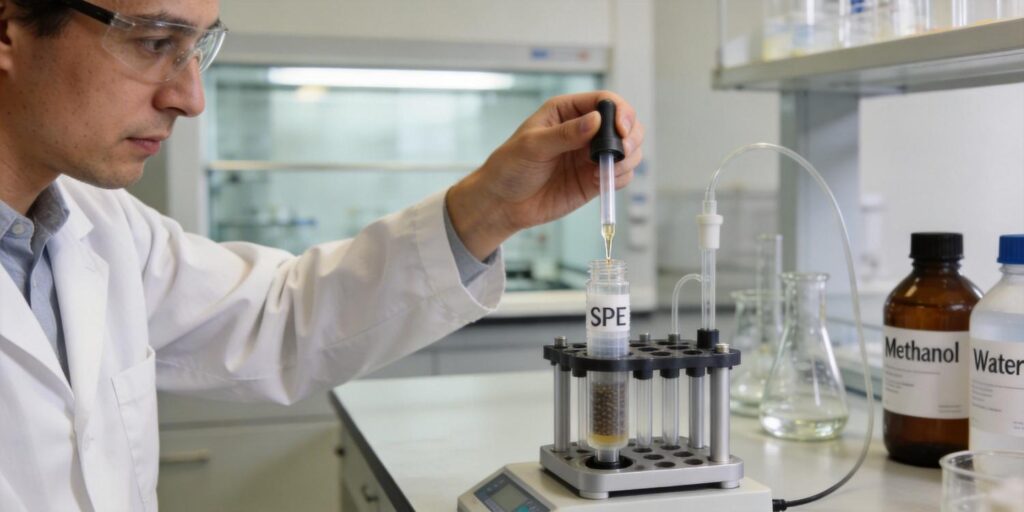
Proper sample preparation is the foundation of successful solid-phase extraction (SPE). Before loading your sample onto an SPE cartridge, several critical factors must be addressed to ensure optimal analyte recovery and minimize interferences. The sample matrix can significantly impact SPE performance, particularly when dealing with viscous samples or those containing particulates, fibrin, mucus, proteins, or other cellular components.
For difficult matrices, consider these preparation strategies:
- Dilution: Diluting dense or viscous samples with water or appropriate buffer often improves flow characteristics and enhances mass transfer onto the cartridge.
- Filtration: Remove particulates that could clog frits and sorbent pores.
- Centrifugation: Clarify samples by separating solid components.
- Protein Precipitation: For biological samples, precipitate proteins that could interfere with analyte binding.
- pH Adjustment: Modify sample pH to optimize analyte retention, particularly for ion-exchange mechanisms.
When working with plasma samples, exercise caution with dilution. Improper dilution can dilute anti-coagulants, potentially causing clotting, or trigger protein precipitation if incompatible reagents are used. Always validate dilution methods manually before implementing automated procedures.
For automated SPE workstations, sample dilution serves dual purposes: it facilitates sample handling and improves binding to retention sites by enhancing mass transfer onto the cartridge. However, this must be balanced against potential matrix effects and analyte solubility considerations.
Flow Rate Importance
Flow rate control is arguably the most critical parameter in SPE sample loading. As Bidlingmeyer (1984) demonstrated, recovery is dependent on flow rate through the SPE device because breakthrough volume decreases due to band-broadening at higher flow rates. Mayer and Poole (1994) further established that analyte recovery by SPE shows significant flow-rate dependence when sample volume exceeds the analyte’s breakthrough volume.
Optimal Flow Rate Ranges
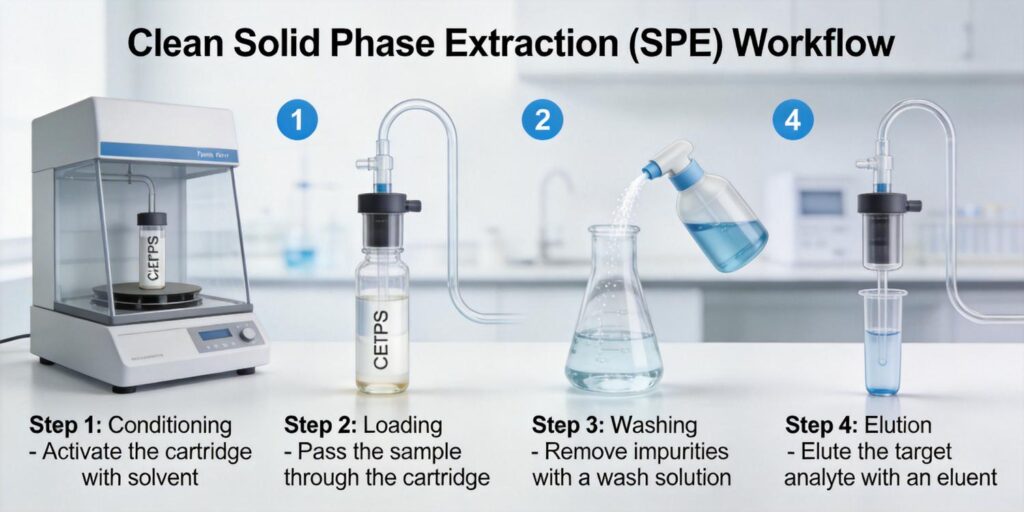
Recommended flow rates for sample application typically range from 1-2 mL/min for manual processing. For automated systems, flow rates should be optimized for each step:
- Conditioning: Less sensitive to flow rate variations
- Loading: Most critical step for flow rate control
- Rinsing: Moderate sensitivity to flow rate
- Elution: Critical for complete analyte recovery
Excessive flow rates during sample loading can result in breakthrough and/or band broadening due to inadequate mass transfer of analyte to sorbent binding sites. This occurs because insufficient diffusion and mass transfer (residence time) prevents analytes from reaching binding sites before exiting the sorbent bed.
Flow Rate Effects on Different SPE Formats
The relationship between flow rate and breakthrough volume varies between different SPE formats:
- Cartridge devices: Show continuous decrease in breakthrough volume with increasing flow rate, indicating that the slowest practical flow rate is preferred.
- Particle-loaded membranes: Breakthrough volume is not strongly affected by sample flow rate between approximately 10-30 mL/min, with decreased sensitivity to flow rate changes over practical operating ranges.
For reproducible results, flow rates should be controlled within reasonable limits, particularly for cartridge devices where breakthrough volumes are more sensitive to flow rate variations.
Preventing Analyte Breakthrough
Understanding Breakthrough Volume
Breakthrough is defined as the ineffective retention of target analytes on the solid phase sorbent, resulting in low analyte recovery. Larrivee and Poole (1994) defined breakthrough volume as “the volume of sample, assumed to have a constant concentration, that can be passed through the SPE device before the concentration of the analyte at the outlet of the device reaches a certain fraction of the concentration of the analyte at the inlet.”
The breakthrough volume (Vb) is typically defined as the volume at which UV absorbance of the device effluent reaches 1% of the sample concentration. This represents the largest sample volume that can be processed without significant analyte loss, with recovery theoretically at 100% for all sample volumes less than the breakthrough volume.
Causes of Breakthrough
Common causes of breakthrough during sample application include:
- Excessive flow rates that exceed sorbent affinity for analyte binding
- Improper conditioning of the sorbent bed
- Inappropriate loading solvent (incorrect ionic strength or organic strength)
- Volume overload where weakly retained analytes migrate with the matrix
- Mass overload where sorbent capacity is insufficient for analyte or matrix components
- Incorrect sorbent selection for the target analyte
Breakthrough Volume Determination
Two practical approaches exist for determining breakthrough volumes:
- Direct method: Pass analyte solution at constant flow rate through the sampling device and monitor appearance at the exit. The analyte concentration should not overload the sorbent, and the detector must be sufficiently sensitive.
- Fractional method: Collect effluent aliquots using a fraction collector and analyze each separately to determine when breakthrough occurred.
For compounds with log Pow values above approximately 3.5, Nakamura et al. (1996) reported no breakthrough from alkyl-bonded silica sorbents up to sample volumes of one liter, though sorbent mass in these experiments was unspecified.
Practical Strategies to Prevent Breakthrough
- Optimize flow rates: Use the slowest practical flow rate that provides adequate throughput while maintaining recovery.
- Match sorbent mass to sample volume: Ensure sufficient sorbent capacity for both analyte and matrix components.
- Proper conditioning: Ensure complete activation of binding sites before sample loading.
- Appropriate solvent selection: Use loading solvents that promote analyte retention without causing premature elution.
- Monitor breakthrough curves: For critical applications, experimentally determine breakthrough volumes under actual operating conditions.
Matrix Considerations
Matrix Effects on SPE Performance
The sample matrix profoundly influences SPE efficiency through several mechanisms:
- Competitive binding: Matrix components compete with analytes for limited sorbent binding sites.
- Physical interference: Particulates, proteins, and cellular components can clog frits and sorbent pores.
- Chemical interference: Matrix components may modify solvent properties or pH, affecting analyte retention.
- Viscosity effects: High viscosity samples require adjusted flow rates and may benefit from dilution.
Matrix-Specific Considerations
Biological Matrices (Plasma, Serum, Urine)
- Protein content: Plasma contains approximately twice the protein concentration of serum. Both require careful handling to prevent protein precipitation during sample preparation.
- Anti-coagulants: Dilution can reduce anti-coagulant concentrations, potentially causing clotting in plasma samples.
- Urine: Generally lower in proteins but may contain salts and metabolites that affect SPE performance.
Environmental Matrices (Water, Soil Extracts)
- Particulate matter: Often requires filtration or centrifugation before SPE.
- Organic content: Humic acids and other natural organic matter can compete for binding sites.
- Ionic strength: Salt content affects ion-exchange mechanisms and may require adjustment.
Food and Agricultural Matrices
- Lipid content: May require defatting steps before SPE.
- Pigments and natural products: Can interfere with detection or compete for binding sites.
- Complex mixtures: Often require multiple cleanup steps or specialized sorbents.
Matrix Modification Strategies
When matrix characteristics impede SPE performance, consider these modifications:
- Dilution: The simplest solution for dense or viscous samples. Dilute with water or appropriate buffer to improve flow characteristics and mass transfer.
- Filtration: Remove particulates using appropriate filter pore sizes.
- Centrifugation: Separate solid components before SPE.
- Protein precipitation: For biological samples, precipitate proteins using organic solvents or acids.
- pH adjustment: Modify sample pH to optimize analyte retention, particularly for ionizable compounds.
- Salt addition or removal: Adjust ionic strength to enhance or suppress ion-exchange interactions.
SPE Device Selection Based on Matrix
Matrix characteristics should guide SPE device selection:
- Particle size: Smaller particles (8-10 μm) provide better efficiency but generate higher backpressures and are more prone to clogging.
- Pore size: Larger pores accommodate samples with particulate matter but may reduce surface area.
- Bed depth: Shallower beds reduce backpressure but may have lower capacity.
- Frit characteristics: Larger frit pore diameters or different frit types (hydrophobicity) can improve flow for difficult matrices.
- Column diameter: Wider columns spread sample over larger surface area, potentially improving flow.
Practical Recommendations
- Characterize your matrix: Understand viscosity, particulate content, protein concentration, and potential interferents.
- Pilot studies: Conduct small-scale experiments to optimize conditions before processing large sample sets.
- Quality control: Include matrix-matched standards and blanks to monitor matrix effects.
- Method validation: Validate SPE methods with actual sample matrices, not just standard solutions.
- Consider automation: Automated systems provide better reproducibility for flow-sensitive steps.
By carefully considering matrix characteristics and implementing appropriate sample preparation strategies, analysts can optimize SPE performance, maximize analyte recovery, and minimize interferences across diverse sample types.