Sources of Contamination in SPE Workflows
Solid Phase Extraction (SPE) contamination problems can arise from multiple sources, compromising analytical accuracy and reproducibility. According to forensic science literature, contamination issues are categorized alongside flow problems, recovery problems, and nonextraction problems as fundamental SPE troubleshooting areas.
SPE Device-Related Contamination
The most common contamination sources directly attributable to SPE devices include:
- Plasticizers and phthalates from polypropylene cartridges or polyethylene frits
- Polymer residuals from sorbent materials
- Surface contaminants that can leach during extraction processes
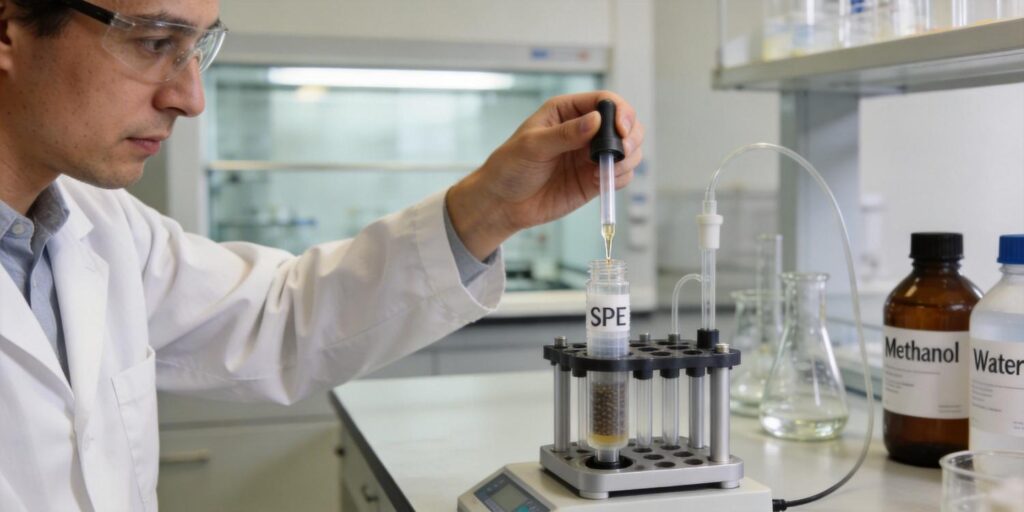
Figure 5 in forensic SPE literature illustrates extraction tube components that can contribute contaminants, including cartridge walls, frits, and sorbent materials. Quality manufactured SPE devices should not contribute measurable contaminants above low nanogram (ppb) levels, but below these levels, contamination becomes more likely.
Endogenous Matrix Contaminants
Biological samples are notoriously dirty, containing endogenous interferents that vary with each sample and patient. These matrix components can:
- Co-elute with target analytes during chromatography
- Mask analyte signals during detection
- Vary in concentration between samples, creating inconsistent interference patterns
Reagent and Solvent Contaminants
Solvents and buffers may contain impurities that interfere with analyses. Specific issues include:
- Old or impure derivatization reagents creating interference peaks
- Solvent impurities that accumulate during extraction
- Buffer contaminants that co-extract with analytes
The use of fresh, high-purity reagents minimizes these problems, but systematic quality control is essential for trace-level analyses.
Laboratory Environmental Contaminants
Cross-contamination can occur from laboratory surfaces, equipment, and handling procedures. Common sources include:
- Residual analytes on vacuum manifold surfaces
- Contaminated pipettes and sample handling equipment
- Environmental contaminants introduced during sample preparation
Sample Carryover Issues in SPE Systems
Carryover represents a specific type of contamination where residual sample components from one extraction “carry over” into subsequent samples. This problem is most serious when a sample with high analyte concentration contaminates a subsequent sample containing low or non-existent analyte levels.
Determining Carryover
The standard method to determine carryover involves:
- Running a blank sample containing no analyte of interest
- Processing a sample with very high concentration of the analyte
- Following with two additional blank samples
- Measuring analyte amounts in the final two blank samples
Remember that measured carryover represents contamination from the entire sample preparation process, not just the SPE portion. This includes manual preparation steps, automated SPE methods, sample evaporation or derivatization, and final analysis.
Fluid Path Contamination in Automated Systems
All automated SPE workstations have fluid paths that transport reagents and samples. Between samples, these paths must be thoroughly cleaned to minimize carryover. Key considerations include:
- Sample matrix compatibility: Cleaning reagents must be compatible with the sample matrix, especially with biological samples containing proteins
- Analyte solubility: The most effective way to eliminate carryover is to use reagents that solubilize the analyte well to wash it away
- Solvent miscibility: Elution reagents must be miscible with sample matrices or wash solvents applied before elution
For protein-rich samples like plasma and serum, the first cleaning step must use aqueous reagents to remove proteins before organic cleaning steps.
Preventing Fluid Path Blockages
Biofluids or environmental samples commonly contain clots or precipitates that can block fluid paths. Prevention strategies include:
- Centrifugation to remove particulates before extraction
- Filtration (with caution not to filter out bound analytes)
- Sonication/dilution to reduce particle concentration
- Minimizing delays between sample preparation and extraction
Cleaning Procedures for SPE Systems
Prewashing SPE Cartridges
Quality manufactured SPE devices should not contribute measurable contaminants above low nanogram levels, but prewashing is recommended for trace-level analyses. The recommended prewash procedure involves:
- Using the strongest eluotropic solution (typically the elution solvent)
- Applying 10-20 times the bed volume (3-4 mL for a 200-mg column)
- Following with routine conditioning steps
Acids used for sample washes may leach surface phthalate esters from cartridge walls or frits, so prewashes with these solutions may further reduce contaminants. The final prewash should always be the elution solvent.
Automated System Cleaning Protocols
For automated SPE workstations, effective cleaning protocols depend on:
- Sample matrix characteristics: Different matrices require different cleaning approaches
- Analyte properties: Cleaning reagents must effectively solubilize target analytes
- Fluid path compatibility: Cleaning methods must not damage system components
Effective cleaning techniques include:
- Multiple small-volume washes: More effective than single high-volume washes
- Intermediate solvents: When switching between immiscible solvents (e.g., hexane to methanol), use intermediate reagents like isopropanol or acetone
- Specialized cleaning agents: Bleach (with compatibility considerations) or non-ionic surfactants for protein removal
Disposable Systems for Critical Applications
For applications requiring absolute prevention of cross-contamination, disposable systems like Clean-Thru tips provide complete isolation between samples and extraction apparatus. These systems:
- Eliminate sample contact with vacuum manifold lids
- Provide completely disposable fluid paths
- Offer direct, accurate routes to waste or collection vessels
- Discard columns and tips as complete units after each extraction
Laboratory Best Practices for Contamination Prevention
General Laboratory Procedures
Implementing systematic laboratory practices significantly reduces contamination risks:
- Cartridge storage: Keep cartridges in sealed bags until use; store opened cartridges in zipper-locked bags or desiccators
- Reservoir use: When using empty reservoirs attached to cartridges, use long disposable pipets to ensure proper flow
- Flow control: Use stopcocks to adjust/control flow through individual cartridges
- Water removal: Remove residual water effectively by centrifugation (5000 rpm, 5 min) rather than vacuum or nitrogen drying
SPE Process Optimization
Specific steps in the SPE process require particular attention to prevent contamination:
Prewash and Preconditioning
- Remove all strong prewash solvents for GC applications (dichloromethane, hexane, ethyl acetate) before preconditioning and loading
- Ensure correct pH for ion-suppression (acids) or minimal silanol interactions (bases)
- Leave approximately 1-2 mm of preconditioning solvent above the sorbent bed to prevent drying
Sample Loading and Washing
- Leave 1/4 to 1/2 tube volume above sorbent bed when using tube reservoirs
- Use drop-wise solvent flow when time/throughput is not a major concern
- Wipe needles of manifolds before elution steps to minimize eluate contamination
Elution and Collection
- Allow cartridges/plates to soak with eluent for 0.5-1 minute to improve recovery
- Consider using several smaller eluent aliquots rather than one large volume
- Choose eluents considering ease of evaporation if reconstitution is needed
Quality Control and Validation
Regular quality control measures are essential for contamination prevention:
- Method blanks: Include regular method blanks to monitor background contamination
- Carryover testing: Periodically test for carryover using the high-concentration/low-concentration blank sequence
- System suitability: Validate cleaning protocols for automated systems
- Reagent quality: Use fresh, high-purity reagents and monitor for degradation
Advanced Technologies for Contamination Control
Modern SPE technologies offer enhanced contamination prevention:
- Reduced Solvent Volume (RSV) columns: Use 75% less solvent than traditional packed columns, reducing potential contamination sources
- High-efficiency copolymeric columns: Provide cleaner extracts with fewer interference peaks
- Specialized sorbents: Tailored chemistries for specific analyte classes minimize co-extraction of contaminants
By implementing these comprehensive contamination prevention strategies, laboratories can ensure the reliability and accuracy of their SPE workflows while maintaining the sensitivity required for modern analytical applications. Regular monitoring and systematic approach to contamination sources form the foundation of successful SPE methodology in both research and regulated environments.