What Determines Sorbent Capacity in SPE?
Solid Phase Extraction (SPE) sorbent capacity represents the maximum amount of analyte a packed bed can retain from a sample matrix. Understanding the factors that determine this capacity is crucial for method development and optimization. According to established literature, specific capacity (Csp) is an intrinsic property defined as the amount of material retained per amount of packing used, typically expressed as a percentage.
Key Factors Influencing Sorbent Capacity
1. Organic Loading and Bonded Phase Characteristics
The organic loading of an SPE column packing has a direct impact on capacity. Generally, higher organic loading correlates with higher capacity. For silica-based sorbents, typical capacity values range between 5-50 mg per gram, with polymeric SPE packings often showing somewhat higher values. The nature of the bonded phase significantly affects capacity—C18 phases are more retentive than C8 for many non-polar species due to increased hydrophobic interactions.
2. Sorbent Particle and Pore Size
According to the Van Deemter equation, sorbent performance depends on particle and pore size. Smaller particle sizes (dp) and larger pore sizes (increasing Dp) contribute to lower height-equivalent of theoretical plates (H), improving efficiency. However, there’s a balance to strike—larger pores reduce surface area and therefore capacity. Studies show that intermediate porosity (around 300 Å) often provides optimal balance between kinetics and capacity for many applications.
3. Sample Matrix Effects
The sample matrix can significantly reduce sorbent capacity through competitive interactions. Biological samples containing proteins or environmental samples with humic matter present at high concentrations can compete with analytes for binding sites. When Ki·ci (adsorption equilibrium constant × concentration) becomes large, capacity decreases substantially.
4. Bed Geometry and Configuration
Unlike HPLC where column length increases resolution, SPE operates as “stop-and-go” chromatography. Capacity remains constant regardless of bed height, but flow characteristics change with cross-sectional area. A 100 mg bed in a 6-mL tube provides the same capacity as in a 1-mL tube but offers better flow due to increased cross-sectional area and reduced bed height.
5. Chemical Properties of Sorbent
The polymeric configuration on the sorbent affects capacity. Random, linear, and monolayer extraction columns yield distinctly different surface characteristics. The nature of the polymer backbone, whether silica-based or polymeric (like polystyrene-divinylbenzene), significantly influences capacity and performance characteristics.
Overloading Effects and Their Consequences
Breakthrough and Premature Elution
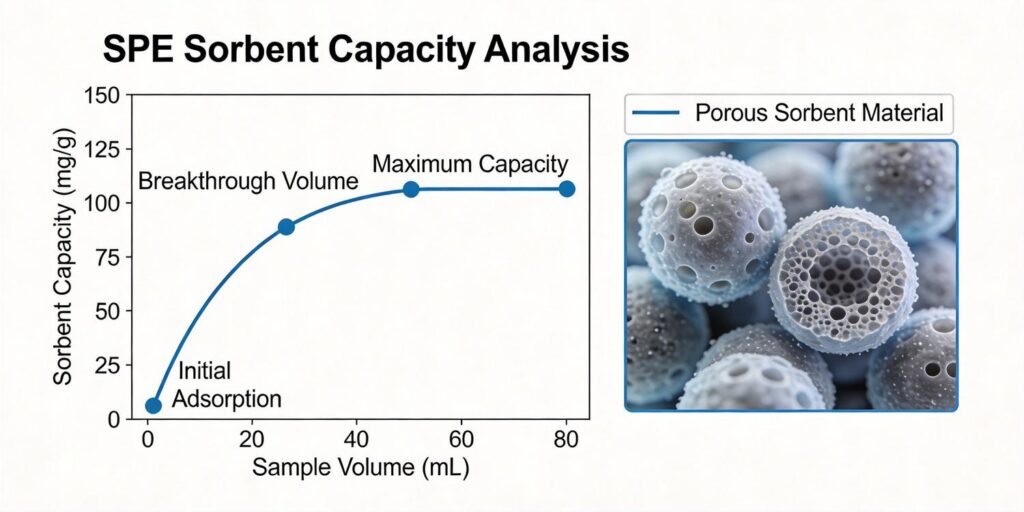
When sorbent capacity is exceeded, breakthrough occurs—analyte appears in the effluent before the entire sample has been processed. This phenomenon can be monitored using a second cartridge in series with the primary extraction cartridge. If analyte appears in the eluent of the second cartridge after separate elution, the sorbent capacity of the first cartridge has clearly been exceeded.
Reduced Recovery and Inconsistency
Overloading leads to inconsistent recovery and poor method reproducibility. The relationship between breakthrough volume (Vb), inter-particle volume (V0), efficiency (N), and capacity factor (k’) is described by the Lovkvist and Jonsson equations. For SPE devices with N < 4, premature breakthrough occurs for kinetic reasons—molecules travel through the device faster than they can be adsorbed.
Matrix Competition Effects
Actual capacity can be defined as total capacity under ideal conditions minus any reduction due to competition from matrix components. This competitive effect is particularly problematic when extracting from complex matrices like biological fluids or environmental samples containing high concentrations of interfering compounds.
Flow Rate Considerations
Linear velocity, rather than flow rate, is the critical kinetic parameter. High linear velocities may result in premature breakthrough, but flow rates can be increased while keeping linear velocities low by increasing the cross-sectional area of the packed bed. For example, 47 mm disc-shaped sorbent beds can process large volumes at flow rates up to 200 mL per minute without breakthrough when linear velocities remain moderate.
Method Optimization Strategies for Maximum Efficiency
1. Systematic Capacity Testing
A practical approach to determining capacity involves:
- Preparing appropriate dilutions of your compound in distilled water
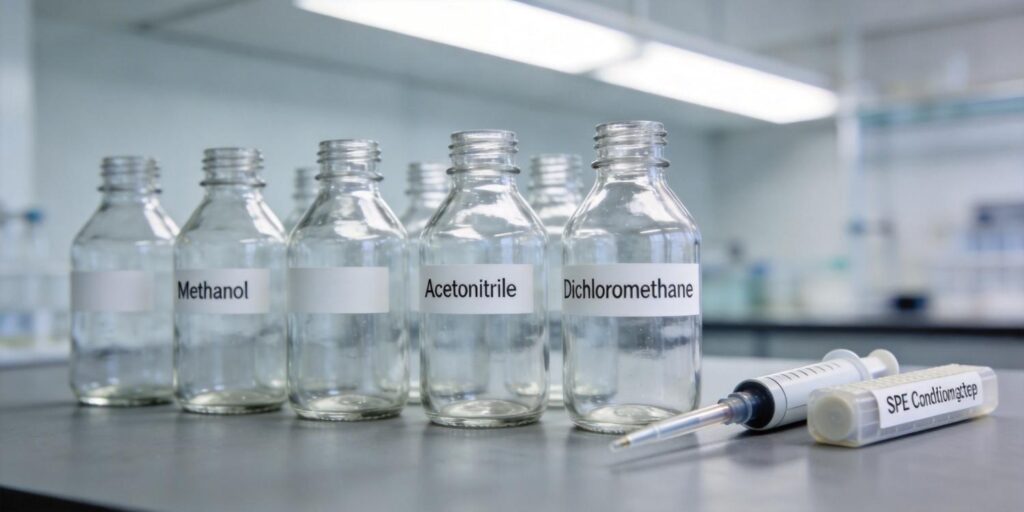
- Conditioning the extraction column with appropriate solvent
- Adding increments of sample compounds and analyzing to determine breakthrough concentration
- Calculating Csp and determining optimal conditions
2. Sorbent Selection and Phase Optimization
When capacity issues arise, consider these solutions:
- Increase bed size to overcome competitive interactions
- Change sorbent nature—if using monomeric C18, switch to higher-loaded polymeric versions
- Change mechanism—consider ion exchange or normal phase for different selectivity
- Use coupled columns—C18 columns coupled to ion exchangers can filter out unwanted material that might poison surfaces
3. Sample Preparation and Matrix Management
Proper sample pretreatment significantly affects capacity utilization:
- Dilute samples 1:1 with buffer to improve flow during loading
- For samples in polar solvents like methanol, dilute 20:1 with water to improve retention
- Filter through 0.45 μm membranes or centrifuge at ≥3000 rpm to remove particulates
- Adjust pH to optimize retention based on analyte pKa values
4. Flow Rate and Conditioning Optimization
Proper conditioning and flow control prevent channeling and ensure maximum capacity utilization:
- Maintain flow rates between 0.5-3.0 mL/min for sufficient solvent-sorbent contact
- Use methanol for conditioning reversed phase columns—it meets all criteria for effective wetting
- Avoid excessive vacuum or pressure that can cause channeling and reduce effective surface area
5. Recovery vs. Capacity Balance
Remember that capacity and recovery are distinct concepts. Capacity is the amount an SPE device can retain, while recovery is the actual amount retained and retrieved. The optimal situation uses sorbent capacity in excess of the analyte amount, but excessive packing increases costs and solvent usage. Aim for the smallest amount of sorbent that achieves your recovery targets while maintaining adequate signal-to-noise ratios.
6. Validation and Quality Control
When optimizing methods, validate these key variables:
- Sorbent weight, different cartridges, and different lots
- Preconditioning solvents and conditions
- Loading solvent composition (% organic, pH, ionic strength, volume)
- Wash solvent optimization
- Eluent volume and composition
- Flow rates during loading, wash, and elution steps
Practical Considerations for SPE Method Development
Choosing the Right Phase
The quickest way to determine which phase yields the best capacity for your compounds is to extract neat standards on a variety of phases and check recovery. This provides rapid insight into which mechanism works best for your application. Remember that capacities of reversed phase and adsorption columns are generally greater than those of ion-exchange columns.
Modern SPE Standards
Today’s SPE has become a real science. If you’re not achieving 90% absolute recovery of your analyte, your method likely needs optimization. However, evaluate method performance based on the optimal recovery needed to sustain required signal-to-noise ratios, not just absolute percent recovery. Sometimes 30% recovery with excellent selectivity provides better analytical results than 90% recovery with interfering compounds.
Equipment and Format Selection
Consider your specific needs when selecting SPE formats:
- Cartridges: Available with sorbent bed masses from 10 mg to 10 g or more
- 96-well plates: Ideal for high-throughput applications with typical sample volumes from 10-375 μL
- Discs: Offer advantages for preventing channeling and processing large volumes
For more information about our comprehensive range of SPE products, including HLB SPE Cartridges, MAX SPE Cartridges, MCX SPE Cartridges, WAX SPE Cartridges, WCX SPE Cartridges, and 96-well SPE Plates, visit our product pages for detailed specifications and application notes.