1. Chemical Characteristics of Acidic Contaminants in Environmental Water
Acidic compounds represent a significant class of environmental contaminants that require specialized extraction techniques for accurate monitoring. These analytes typically contain functional groups that can donate protons in aqueous solutions, resulting in negatively charged species at appropriate pH levels. Common acidic contaminants found in environmental water samples include:
Phenols and Chlorophenols
Phenolic compounds feature hydroxyl groups attached to aromatic rings, with pKa values typically ranging from 8-10. Chlorinated phenols, such as 2,4-dichlorophenol and pentachlorophenol, are particularly concerning due to their persistence and toxicity. These compounds are commonly found in industrial effluents, agricultural runoff, and as degradation products of pesticides.
Herbicides and Pesticides
Many modern herbicides exhibit acidic properties, including phenoxyacetic acids (2,4-D, MCPA), sulfonylureas, and imidazolinones. These compounds often contain carboxylic acid groups with pKa values between 2-5, making them ideal candidates for anion exchange extraction. Their widespread agricultural use necessitates sensitive detection methods in surface and groundwater monitoring programs.
PFAS Intermediates and Related Compounds
Per- and polyfluoroalkyl substances (PFAS) and their intermediates frequently contain sulfonic acid or carboxylic acid groups that impart strong acidic characteristics. These persistent organic pollutants have become a major environmental concern due to their stability and bioaccumulation potential.
Organic Acids from Industrial Processes
Benzene- and naphthalene-sulfonates, along with various carboxylic acids from industrial discharges, represent another category of acidic contaminants requiring specialized extraction approaches.
2. Why Weak Anion Exchange (WAX) Is Effective for Acidic Analytes
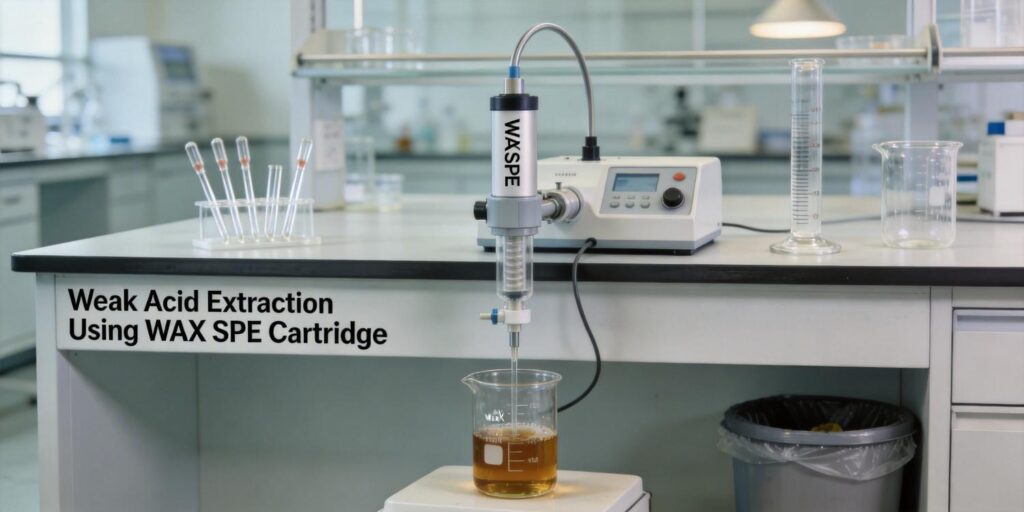
Weak anion exchange (WAX) solid-phase extraction represents a sophisticated mixed-mode approach specifically designed for strong acidic compounds. The effectiveness of WAX sorbents stems from their dual retention mechanism:
Mixed-Mode Retention Mechanism
WAX sorbents combine both ion-exchange and reversed-phase interactions, providing superior retention for acidic analytes. According to Waters documentation, Oasis WAX sorbent features a tightly controlled ion-exchange capacity of 0.6 meq/g, ensuring reproducible SPE protocols. The mixed-mode design allows retention of analytes through multiple interaction types, significantly improving recovery rates for challenging acidic compounds.
Targeted Selectivity for Strong Acids
WAX sorbents are specifically engineered for compounds with pKa values less than 1, making them ideal for sulfonic acids and other strongly acidic species. This targeted selectivity reduces interference from weakly acidic compounds and neutral organic matter, resulting in cleaner extracts and improved analytical sensitivity.
Enhanced Sorbent Characteristics
Modern WAX sorbents, such as those in the Oasis product line, are water-wettable polymeric materials stable across the entire pH range (0-14). This eliminates silanol interactions that can complicate method development with traditional silica-based sorbents. The absence of silanol groups ensures predictable retention behavior and simplifies protocol optimization.
3. Sample pH Adjustment Before SPE Loading
Proper pH adjustment is critical for successful WAX SPE extraction, as it determines the ionization state of both the analytes and the sorbent functional groups:
Optimal pH Range
For effective retention of acidic compounds on WAX sorbents, samples should be adjusted to pH 6-8. This ensures that acidic analytes are predominantly in their anionic form while maintaining the protonated state of the weak anion exchange sites on the sorbent.
Buffer Selection
Use volatile buffers compatible with subsequent LC-MS analysis, such as ammonium acetate or ammonium formate. Avoid phosphate buffers that can interfere with mass spectrometry detection. Typical buffer concentrations range from 10-50 mM, providing adequate pH control without excessive ionic strength.
Practical Considerations
Always verify pH after adjustment using a calibrated pH meter. For field samples, consider adding buffer immediately after collection to stabilize pH and prevent analyte degradation. For samples with high buffering capacity, additional buffer may be required to achieve the target pH range.
4. Conditioning Steps for WAX Cartridges
Proper conditioning prepares the WAX sorbent for optimal analyte retention and ensures consistent performance:
Standard Conditioning Protocol
- Methanol Activation: Pass 2-3 column volumes of methanol through the cartridge to wet the polymeric matrix and remove any storage solvents.
- Water Equilibration: Follow with 2-3 column volumes of deionized water to remove methanol and prepare the sorbent for aqueous sample loading.
- Buffer Conditioning: Apply 1-2 column volumes of the same buffer used for sample pH adjustment to establish the proper ionic environment.
Critical Considerations
Never allow the sorbent to dry between conditioning and sample loading, as this can create channels and reduce retention efficiency. Maintain a flow rate of 1-5 mL/min during conditioning to ensure proper sorbent wetting without excessive pressure.
Troubleshooting Tips
If dealing with particularly challenging matrices, consider adding a 0.1% formic acid conditioning step before buffer application to protonate the weak anion exchange sites more effectively.
5. Washing Strategies to Remove Neutral Organic Matter
Effective washing removes interfering compounds while retaining target acidic analytes:
Primary Wash Solutions
According to Waters Oasis protocols, two primary wash strategies are recommended for WAX cartridges:
- 2% Formic Acid Wash: This acidic wash removes neutral and basic interferences while maintaining retention of acidic analytes through ion-exchange mechanisms.
- 5% Ammonium Hydroxide Wash: This basic wash can be used in alternative protocols to remove different classes of interferences.
Solvent Selection for Matrix Cleanup
Methanol or methanol-water mixtures (typically 5-20% water) effectively remove neutral organic matter, humic acids, and other hydrophobic interferences without eluting target acidic compounds. The water content can be adjusted based on the hydrophobicity of the interferences present in specific environmental samples.
Volume Optimization
Typically, 2-3 column volumes of wash solvent provide adequate cleanup. For samples with high organic matter content (such as surface water with significant humic acid content), additional wash volumes or sequential washes with different solvents may be necessary.
6. Elution Conditions Using Acidic Organic Solvents
Effective elution disrupts the ion-exchange interactions while maintaining analyte stability:
Recommended Elution Solvents
WAX protocols typically employ acidic organic solvents for efficient analyte recovery:
- 2% Formic Acid in Methanol: This is the primary elution solvent in many WAX protocols, effectively neutralizing the ion-exchange interactions while providing good solubility for most acidic compounds.
- 5% Ammonium Hydroxide in Methanol: Used in alternative protocols, particularly for certain classes of acidic compounds.
- Pure Methanol: Often used as a second elution step to ensure complete recovery of all retained compounds.
Elution Volume Optimization
Typically, 2-3 column volumes of elution solvent provide >95% recovery for most acidic compounds. For quantitative applications, collect eluate in fractions and analyze separately to determine the optimal volume for complete elution.
Post-Elution Treatment
After elution, consider evaporating the solvent under gentle nitrogen stream and reconstituting in mobile phase compatible with your LC-MS system. For volatile elution solvents like methanol with formic acid, evaporation and reconstitution can significantly improve detection limits.
7. Example LC-MS Workflow for Environmental Monitoring
Complete Method Outline
Sample Preparation:
1. Collect 500 mL of environmental water sample in clean glass containers
2. Filter through 0.45 μm glass fiber filter to remove particulates
3. Adjust pH to 7.0 ± 0.2 using ammonium hydroxide or formic acid
4. Add internal standards at this stage for quantification
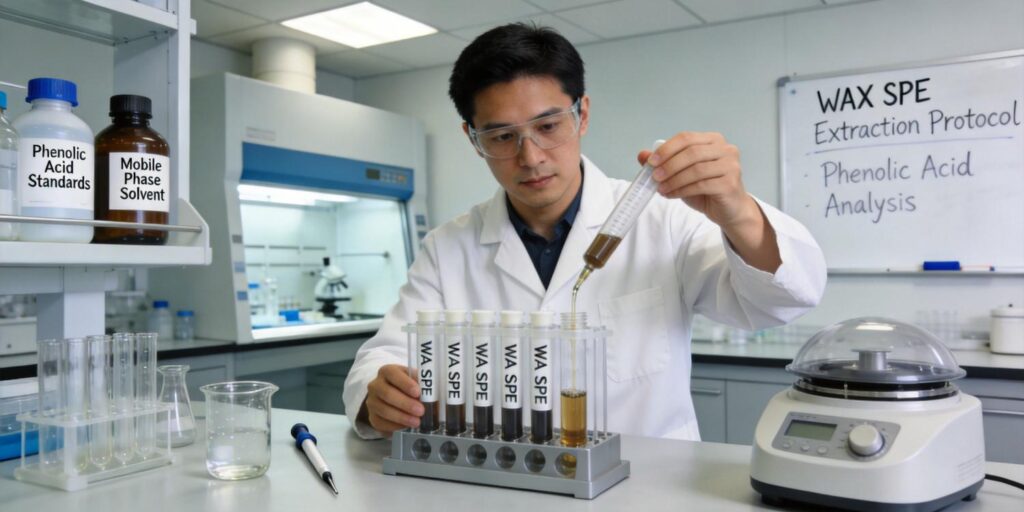
SPE Procedure (using 6 cc/150 mg WAX cartridge):
1. Condition with 6 mL methanol, 6 mL deionized water, 6 mL pH 7 buffer
2. Load sample at 5-10 mL/min flow rate
3. Wash with 6 mL of 2% formic acid in water
4. Wash with 6 mL of methanol
5. Dry cartridge under vacuum for 5 minutes
6. Elute with 6 mL of 2% formic acid in methanol
7. Elute with 6 mL of pure methanol
8. Combine eluates and evaporate to dryness under nitrogen at 40°C
9. Reconstitute in 1 mL of initial mobile phase for LC-MS analysis
LC-MS Conditions
Column: C18 reversed-phase column (100 × 2.1 mm, 1.7 μm)
Mobile Phase A: Water with 0.1% formic acid
Mobile Phase B: Acetonitrile with 0.1% formic acid
Gradient: 5% B to 95% B over 15 minutes
Flow Rate: 0.3 mL/min
Injection Volume: 10 μL
MS Detection: Electrospray ionization in negative mode with multiple reaction monitoring (MRM)
Quality Control Measures
Include method blanks, matrix spikes, and continuing calibration verification samples in each batch. Monitor recovery of internal standards and surrogate compounds to ensure method performance. For regulatory applications, follow appropriate quality assurance/quality control protocols as specified by relevant environmental monitoring guidelines.
Method Performance Expectations
Properly optimized WAX SPE methods typically achieve recoveries of 70-120% for most acidic compounds with relative standard deviations <15%. Detection limits in the low ng/L range are achievable for many acidic pesticides and phenolic compounds when combined with modern LC-MS/MS instrumentation.
Conclusion
Weak anion exchange solid-phase extraction represents a powerful tool for environmental chemists monitoring acidic contaminants in water samples. The mixed-mode retention mechanism of WAX sorbents provides superior selectivity and recovery for challenging acidic analytes compared to traditional reversed-phase approaches. By following optimized protocols for pH adjustment, conditioning, washing, and elution, laboratories can achieve robust, sensitive methods for monitoring phenols, acidic herbicides, PFAS intermediates, and other environmentally relevant acidic compounds.
For laboratories considering implementation of WAX SPE methods, Poseidon Scientific offers a range of WAX SPE cartridges and 96-well SPE plates designed for high-throughput environmental monitoring applications. Our products provide the consistency and performance required for reliable trace-level analysis of acidic contaminants in complex environmental matrices.