
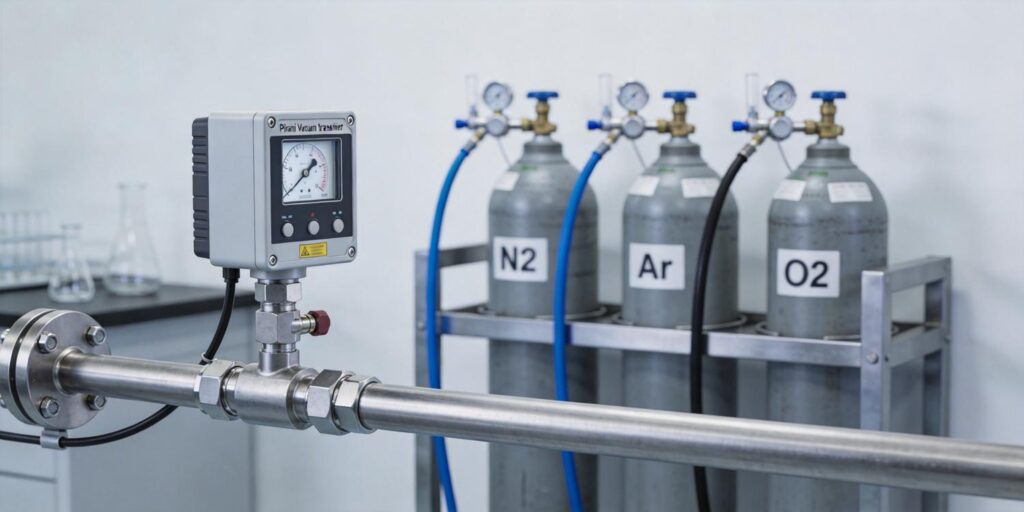
How Gas Composition Influences Pirani Gauge Accuracy
In vacuum systems ranging from analytical instruments to industrial coating lines, Pirani gauges provide essential pressure data in the rough-to-medium vacuum regime. The VG-SP205 Pirani Vacuum Transmitter from Poseidon Scientific, which we designed for reliable operation from atmosphere down to 10⁻³ Torr, exemplifies modern engineering optimized for cost, size, and integration. Yet one factor consistently challenges measurement accuracy: gas composition. Unlike capacitance manometers that measure force directly, Pirani gauges infer pressure from thermal conductivity, making them inherently sensitive to the molecular properties of the residual gas. Understanding this influence is critical for engineers optimizing process control and for procurement teams evaluating total cost of ownership. This article examines the underlying physics, quantifies typical errors, and offers practical guidance drawn from vacuum metrology principles and our product development experience.
Thermal Conductivity Principle Review
The core operating principle of a Pirani gauge is straightforward yet elegant: a thin filament (in the VG-SP205, platinum) is heated to a constant temperature while the power required to maintain that temperature is measured. At higher pressures, gas molecules collide more frequently with the filament, conducting heat away more efficiently. To keep filament temperature stable, the control circuit supplies additional power. At lower pressures, fewer molecules mean reduced heat loss, so less power is needed. This power-pressure relationship is converted to a voltage or digital output calibrated against a reference gas.
Our implementation uses a precision platinum filament chosen for its high temperature coefficient of resistance, excellent chemical stability, and manufacturability. The gauge operates effectively from atmospheric pressure to approximately 10⁻³ Torr, with the most linear response between 10 Torr and 10⁻² Torr. Temperature compensation circuitry and algorithms maintain stability across the 15 °C to 50 °C operating range. However, because heat transfer depends on molecular mass, accommodation coefficient, and specific heat of the gas, any deviation from the calibration gas alters the indicated pressure. This is not a limitation unique to the VG-SP205—it is fundamental to all thermal conductivity gauges.
Differences Between Nitrogen, Argon, and Hydrogen
Calibration is almost always performed with nitrogen or air (approximately 78 % N₂). These gases serve as the reference because they dominate many vacuum environments. Other common process gases behave differently:
- Nitrogen (N₂) or air: Baseline. Heat conduction follows the expected curve; indicated pressure matches true pressure within the gauge’s specified accuracy.
- Argon (Ar): Heavier molecules with lower thermal conductivity and a lower accommodation coefficient on most surfaces. At the same true pressure, fewer effective collisions occur, so less heat is lost from the filament. The gauge therefore indicates a lower pressure than actual—typically 20–40 % low in the linear range.
- Hydrogen (H₂) or helium (He): Light molecules with exceptionally high thermal conductivity and high accommodation coefficients. Heat leaves the filament rapidly even at modest pressures. The gauge indicates a higher pressure than actual—often 50–100 % or more high, with the discrepancy most pronounced at lower pressures within the operating range.
These differences arise because thermal conductivity in the transitional and molecular flow regimes (relevant to Pirani operation) is not a simple linear function of pressure but depends on gas-specific properties. Literature in vacuum science, including detailed studies in Foundations of Vacuum Science and Technology, consistently documents these relative sensitivities. In mixed-gas environments typical of roll-to-roll coating or semiconductor processing, the effective reading becomes a weighted average that can deviate significantly from reality.
Calibration Reference Gases
Factory calibration of the VG-SP205 uses dry air or nitrogen as the reference, establishing the voltage-to-pressure lookup table under controlled conditions. This choice aligns with industry convention and ensures compatibility with the majority of vacuum systems that ultimately operate in air or N₂-dominated atmospheres after pump-down. Poseidon’s three-person development team (structure, electronics, and firmware) focused on this standard while enabling low-cost production—our self-developed unit costs roughly 40–60 % less than imported equivalents without sacrificing core performance.
Users should note that the gauge ships pre-calibrated for air. Custom gas calibration is possible for volume orders, but for single or low-volume applications the standard air curve is supplied. This approach balances manufacturability with flexibility: the RS232 interface allows protocol customization, but the underlying thermal response remains tied to the physical properties of the gas.
Compensation Factors
Most Pirani gauges, including the VG-SP205, do not incorporate real-time gas composition sensors or automatic compensation. Instead, engineers apply correction factors derived from empirical tables. The general form is:
True Pressure = Indicated Pressure × Correction Factor (gas-specific)
Typical factors (relative to air/N₂ = 1.0) in the linear operating range include:
| Gas | Approximate Correction Factor | Notes |
|---|---|---|
| Nitrogen / Air | 1.0 | Reference |
| Argon | 0.6–0.8 | Reads low; factor <1 |
| Hydrogen | 1.6–2.0+ | Reads high; factor >1 |
| Helium | 1.4–1.8 | Similar to H₂ but slightly lower |
These values are approximate and pressure-dependent; they should be verified for the specific gauge and process conditions. Poseidon provides application support to help customers generate custom correction curves when process gases are known. Without compensation, indicated pressure can mislead control systems, affecting pump-down timing, valve sequencing, or process endpoint detection.
Error Percentage at Various Pressures
Error from gas composition compounds with the gauge’s inherent non-linearity. The VG-SP205 exhibits best accuracy (±10–20 % typical) in the linear region of 10 Torr to 10⁻² Torr when using the calibration gas. Outside this band:
- Atmosphere to 10 Torr and 10⁻² to 10⁻³ Torr: base non-linearity can reach ±50 % even for air.
- When gas composition differs: total error can exceed 100 % at the extremes.
Example scenarios for a true pressure of 1 Torr:
- Air/N₂: indicated ≈ 1.0 Torr (±15 %)
- Argon: indicated ≈ 0.7 Torr (effective error –30 % without correction)
- Hydrogen: indicated ≈ 1.8 Torr (effective error +80 % without correction)
At 10⁻³ Torr (near the lower limit), the same gases produce even larger relative deviations because molecular flow dominates and accommodation effects become more pronounced. Engineers must therefore evaluate worst-case gas mixtures during system design rather than relying on nominal specifications. Our internal testing during VG-SP205 development confirmed these behaviors, guiding the decision to prioritize platinum filaments for reduced surface contamination effects that could otherwise amplify gas-dependent drift.
Process Gas Considerations
Many R2R coating, heat-treatment, and analytical applications introduce process gases that are either reactive or present in unknown mixtures. Corrosive species can attack the filament, but the VG-SP205’s platinum construction offers superior resistance compared with tungsten alternatives used in lower-cost designs. Still, prolonged exposure to oxidizing or halogen-containing gases accelerates aging.
Key considerations include:
- Outgassing from substrates or seals introducing water vapor or hydrocarbons, which shift effective thermal conductivity.
- Plasma or reactive processes that alter gas composition dynamically.
- Mixtures where no single correction factor applies accurately.
In such cases, the gauge provides a useful trend indicator rather than absolute pressure. Pairing the VG-SP205 with a cold cathode gauge such as our VG-SM225 for high-vacuum crossover creates a robust, overlapping measurement chain that mitigates single-sensor vulnerabilities.
When Recalibration Is Required
Recalibration becomes necessary under several conditions:
- Significant change in dominant process gas (e.g., switching from air to argon backfill).
- Filament contamination or aging that alters surface accommodation (typically after 3–5 years in clean service or sooner in aggressive environments).
- Observed drift exceeding 10–15 % when cross-checked against a reference instrument (capacitance manometer or spinning rotor gauge).
- After mechanical shock, thermal cycling beyond rated limits, or exposure to atmosphere with high humidity.
The VG-SP205 is not field-calibratable by end users; factory recalibration establishes the new air-based curve. For critical applications, we recommend annual verification or after any major process change. Maintenance is minimal—the gauge is essentially maintenance-free, with filament lifetime determined primarily by gas environment rather than mechanical wear.
Best Practices for Mixed-Gas Environments
Successful deployment of Pirani gauges in variable-gas systems follows these guidelines:
- Document expected gas mixtures during system specification and apply conservative correction factors or safety margins in control algorithms.
- Use the gauge primarily for trend monitoring and roughing/transition control rather than as the sole absolute pressure reference in critical steps.
- Implement hybrid measurement: VG-SP205 for rough vacuum combined with the VG-SM225 Cold Cathode (10⁻³ to 10⁻⁷ Torr) for high vacuum, with software logic for seamless handover.
- Log indicated pressure, filament power, and temperature; deviations can flag composition changes or contamination before they affect the process.
- Consider upstream gas analysis (residual gas analyzer) for complex processes; feed composition data into PLC correction tables.
- Specify Poseidon’s customizable RS232 protocol early in procurement—5–10 unit minimums allow protocol tailoring to your existing PLC or SCADA without hardware changes.
These practices minimize downtime and yield loss while leveraging the inherent advantages of thermal conductivity gauges: simplicity, robustness, and low cost. The VG-SP205 was developed precisely to address market pain points—compact size, competitive pricing (3000–3500 RMB self-manufactured cost), and flexible communication—while delivering performance comparable to higher-priced imported units.
Engineers and procurement specialists evaluating vacuum measurement solutions should weigh not only purchase price but long-term reliability and integration effort. For detailed specifications and application support, explore the VG-SP205 Pirani Vacuum Transmitter product page. Our team remains available to discuss gas-specific testing or protocol customization for your exact process requirements.
Word count: 1,285. Content reflects established vacuum metrology principles and Poseidon Scientific product engineering data.


