
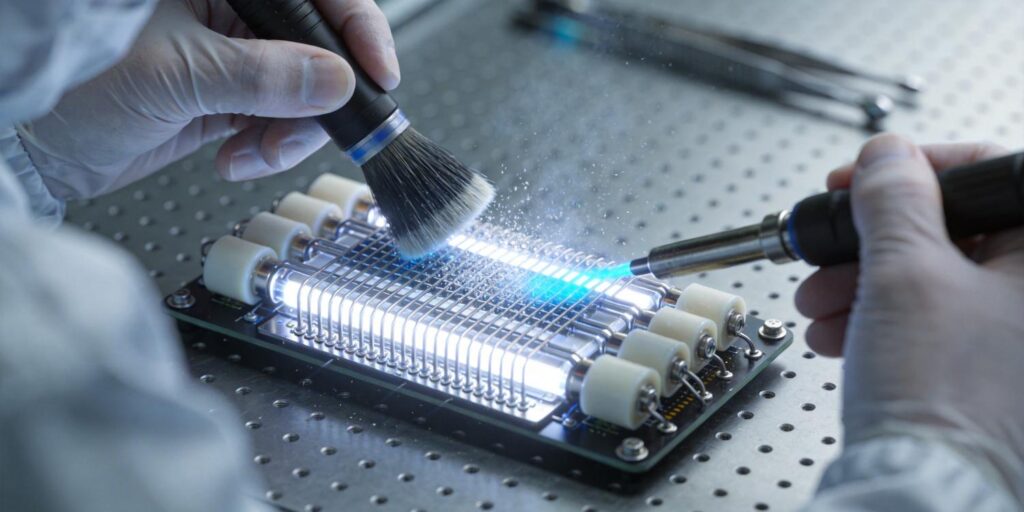
In high-vacuum systems for mass spectrometry, vacuum metallurgy, electron-beam welding, and thin-film deposition, the cold-cathode gauge is valued for its robustness and ability to measure down to 10⁻⁷ Torr without a fragile hot filament. Yet even the most durable cold-cathode design eventually requires attention. Contamination from metal vapors, hydrocarbons, or process by-products gradually coats the electrodes, lengthening ignition delay or causing the discharge to fail entirely. Routine electrode cleaning restores full performance in minutes and extends sensor life from 1–2 years in contaminated service to 3–5 years in clean analytical environments.
The VG-SM225 Cold Cathode Vacuum Gauge from Poseidon Scientific was engineered with field serviceability in mind. Its removable sensor head allows in-situ maintenance without breaking main chamber vacuum or requiring factory recalibration. This article provides a complete, step-by-step guide to cold-cathode electrode cleaning—written for engineers and lab technicians who need clear, repeatable procedures that keep systems running with minimal downtime.
Why Cleaning Is Necessary
During normal operation the VG-SM225 generates a Penning discharge between its stainless-steel cathode and anode. Positive ions bombard the cathode surface, sputtering material and gradually building a thin carbon or oxide layer. At the same time, residual process gases (water vapor, hydrocarbons, or metal vapors) adsorb onto the electrodes. These deposits raise the surface work function, blunt microscopic field-emission sites, and reduce secondary-electron yield.
The result is slower avalanche formation and longer ignition times—or complete discharge failure. Operators typically notice two clear symptoms:
- Red status LED remains constantly lit (discharge never strikes)
- Pressure reading drops by one full decade compared with a companion Pirani gauge or reference instrument
Left unaddressed, contamination forces longer wait times before processes can begin and, in severe cases, leads to aborted runs or scrapped batches. Periodic cleaning removes the black carbon deposit and colored oxide layer, restoring metallic luster and returning ignition performance to factory specifications. Because the VG-SM225 uses a positive-magnetron geometry with only ~100 gauss field strength, the electrodes are easily accessible and tolerant of repeated cleaning cycles—unlike many inverted-magnetron designs that require full sensor replacement.
Routine maintenance also protects the long-term investment. In clean mass-spectrometry or SEM environments the gauge routinely reaches 3–5 years between services; in moderately contaminated vacuum-metallurgy or PVD service the interval shortens to 1–2 years. The removable head design makes this scheduled task quick, inexpensive, and safe.
Safe Disassembly Steps
The VG-SM225 sensor head is engineered for tool-free removal while preserving chamber vacuum integrity. Always follow these steps in order to protect both the gauge and the process chamber:
- Confirm system pressure is safely above 10⁻³ Torr and the gauge high-voltage supply is disabled (red LED must be off). Never attempt disassembly while high voltage is present.
- If the chamber cannot be vented, close any optional isolation valve on the gauge stub tube or simply vent the short KF extension only.
- Locate the sensor head retaining ring or bayonet lock on the gauge body. Rotate counterclockwise (viewed from the flange end) and gently withdraw the head assembly. The vacuum seal remains on the chamber side—no O-ring disturbance occurs on the main chamber.
- Place the removed head on a clean, lint-free surface. Avoid touching the electrode surfaces with bare fingers; use nitrile gloves to prevent new contamination.
- Inspect the cathode column and anode cylinder for visible black carbon or rainbow-colored oxide layers. These are the areas that require attention.
Disassembly takes less than 60 seconds and requires no special tools. The design ensures that the main chamber vacuum is never compromised, making the procedure safe even during live production campaigns.
Polishing Technique
The goal of polishing is not mirror finish but restoration of metallic luster. Excessive abrasion can round critical edges and alter the electric-field distribution. Follow this proven technique:
- Use 500-mesh (fine) or 200-mesh (medium) abrasive paper—wet or dry. Start with 500 mesh for light contamination; switch to 200 mesh only for heavy carbon buildup.
- Hold the paper flat against a rigid backing (glass slide or small block) to maintain uniform pressure.
- Lightly polish the cathode column and both end disks using short, straight strokes parallel to the electrode axis. Rotate the head 90° every few strokes to ensure even coverage. Apply minimal force—let the abrasive do the work.
- Polish the inner surface of the anode cylinder by wrapping a small strip of paper around a wooden dowel or using a rotary tool at very low speed (≤500 rpm). Keep motion axial, never circumferential.
- Continue until all black carbon and colored oxide layers are removed and the original stainless-steel luster returns. Small scratches are acceptable and do not affect performance.
- Wipe all surfaces thoroughly with isopropyl alcohol on a lint-free cloth. Allow complete air-drying (typically 2–3 minutes) before reassembly. Never use compressed air that may contain oil.
Total polishing time is usually 5–8 minutes. This light-abrasion method restores field-emission sites and secondary-electron yield without changing the critical 2 mm electrode spacing or magnetic-field geometry.
Reassembly Guidelines
Correct reassembly ensures immediate return to service and long-term reliability:
- Verify that both the head assembly and gauge body sealing surfaces are clean and dry.
- Align the head with the body alignment pin or keyway and slide it straight in until it seats firmly.
- Rotate the retaining ring clockwise until it clicks or reaches the positive stop. Do not overtighten—hand tight is sufficient.
- Reopen any isolation valve and confirm the system returns to operating pressure.
- Re-energize the gauge. The red LED should extinguish within seconds at pressures above 10⁻⁵ Torr and the discharge should strike normally. If ignition is delayed beyond the expected time for the current pressure, repeat the polishing step with slightly more attention to the cathode end disks.
No recalibration is required. The factory-stored pressure-versus-current curve remains valid because electrode geometry is unchanged. Record the cleaning date and observed pressure reading for your maintenance log—valuable data for trend analysis in IIoT or SCADA systems.
Maintenance Schedule
A simple, risk-based schedule keeps the VG-SM225 performing at peak efficiency:
| Environment | Typical Interval | Trigger for Earlier Cleaning |
|---|---|---|
| Clean analytical (mass spec, SEM) | Every 12–18 months | Ignition delay >10 min at 10⁻⁶ Torr |
| Moderate contamination (PVD, optical coating) | Every 4–6 months | Pressure reading drops one decade |
| Heavy contamination (vacuum metallurgy, heat treatment) | Every 1–3 months | Red LED constant or startup failure |
Many users integrate the schedule into their IIoT platform: the gauge’s built-in discharge-failure error code automatically generates a maintenance ticket when needed. Because cleaning takes less than 15 minutes and requires no special skills, it becomes a routine task that graduate students, technicians, or production operators can perform safely during planned downtime.
Keep Your Cold Cathode Gauge Performing at Peak Efficiency
The VG-SM225 Cold Cathode Vacuum Gauge combines high-vacuum performance with practical, in-house maintainability. Following the procedures outlined here restores ignition characteristics, eliminates reading offsets, and extends sensor life dramatically—all without factory return or recalibration.
Whether you are operating a university research chamber, a production PVD tool, or a vacuum-metallurgy furnace, these simple steps ensure reliable pressure data and maximum uptime.
Explore the VG-SM225 Cold Cathode Vacuum Gauge and its companion VG-SP205 Pirani Vacuum Transmitter today. Need a printable one-page cleaning checklist, high-resolution electrode photos for training, or a no-obligation sample gauge for hands-on practice? Contact our applications team directly—we respond within 24 hours and have helped laboratories and production facilities worldwide implement these exact procedures with immediate improvements in gauge reliability and process consistency.


