Why Flow Rate Matters in SPE Extraction
In solid phase extraction (SPE), flow rate control is not merely a procedural detail—it’s a fundamental parameter that directly impacts extraction efficiency, analyte recovery, and method reproducibility. Unlike high-performance liquid chromatography (HPLC), where flow characteristics are precisely engineered, SPE flow dynamics are more variable and require careful optimization for each application.
The importance of flow rate stems from the kinetic nature of analyte-sorbent interactions. As noted in Forensic and Clinical Applications of Solid Phase Extraction, “Regulation of flow rates is a critical aspect of extraction efficacy, particularly at sample application and elution steps.” Flow rates that are too fast can adversely affect recovery of target analytes, especially when ion-exchange mechanisms are employed, while flows that are too slow add unnecessary time to the analysis and may facilitate entrapment of unwanted matrix components in terminal pores of the sorbent.
The Kinetic Basis of Flow Rate Effects
SPE involves mass transfer processes where analytes must diffuse from the bulk solution to the sorbent surface, interact with functional groups, and establish equilibrium binding. These processes require finite time, and flow rate directly controls the residence time of analytes within the sorbent bed. According to research by Bidlingmeyer (1984), “recovery is dependent on flow rate through the SPE device because breakthrough volume is decreased due to band-broadening at higher flow rates.”
Mayer and Poole (1994) further demonstrated that “the recovery of analytes by SPE shows significant flow-rate dependence when the sample volume exceeds the breakthrough volume of the analyte.” This relationship underscores the importance of matching flow rates to both the chemical properties of analytes and the physical characteristics of the sorbent bed.
Effects on Analyte Retention and Recovery
Ion Exchange vs. Reversed Phase Sensitivity
Different SPE mechanisms exhibit varying sensitivity to flow rate variations. As a general rule, ion exchange extractions are more sensitive to flow rates than polar or non-polar extractions. This increased sensitivity stems from the kinetic limitations of ionic interactions, which typically involve slower binding kinetics compared to hydrophobic interactions.
In ion exchange SPE, the electrostatic attraction between charged analytes and oppositely charged sorbent functional groups requires sufficient contact time for effective binding. High flow rates can limit this contact time, leading to incomplete retention and breakthrough. Conversely, reversed-phase interactions (hydrophobic bonding) generally tolerate higher flow rates due to faster equilibrium kinetics.
Breakthrough Volume Relationships
The breakthrough volume (Vb)—the sample volume at which analytes begin to elute unretained—is directly affected by flow rate. Higher flow rates decrease breakthrough volumes due to increased band-broadening effects. This relationship is particularly critical when processing large sample volumes for trace enrichment applications.
Research by Liska et al. (1990) demonstrated that using breakthrough volumes and widths of elution curves, theoretical preconcentration factors could be calculated for various analyte-aqueous sample-sorbent systems. These calculations highlight how flow rate optimization can maximize preconcentration efficiency while maintaining quantitative recovery.
Recovery-Flow Rate Trade-offs
There exists a fundamental trade-off between recovery and flow rate in SPE operations. As flow rates increase, recovery typically decreases due to reduced contact time between analytes and sorbent surfaces. This relationship is particularly pronounced during loading and elution steps, which are generally more sensitive to flow rate variations than conditioning or washing steps.
Experimental data from automated SPE systems demonstrate this effect clearly. In one study, extraction yield increased from about 80% to 95% when lowering the flow rate from 1.5 to 0.33 mL/minute for elution with ammoniated ethyl acetate. Such improvements highlight the importance of flow rate optimization for achieving high recoveries, especially in manual procedures where maintaining low flow rates can be challenging.
Recommended Flow Ranges for SPE Operations
General Guidelines
Based on extensive laboratory experience and literature recommendations, optimal flow rates for SPE operations typically fall within specific ranges:
- Sample Loading: 1-2 mL/min for most applications
- Washing Steps: 1-3 mL/min (less critical than loading/elution)
- Elution: 0.5-2 mL/min, depending on solvent viscosity and analyte properties
- Conditioning: 1-3 mL/min
These ranges provide a starting point for method development, but specific applications may require adjustments based on sorbent characteristics, analyte properties, and matrix composition.
Application-Specific Considerations
Environmental Water Analysis
For large-volume water samples (e.g., 1-liter environmental samples), flow rates should be optimized to balance throughput and recovery. Typically, flow rates of 5-10 mL/min are acceptable for hydrophobic compounds with high log P values (>3.5), while more polar compounds may require slower rates (2-5 mL/min) to ensure complete retention.
Biological Fluid Extraction
When processing biological matrices such as plasma, serum, or urine, flow rate control becomes particularly important due to matrix complexity and potential for protein precipitation. Recommended flow rates for biological samples generally range from 0.5-2 mL/min during loading to minimize protein binding and maximize analyte recovery.
Ion Exchange Applications
For ion exchange SPE, slower flow rates (0.5-1 mL/min) are typically required to ensure adequate contact time for ionic interactions. This is especially important for weakly ionic compounds or when dealing with complex matrices that may contain competing ions.
Practical Laboratory Tips for Flow Rate Control
Manual vs. Automated Systems
Flow rate control differs significantly between manual and automated SPE systems:
Manual Systems (Vacuum Manifolds)
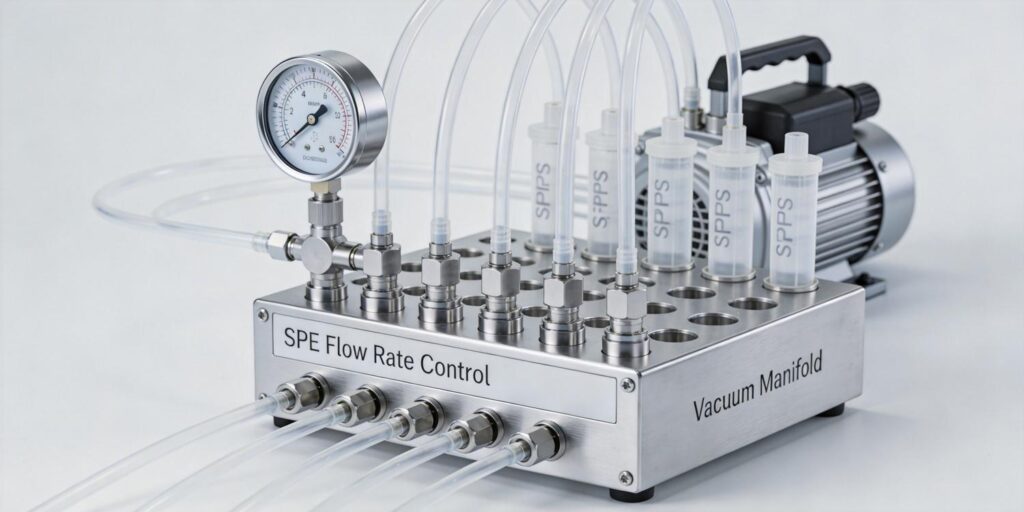
In manual vacuum systems, flow rate is controlled indirectly through vacuum pressure settings. The resulting flow rate depends on vacuum pressure, solvent viscosity, sorbent characteristics, and cartridge format. With negative pressure operation, pressure remains constant while flow rate through the SPE cartridge bed may vary. Key considerations include:
- Use consistent vacuum settings (typically 5-15 inches Hg)
- Monitor flow rates visually (drops/second) and adjust vacuum accordingly
- Standardize procedures across operators to ensure reproducibility
Automated Systems
Modern automated SPE workstations offer superior flow rate control through positive pressure displacement using pumps or syringes. These systems provide the most stable flow characteristics and allow explicit flow rate settings. When evaluating automated systems, consider:
- Ability to set different flow rates for each extraction step
- Flow rate monitoring and adjustment capabilities
- System compatibility with your specific sorbent formats
Optimization Strategies
Method Development Approach
When developing or optimizing SPE methods, follow this systematic approach to flow rate optimization:
- Initial Screening: Start with conservative flow rates (1 mL/min for loading, 0.5 mL/min for elution)
- Recovery Assessment: Measure recovery at different flow rates while keeping other parameters constant
- Breakthrough Evaluation: Determine breakthrough volumes at various flow rates for critical analytes
- Reproducibility Testing: Assess method precision across multiple extractions at selected flow rates
- Throughput Optimization: Balance recovery requirements with practical throughput considerations
Troubleshooting Flow-Related Issues
Common flow-related problems and their solutions include:
| Problem | Possible Causes | Solutions |
|---|---|---|
| Low recovery | Flow rate too high during loading/elution | Decrease flow rate by 50% and reassess recovery |
| Poor reproducibility | Inconsistent flow control | Standardize vacuum/pressure settings; consider automated system |
| Clogging/channeling | Particulate matter in sample; uneven flow | Pre-filter samples; ensure proper sorbent bed preparation |
| Incomplete drying | Insufficient drying time/flow | Increase drying time; ensure proper vacuum/pressure |
Advanced Considerations
Sorbent Particle Size Effects
Sorbent particle size significantly impacts flow characteristics and optimal flow rates. Smaller particles (e.g., 8-10 μm in Empore disks) provide higher surface area and better mass transfer but generate higher backpressure and require slower flow rates. Larger particles (40-60 μm in traditional cartridges) tolerate higher flow rates but may exhibit reduced efficiency.
Solvent Viscosity Considerations
Solvent viscosity directly affects flow rates at constant pressure. When switching between solvents of different viscosities (e.g., water to methanol), flow rates will naturally vary unless pressure is adjusted accordingly. Automated systems with flow rate monitoring can compensate for these variations, while manual systems require operator adjustment.
Temperature Effects
Temperature influences both solvent viscosity and analyte-sorbent interaction kinetics. For consistent results, maintain stable laboratory temperatures and consider temperature effects when comparing flow rates across different experimental conditions.
Quality Control and Documentation
Proper documentation of flow rate parameters is essential for method validation and transfer:
- Record specific flow rates (mL/min) or vacuum/pressure settings for each method step
- Include flow rate specifications in standard operating procedures
- Monitor and document flow rate consistency during method validation
- Establish acceptance criteria for flow-related parameters in quality control protocols
Conclusion
Flow rate control represents a critical but often overlooked aspect of SPE method optimization. By understanding the kinetic principles underlying analyte-sorbent interactions and implementing systematic optimization strategies, laboratories can achieve improved recoveries, better reproducibility, and more robust analytical methods. Whether using manual vacuum manifolds or sophisticated automated systems, careful attention to flow rate parameters can significantly enhance SPE performance across diverse applications from environmental monitoring to pharmaceutical analysis.
For laboratories seeking to optimize their SPE workflows, Poseidon Scientific’s HLB SPE cartridges and other SPE products offer consistent performance characteristics that facilitate flow rate optimization and method development.