Trace Pesticide Contamination Concerns in River Water
River water monitoring for trace pesticide contamination represents one of the most critical environmental analytical challenges facing regulatory agencies and research institutions today. Pesticides, even at sub-part-per-billion (ppb) levels, can have profound ecological impacts, affecting aquatic life, disrupting ecosystems, and potentially entering drinking water supplies. The analytical challenge is compounded by the diverse chemical nature of modern pesticides—ranging from non-polar organochlorines to polar carbamates and acidic herbicides—all of which require specialized extraction approaches.
According to environmental monitoring studies, river water typically contains pesticides at concentrations between 0.01-10 μg/L, with many compounds requiring detection limits below 0.1 μg/L to meet regulatory standards. The complexity of river water matrices, containing dissolved organic matter, suspended solids, and various salts, further complicates trace analysis, making effective sample preparation essential for accurate quantification.
Sample Collection and Preservation Protocols
Proper sample collection and preservation form the foundation of reliable trace pesticide analysis. River water samples should be collected in pre-cleaned amber glass containers to prevent photodegradation of light-sensitive compounds. For comprehensive pesticide screening, 1-2 liter samples are typically required to achieve adequate detection limits after concentration.
Immediate preservation is critical: samples should be acidified to pH 2-3 with hydrochloric or sulfuric acid to stabilize acidic pesticides and prevent microbial degradation. Refrigeration at 4°C during transport and storage is essential, with analysis ideally completed within 7 days of collection. For longer-term storage, freezing at -20°C is recommended, though some compounds may degrade even under these conditions.
Pre-filtration to Remove Particulates
Before SPE extraction, river water samples must undergo thorough filtration to remove suspended solids that could clog SPE cartridges and interfere with analysis. Glass fiber filters (0.45 μm or 0.7 μm) are typically employed, though membrane filters can also be used. The filtration step serves multiple purposes:
- Removes particulate matter that could physically block SPE cartridges
- Eliminates sediment-bound pesticides that would otherwise be inaccessible to SPE extraction
- Reduces potential interferences from colloidal material
- Prevents SPE cartridge fouling, ensuring consistent flow rates
It’s important to note that filtration may remove some particle-associated pesticides, so the analytical method should account for this fraction if total pesticide content is required.
Selection of HLB SPE Cartridge for Broad Pesticide Retention
The choice of SPE sorbent is perhaps the most critical decision in pesticide analysis methodology. For comprehensive pesticide screening in river water, HLB (Hydrophilic-Lipophilic Balanced) cartridges represent the optimal choice. These polymeric sorbents, typically composed of N-vinylpyrrolidone and divinylbenzene copolymers, offer several distinct advantages for pesticide analysis:
Why HLB Excels for Pesticide Extraction
HLB sorbents provide balanced retention of both polar and non-polar pesticides through a combination of reversed-phase and hydrophilic interactions. Unlike traditional C18 silica-based sorbents, HLB maintains excellent wettability even when dry, ensuring consistent performance across the entire pesticide polarity spectrum. Research demonstrates that HLB cartridges can effectively retain pesticides with log P values ranging from -2 to 7, covering virtually all pesticide classes encountered in environmental monitoring.
Technical Specifications for Optimal Performance
For river water applications, 200-500 mg HLB cartridges in 3-6 cc configurations provide the ideal balance between capacity and flow characteristics. The 30-60 μm particle size range ensures adequate surface area for trace enrichment while maintaining reasonable flow rates during large-volume loading. Glass cartridges with Teflon frits are particularly recommended for trace-level analysis at parts-per-trillion (PPT) levels, as they minimize background contamination from cartridge materials.
Loading Large Water Volumes (500 mL–1 L)
Trace pesticide analysis requires substantial sample volumes to achieve adequate analyte mass for detection. Loading 500 mL to 1 liter of river water through HLB cartridges represents standard practice for achieving detection limits in the low ng/L range. Several technical considerations ensure successful large-volume loading:
Flow Rate Optimization
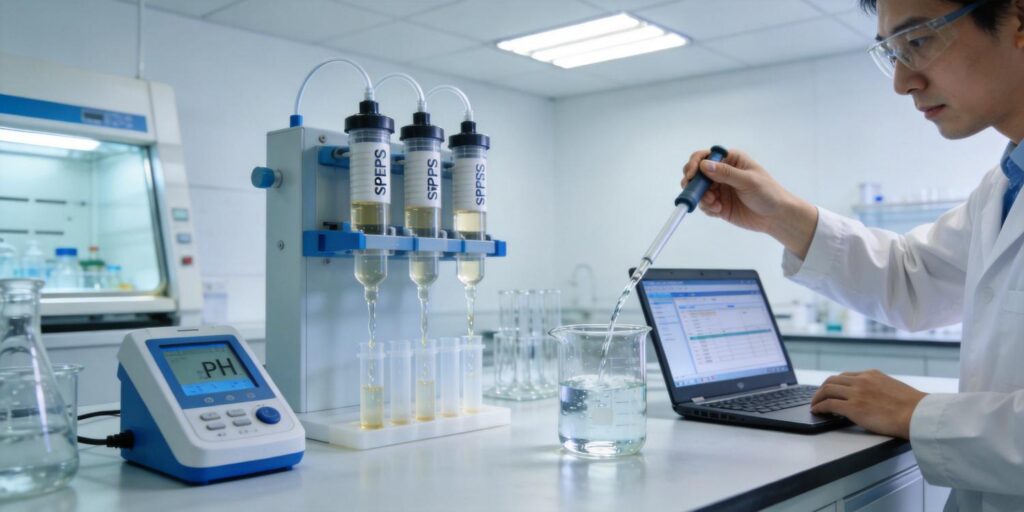
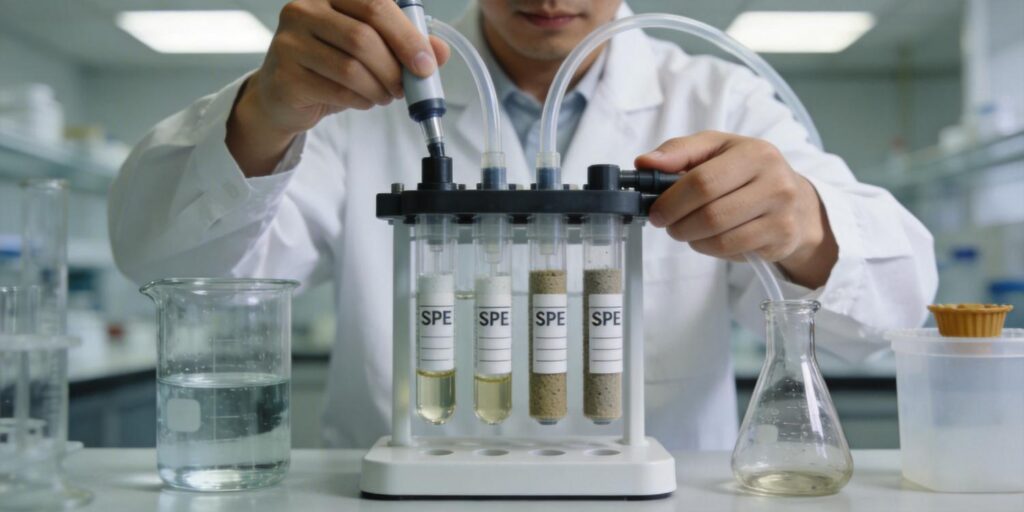
Maintaining controlled flow rates during sample loading is crucial for maximizing pesticide retention. Flow rates should not exceed 10-15 mL/min for 500 mg HLB cartridges. Slower flow rates (5-10 mL/min) typically yield better recovery for more polar pesticides, as they allow sufficient time for analyte-sorbent interactions. Vacuum manifolds with adjustable pressure controls or positive pressure systems provide the most consistent flow management.
Breakthrough Prevention
For 1-liter samples, monitoring for breakthrough is essential, particularly for early-eluting polar pesticides. Using two cartridges in series or incorporating a small percentage of organic modifier (1-5% methanol) in the sample can help prevent breakthrough while maintaining adequate retention of non-polar compounds.
Washing to Remove Dissolved Organic Matter
River water contains significant amounts of dissolved organic matter (DOM)—primarily humic and fulvic acids—that can co-extract with pesticides and interfere with subsequent GC-MS analysis. An effective washing step is therefore essential for obtaining clean extracts.
Optimized Wash Protocols
After sample loading, HLB cartridges should be washed with 5-10 mL of water containing 5-10% methanol or acetonitrile. This mild organic content helps remove polar interferences while retaining most pesticides on the sorbent. For particularly challenging matrices with high DOM content, additional washing with acidified water (pH 2-3) or buffer solutions may be necessary.
Drying Considerations
Complete drying of the SPE cartridge before elution is critical for successful solvent exchange and concentration. After washing, cartridges should be dried under vacuum for 10-15 minutes or centrifuged to remove residual water. Incomplete drying can lead to poor recovery during elution and difficulties in subsequent solvent evaporation.
Elution with Methanol for Comprehensive Pesticide Recovery
Methanol serves as the optimal elution solvent for broad-spectrum pesticide recovery from HLB cartridges. Its intermediate polarity effectively elutes both polar and non-polar compounds, while its volatility facilitates subsequent concentration steps.
Elution Volume and Technique
Typically, 5-10 mL of methanol in 2-3 aliquots provides complete elution of retained pesticides. Allowing the solvent to soak in the cartridge for 30-60 seconds before applying vacuum or pressure improves recovery, particularly for strongly retained compounds. For certain pesticide classes, methanol:ethyl acetate mixtures (80:20 or 90:10) may offer improved recovery of specific compounds.
Collection and Handling
Eluates should be collected in calibrated glass tubes or vials to monitor volume accurately. Immediate evaporation or storage at -20°C prevents analyte degradation, particularly for labile pesticides like carbamates.
Concentration and Solvent Exchange for GC-MS Analysis
The final preparation step involves concentrating the extract and exchanging methanol for a solvent compatible with GC-MS analysis, typically ethyl acetate or hexane.
Gentle Evaporation Techniques
Evaporation should be performed under a gentle stream of nitrogen at 30-40°C to prevent loss of volatile pesticides. Automated evaporation systems with temperature control provide the most reproducible results. The extract should be concentrated to near dryness (50-100 μL) then reconstituted in 1 mL of GC-compatible solvent.
Solvent Exchange Protocol
After initial concentration, adding 0.5-1 mL of ethyl acetate or hexane and re-concentrating to the final volume ensures complete solvent exchange. This step is critical for preventing methanol-related issues in GC injection, including peak broadening and poor chromatography.
Final Extract Considerations
The final extract volume should be adjusted based on the required detection limits and injection volume. Typical final volumes range from 100-500 μL, providing adequate concentration factors of 1000-10,000× relative to the original river water sample. Adding internal standards before final concentration helps correct for any analyte losses during the entire SPE process.
Quality Control and Method Validation
Implementing comprehensive quality control measures is essential for reliable trace pesticide analysis. Method blanks, matrix spikes, and duplicate samples should accompany each batch of river water samples. Recovery studies using pesticide standards at relevant concentrations (0.1-10 μg/L) validate the entire SPE procedure, while continuing calibration verification ensures ongoing method performance.
Conclusion
Effective SPE sample preparation for trace pesticide detection in river water requires careful attention to each step of the process—from proper sample collection through final extract preparation. The HLB SPE approach outlined here provides a robust, versatile methodology suitable for monitoring diverse pesticide classes at environmentally relevant concentrations. By following these optimized protocols, environmental laboratories can achieve the sensitivity, selectivity, and reproducibility required for regulatory compliance and scientific research in aquatic pesticide monitoring.
For laboratories seeking to implement or optimize these methods, Poseidon Scientific offers a comprehensive range of HLB SPE cartridges specifically designed for environmental applications, along with complementary products including MCX and MAX cartridges for specialized applications requiring mixed-mode retention mechanisms.