
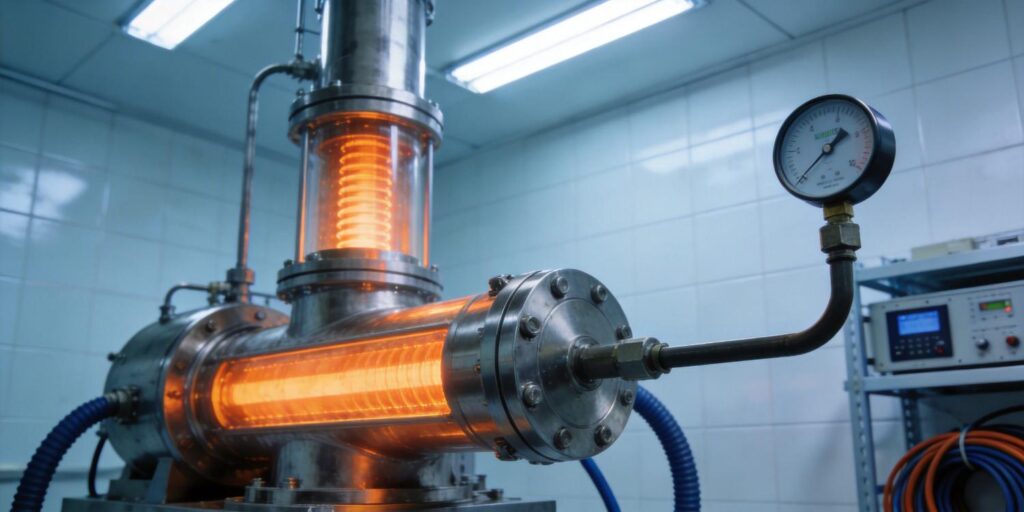
In high-vacuum systems used for semiconductor processing, mass spectrometry, vacuum heat treatment, and medical-device sterilization, a bake-out cycle is the final step to reach true ultra-high vacuum. By heating the chamber walls, flanges, and internal components to 150–250 °C (or higher) for 12–48 hours under active pumping, adsorbed water vapor, hydrocarbons, and other contaminants are driven off. Outgassing rates can drop by orders of magnitude, allowing base pressures below 10⁻⁷ Torr to be achieved quickly and repeatably. However, this same thermal excursion can destroy or permanently shift the calibration of any vacuum gauge left exposed. Poseidon Scientific’s VG-SP205 Pirani Vacuum Transmitter and VG-SM225 Cold Cathode Vacuum Gauge are rated for continuous operation only up to 50 °C. Protecting them during bake-out is therefore not optional—it is a standard engineering requirement that preserves both gauge life and system reliability.
Purpose of Bake-Out in High Vacuum Systems
Bake-out addresses the fundamental limitation of vacuum systems: virtual leaks. Even after mechanical pumping, monolayer films of water and residual process gases remain on stainless-steel surfaces. At room temperature these films release molecules slowly; at elevated temperature the desorption rate increases exponentially. A properly executed bake-out reduces the chamber’s outgassing load from 10⁻⁹ Torr·L/s·cm² to <10⁻¹² Torr·L/s·cm², shortening pump-down times from days to hours and enabling repeatable process pressures. Without bake-out, residual gas analyzers show persistent H₂O and CO peaks that contaminate sensitive substrates or shift mass-spectrometer baselines. The trade-off is thermal stress on every component attached to the chamber—including vacuum gauges.
Maximum Allowable Gauge Temperature Limits
Both Poseidon gauges share an operating range of 15–50 °C. Beyond this window, performance degrades rapidly:
| Gauge | Max Operating Temp | Consequence of Exceeding Limit |
|---|---|---|
| VG-SP205 Pirani | 50 °C | Filament resistance drift >±50 % at atmospheric and low-pressure ends; temperature-compensation algorithm saturates |
| VG-SM225 Cold Cathode | 50 °C | Ion-current baseline shifts; startup voltage margin erodes; permanent electrode oxidation possible |
At 150 °C the VG-SP205 platinum filament can reach oxidation rates that shorten life from years to hours. The VG-SM225’s high-voltage electronics and NdFeB magnet also suffer: insulation resistance drops and magnetic field strength can degrade slightly. These limits are conservative compared with some legacy gauges but reflect the priority Poseidon places on long-term stability and low-cost field maintenance.
Thermal Isolation Techniques (Valves, Extensions)
The simplest and most effective protection is to prevent heat from reaching the gauge at all. Three proven methods are used in production systems:
1. All-Metal Isolation Valves
A right-angle or inline vacuum valve (KF16/KF25 or CF) placed between the chamber port and the gauge isolates the sensor during bake-out. Close the valve before ramp-up; the gauge remains at ambient temperature while the chamber reaches 200 °C+. After cool-down, reopen the valve and resume monitoring. This method adds only one extra flange and <10 minutes to the bake-out procedure. Because the VG-SP205 and VG-SM225 use identical RJ45 connectors and mounting footprints, swapping gauges behind the same valve is straightforward.
2. Heated Extension Tubes
For systems where valve conductance is unacceptable, a 300–500 mm stainless-steel extension tube (KF or CF) with external heaters keeps the gauge 150–200 mm away from the hot chamber wall. The tube itself is baked, but thermal conduction drops rapidly with length. A simple calculation shows that a 400 mm tube with 6 mm wall thickness limits gauge-end temperature to <45 °C when the chamber is at 200 °C. Add a small cooling fin or forced-air collar at the gauge end for extra margin.
3. Combined Valve + Extension
The most robust configuration for critical tools: valve + short extension. The valve is closed during bake-out; the short extension minimizes dead volume once reopened. Poseidon offers pre-configured KF25 extension kits with integrated valve mounting flanges—contact engineering for drawings.
Removing vs Shielding Gauges
When space or conductance constraints rule out valves or extensions, engineers must choose between removal and shielding.
| Approach | Pros | Cons | Best for |
|---|---|---|---|
| Complete Removal | Zero thermal risk; blank-off flange keeps chamber leak-tight | Extra labor (15–30 min per gauge); requires re-installation and leak check | R&D chambers, frequent bake-outs, highest reliability |
| Thermal Shielding (foil + standoffs) | Fast; no disconnection | Only reduces peak temperature by 30–50 %; still risks drift if >80 °C | Short bake-outs (<12 h) at <150 °C |
For Poseidon gauges the removable sensor head of the VG-SM225 makes removal particularly attractive: the electronics stay mounted while only the 45 mm sensor cartridge is swapped with a blank. The VG-SP205, being fully sealed, is removed as a unit. In either case, store gauges in a dry, dust-free cabinet during bake-out.
Post-Bake Recalibration Steps
Neither gauge supports field calibration—both are factory-calibrated against NIST-traceable standards. After any bake-out cycle, follow this verification sequence:
- Allow full thermal equilibration (chamber and gauges at 20–25 °C for ≥2 h).
- Pump to a known stable pressure (e.g., 10⁻⁵ Torr) and compare both gauges against each other or a reference instrument. Acceptable deviation: <3 % for VG-SP205, <5 % for VG-SM225.
- Perform a controlled nitrogen bleed to 10⁻² Torr; record 0–10 V analog output and RS-232 pressure value.
- If deviation exceeds limits, flag for factory recalibration or electrode cleaning (VG-SM225 only). The status byte will report any filament-open or discharge-fail conditions immediately.
- Log the post-bake baseline in your SCADA system for future drift trending.
Most customers find no measurable shift when proper isolation is used. When a shift does occur, it is almost always traceable to an isolated valve left open or an extension tube that was too short.
Real Bake-Out Failure Case
A semiconductor etch-tool manufacturer installed VG-SM225 gauges directly on process chambers without isolation valves. During the first 200 °C bake-out the Cold Cathode electronics survived, but the ion-current baseline shifted downward by nearly an order of magnitude and startup time increased from 15 s to >5 min. Root-cause analysis showed partial oxidation of the stainless-steel electrodes and slight demagnetization of the NdFeB ring caused by sustained 180 °C exposure. Production halted for 36 hours while new gauges were installed. After retrofitting all tools with KF25 isolation valves, the same chambers have completed 47 bake-outs over 18 months with zero gauge-related failures and <2 % long-term drift. The lesson: thermal protection is far cheaper than unplanned downtime.
Get the Right Configuration for Your Bake-Out Protocol
Preventing vacuum gauge damage during chamber bake-out is straightforward once the correct isolation strategy is chosen. Poseidon Scientific offers pre-engineered solutions—KF16/KF25 isolation valve kits, 300 mm and 500 mm extension tubes, removable-sensor blanks, and custom RS-232 protocol mapping for your PLC interlocks—all backed by 48-hour evaluation shipments and 5-piece minimum orders.
Download the VG-SP205 datasheet and user manual for detailed temperature-compensation curves.
Download the VG-SM225 datasheet and user manual for removable-sensor cleaning and startup-time specifications.
Need a custom bake-out isolation drawing, valve recommendation, or protocol that automatically closes interlocks above 50 °C? Contact our applications engineering team today at engineering@poseidon-scientific.com or request a free configuration review. We will return a tailored manifold CAD file and bill-of-materials within 24 hours—ensuring your next bake-out is both fast and gauge-safe.
Protect your gauges. Protect your uptime. Bake with confidence.


