Identification of Phospholipid Interference in LC-MS Analysis
Phospholipid interference represents one of the most significant challenges in LC-MS analysis of plasma samples. These endogenous compounds, primarily phosphatidylcholines, lysophosphatidylcholines, and sphingomyelins, can cause severe ion suppression, matrix effects, and increased analytical variability. According to Waters documentation, phospholipids are “the main cause of matrix effects, ion suppression, shortened column life, increased MS maintenance costs, and increased LC-MS quantitative variability.” The problem is particularly acute in electrospray ionization (ESI) where phospholipids compete with analytes for ionization, leading to signal suppression and compromised quantification accuracy.
Monitoring m/z 184 Fragment Ion Signal
The m/z 184 fragment ion serves as a critical diagnostic marker for phospholipid detection in LC-MS systems. This characteristic fragment originates from the phosphocholine head group common to phosphatidylcholines and sphingomyelins. By monitoring this specific ion, analysts can:
- Identify phospholipid-rich regions in chromatograms
- Quantify phospholipid removal efficiency during method development
- Monitor column performance and detect phospholipid buildup
- Validate SPE method effectiveness in removing matrix interferences
Research indicates that effective SPE methods should remove 95% or more of common phospholipids from plasma samples to ensure reliable analytical results.
Selection of Mixed-Mode SPE Sorbent
Mixed-mode sorbents combining reversed-phase and ion-exchange mechanisms offer superior phospholipid removal compared to single-mode sorbents. The optimal choice depends on analyte properties:
For Basic Compounds (pKa ≥ 4.5)
Mixed-mode cation exchange (MCX) sorbents provide excellent phospholipid removal while retaining basic analytes. According to Waters data, Oasis PRiME MCX can remove up to 99% of phospholipids through its unique combination of reversed-phase and strong cation exchange interactions.
For Acidic and Neutral Compounds
Mixed-mode anion exchange (MAX) or weak cation exchange (WCX) sorbents may be more appropriate, though HLB (Hydrophilic-Lipophilic Balance) polymeric sorbents also demonstrate excellent phospholipid removal capabilities.
For Broad-Spectrum Applications
HLB polymeric sorbents, particularly those designed for phospholipid removal like Oasis PRiME HLB, offer comprehensive matrix cleanup without requiring extensive method development.
Plasma Protein Precipitation Before SPE Loading
Protein precipitation serves as a critical preliminary step to prevent SPE cartridge clogging and improve phospholipid removal efficiency. Common approaches include:
- Acetonitrile precipitation (typically 1:3 plasma:ACN ratio): Provides excellent protein removal but may require subsequent dilution to reduce organic content for optimal SPE retention
- Methanol precipitation: Effective for protein removal while maintaining sample compatibility with SPE conditions
- Acid precipitation (using phosphoric or formic acid): Particularly useful for basic compounds, as demonstrated in comprehensive SPE procedures where plasma samples are diluted 1:1 with phosphoric acid pH 2.2
Research by Huang et al. (1997) demonstrated that careful control of sample dilution and pH adjustment significantly improves extraction recoveries for polar compounds while maintaining effective phospholipid removal.
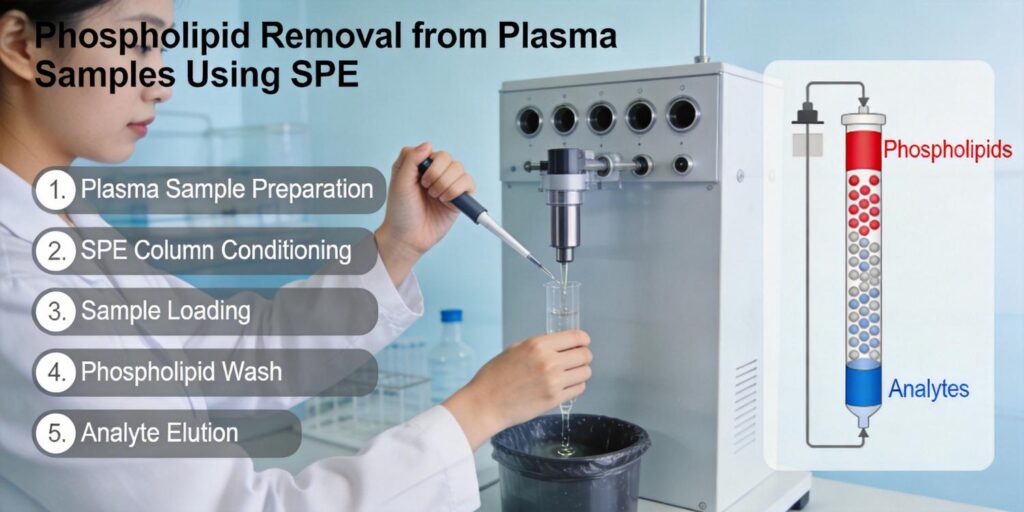
Cartridge Conditioning Protocol
Proper conditioning ensures optimal sorbent performance and reproducible results. For mixed-mode sorbents designed for phospholipid removal:
- Methanol conditioning: 2 mL methanol to activate the sorbent surface
- Water or buffer conditioning: 2 mL of appropriate aqueous solution (typically 0.01 M phosphoric acid pH 2.2 for acidic conditions or ammonium formate buffer for neutral/basic conditions)
- Maintain sorbent wetness: Never allow the sorbent bed to dry between conditioning and sample loading
Advanced sorbents like Oasis PRiME HLB eliminate the need for conditioning and equilibration steps, significantly simplifying the workflow while maintaining excellent phospholipid removal.
Wash Solvent Design for Phospholipid Removal
The wash step represents the critical phase for phospholipid elimination while retaining target analytes. Effective wash strategies include:
For Mixed-Mode Cation Exchange (MCX)
Wash with 100% methanol followed by 2% formic acid in 100 mM ammonium formate aqueous solution. This combination removes phospholipids through reversed-phase mechanisms while maintaining ionic interactions with basic analytes.
For HLB Polymeric Sorbents
5% methanol in water effectively removes phospholipids while retaining most analytes. Research demonstrates that this simple wash can remove over 95% of common phospholipids.
For Comprehensive Cleanup
Additional wash steps using water/acetonitrile (4:1 v/v) can remove weakly bound, highly oxygenated species including glucuronide conjugates, phosphates, ureates, and sugars that might interfere with analysis.
Elution Solvent for Analytes Without Co-eluting Phospholipids
Elution solvent selection must balance complete analyte recovery with minimal phospholipid co-elution:
For Basic Compounds from MCX Sorbents
5% ammoniated methanol provides excellent elution of basic analytes while leaving residual phospholipids on the sorbent. The combination of organic solvent and basic pH disrupts both reversed-phase and ionic interactions.
For HLB Sorbents
90:10 acetonitrile/methanol mixture offers strong elution power for a wide range of compounds while maintaining good phospholipid selectivity.
For Comprehensive Procedures
Multi-fraction elution using acetone:chloroform (1:1 v/v) for acid/neutral fractions and ammoniated ethyl acetate or methylene chloride/isopropanol for basic fractions can provide excellent separation of analytes from phospholipids.
Verification of Matrix Removal Using LC-MS Chromatograms
Comprehensive verification ensures method effectiveness and reliability:
- m/z 184 monitoring: Compare phospholipid signals in extracted samples versus unextracted controls
- Matrix effect evaluation: Use post-column infusion or post-extraction spiking to assess ion suppression
- Chromatographic comparison: Evaluate baseline cleanliness, peak shape, and interference-free regions
- Recovery assessment: Compare analyte responses in extracted samples versus neat standards
- Reproducibility testing: Multiple replicate extractions to ensure consistent phospholipid removal
Research demonstrates that effective SPE methods should achieve phospholipid removal efficiencies exceeding 95% with relative standard deviations less than 7.3% for consistent, reliable results. The resulting chromatograms should show minimal interference from endogenous matrix components, enabling accurate detection and quantitation of target analytes at clinically relevant concentrations.
By implementing these systematic approaches to phospholipid removal, laboratories can significantly improve LC-MS method performance, extend column lifetime, reduce instrument maintenance, and achieve more reliable quantitative results in plasma analysis.